The Future of AI

How powerful will AI become, and how fast? Epoch develops quantitative forecasting models to project where AI is heading, from near-term trends in compute and capabilities to longer-term questions about AI timelines, including when AI might become truly transformative, a threshold sometimes discussed as artificial general intelligence (AGI) or transformative AI (TAI). Epoch examines the evidence behind these forecasts, and tracks what current trends reveal about future AI progress.
Filter

Type
0 results
RIP Classic Reasoning Benchmarks. What's Next?
Newsletter
May 5, 2026
RIP Classic Reasoning Benchmarks. What's Next?

Give up at least one of: text only, short time horizon, easy to grade, and expert human superiority.
By Greg Burnham

Have AI Capabilities Accelerated?
Report
Apr. 16, 2026
Have AI Capabilities Accelerated?

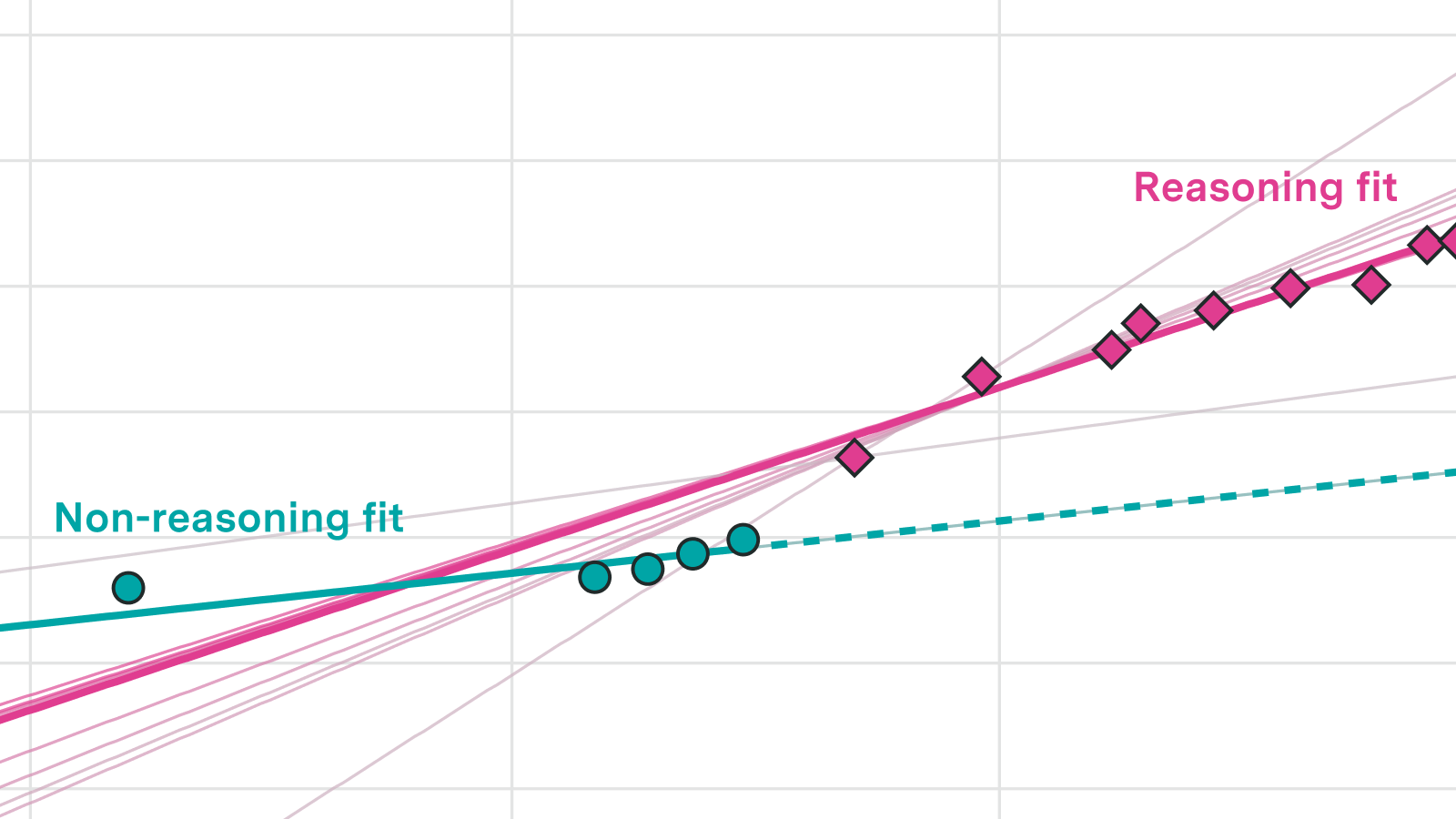
We investigate progress trends on four capability metrics to determine whether AI capabilities have recently accelerated. Three of four metrics show strong evidence of acceleration, driven by reasoning models.

By Jean-Stanislas Denain and Alexander Barry

Claude usage rose by over 40% amid increased attention but remains far behind ChatGPT
Data Insight
Apr. 15, 2026
Claude usage rose by over 40% amid increased attention but remains far behind ChatGPT

By Yafah Edelman, Caroline Falkman Olsson, and Jaeho Lee

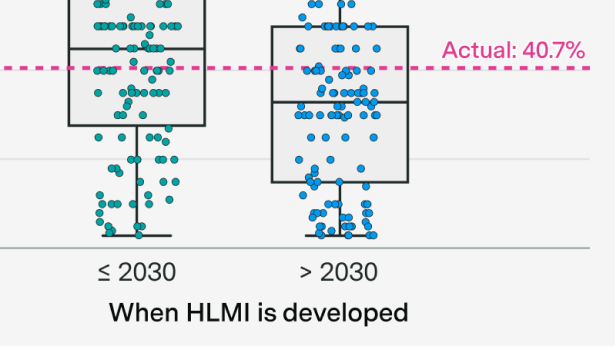
How well did forecasters predict 2025 AI progress?
Newsletter
Jan. 16, 2026
How well did forecasters predict 2025 AI progress?

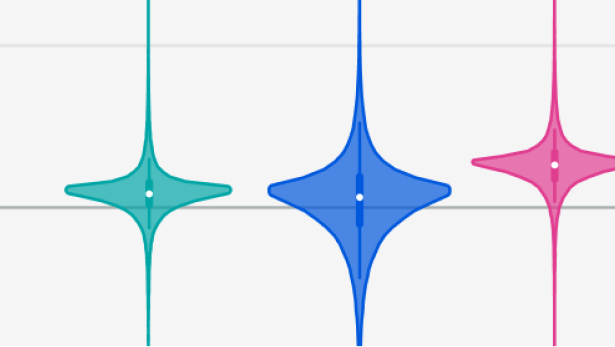
Mostly right about benchmarks, mixed results on real-world impacts
By Anson Ho

What does economics actually tell us about AGI? – Phil Trammell
Podcast
Oct. 1, 2025
What does economics actually tell us about AGI? – Phil Trammell

Stanford economist Phil Trammell joins Epoch AI to explore AGI, growth, GDP limits, and what economic theory can tells us about the future of AI.

By Anson Ho and Phil Trammell

What will AI look like in 2030?
Report
Sep. 16, 2025
What will AI look like in 2030?

If scaling persists to 2030, AI investments will reach hundreds of billions of dollars and require gigawatts of power. Benchmarks suggest AI could improve productivity in valuable areas such as scientific R&D.

By David Owen

Forecasting AI progress until 2040
Podcast
Sep. 4, 2025
Forecasting AI progress until 2040

Epoch AI researchers Jaime Sevilla and Yafah Edelman forecast AI progress to 2040: coding automation, 10% GDP growth, and wild uncertainty after 2035.

By Jaime Sevilla and Yafah Edelman

Newsletter
May 2, 2025
Where’s my ten minute AGI?

Why don't AIs automate more real-world tasks if they can handle 1-hour ones? Anson Ho explores key capability and context bottlenecks.

By Anson Ho

Newsletter
Apr. 26, 2025
The case for multi-decade AI timelines

In this Gradient Updates weekly issue, Ege discusses the case for multi-decade AI timelines.

By Ege Erdil

Is it 3 years, or 3 decades away? Disagreements on AGI timelines
Podcast
Mar. 28, 2025
Is it 3 years, or 3 decades away? Disagreements on AGI timelines

In this podcast episode, two Epoch AI researchers with relatively long and short AGI timelines candidly examine the roots of their disagreements.

By Ege Erdil and Matthew Barnett

GATE: Modeling the trajectory of AI and automation
Paper
Mar. 21, 2025
GATE: Modeling the trajectory of AI and automation

We introduce a compute-centric model of AI automation and its economic effects, illustrating key dynamics of AI development. The model suggests large AI investments and subsequent economic growth.

By The Epoch AI Team

Newsletter
Feb. 21, 2025
AI progress is about to speed up

AI progress is accelerating, with next-gen models surpassing GPT-4 in compute power, driving major leaps in reasoning, coding, and math capabilities.

By Ege Erdil

AI in 2030, scaling bottlenecks, and explosive growth
Podcast
Jan. 17, 2025
AI in 2030, scaling bottlenecks, and explosive growth

Epoch AI presents their first podcast, exploring AI scaling trends, discussing power demands, chip production, data needs, and how continued progress could transform labor markets and potentially accelerate global economic growth to unprecedented levels.

By Jaime Sevilla, Tamay Besiroglu, and Ege Erdil

Challenges in predicting AI automation
Report
Nov. 24, 2023
Challenges in predicting AI automation

Economists have proposed several different approaches to predicting AI automation of economically valuable tasks. There is vast disagreement between different approaches and no clear winner.

By David Owen and Tamay Besiroglu

Explosive growth from AI: A review of the arguments
Paper
Sep. 23, 2023
Explosive growth from AI: A review of the arguments

Our new article examines why we might (or might not) expect growth on the order of ten-fold the growth rates common in today’s frontier economies once advanced AI systems are widely deployed.

By Ege Erdil and Tamay Besiroglu

A compute-based framework for thinking about the future of AI
Viewpoint
May 31, 2023
A compute-based framework for thinking about the future of AI

AI’s potential to automate labor is likely to alter the course of human history within decades, with the availability of compute being the most important factor driving rapid progress in AI capabilities.

By Matthew Barnett

An interactive model of AI takeoff speeds
Update
Jan. 24, 2023
An interactive model of AI takeoff speeds

We have developed an interactive website showcasing a new model of AI takeoff speeds.

By Jaime Sevilla and Edu Roldán

Literature review of transformative artificial intelligence timelines
Report
Jan. 17, 2023
Literature review of transformative artificial intelligence timelines

We summarize and compare several models and forecasts predicting when transformative AI will be developed.

By Keith Wynroe, David Atkinson, and Jaime Sevilla

Grokking “Semi-informative priors over AI timelines”
Report
Jun. 13, 2022
Grokking “Semi-informative priors over AI timelines”

I give visual explanations for Tom Davidson’s report, Semi-informative priors over AI timelines, and summarise the key assumptions and intuitions

By Anson Ho

Grokking “Forecasting TAI with biological anchors”
Report
Jun. 6, 2022
Grokking “Forecasting TAI with biological anchors”

I give a visual explanation of Ajeya Cotra’s draft report, Forecasting TAI with biological anchors, summarising the key assumptions, intuitions, and conclusions.

By Anson Ho

Projecting compute trends in machine learning
Report
Mar. 7, 2022
Projecting compute trends in machine learning

Projecting forward 70 years' worth of trends in the amount of compute used to train machine learning models.

By Tamay Besiroglu, Lennart Heim, and Jaime Sevilla