Energy is at the heart of almost every conversation about AI. The homeowner in middle America says that AI is hiking her energy bill. The educated big-city dweller worries that it’s accelerating climate change. The AI company warns that energy could be the reason the US loses the AI race to China.
Why is energy so central to AI? Is AI really impacting energy bills and the environment? And what are the consequences of the rapid buildout of energy-intensive AI data centers across the US and around the world?
Key facts about AI energy use:
Individual chatbot messages are not very energy-intensive: according to estimates from Epoch AI and independent researchers, a 100-word prompt to a free chatbot uses less energy than a microwave running for 10 seconds.
Aggregate consumption is still small, but growing fast: AI use currently accounts for only a few percent of America’s annual power consumption, substantially less than air conditioning (12%) and lighting (8%), but data center power requirements have been roughly doubling every year.
AI’s climate impact is still modest: data centers account for less than 1% of global CO2 emissions, according to a 2025 International Energy Agency report, but reliance on natural gas makes AI’s current energy mix slightly dirtier than the US grid average.
Local environmental impacts have been observed: a 2025 analysis by University of Tennessee researchers for TIME found that levels of nitrogen dioxide — a pollutant that can aggravate respiratory diseases — spiked in Memphis neighborhoods near xAI’s Colossus 1 data center following the installation of gas turbines.
The effect on local electricity prices remains unclear: states dense with data centers often saw smaller price increases than the national average between 2020 and 2025, and analysts disagree over whether some recent increases are attributable to AI demand.
Why energy is so central to AI
AI systems use computing power to execute algorithms that learn from data. Energy is needed for the entire process. There are many different AI systems: some help forecast the weather, others categorize photos or subtitle online videos. However, when people talk about “AI” today, they are usually referring to the large language models (LLMs) that power chatbots and coding assistants, such as OpenAI’s ChatGPT and Anthropic’s Claude. Today, LLMs are the fastest-growing driver of AI energy demand.
Developing AI models
Before these AI models can be used, they must be trained, a process of “learning” patterns in vast amounts of data. This involves a huge number of calculations called floating-point operations (FLOP). Each individual calculation is tiny — something you could do on a calculator — but the scale of data used to train modern LLMs is enormous, representing a significant share of all the text on the internet. Recent frontier LLM training involves around 100 septillion — that’s a 1 followed by 26 zeros — calculations. If every person on Earth were tasked with performing one of these calculations every second, it would take about 400 million years to train a frontier model.
To complete training in a reasonable amount of time, AI companies use hundreds of thousands of specialized computer chips called graphics processing units (GPUs) each capable of performing trillions of calculations per second. But this speed requires a lot of energy. For example, training the final version of Grok 4, released by Elon Musk’s xAI (now SpaceXAI) in July 2025, consumed as much energy as it would take to power a town of 4,000 Americans for a year.
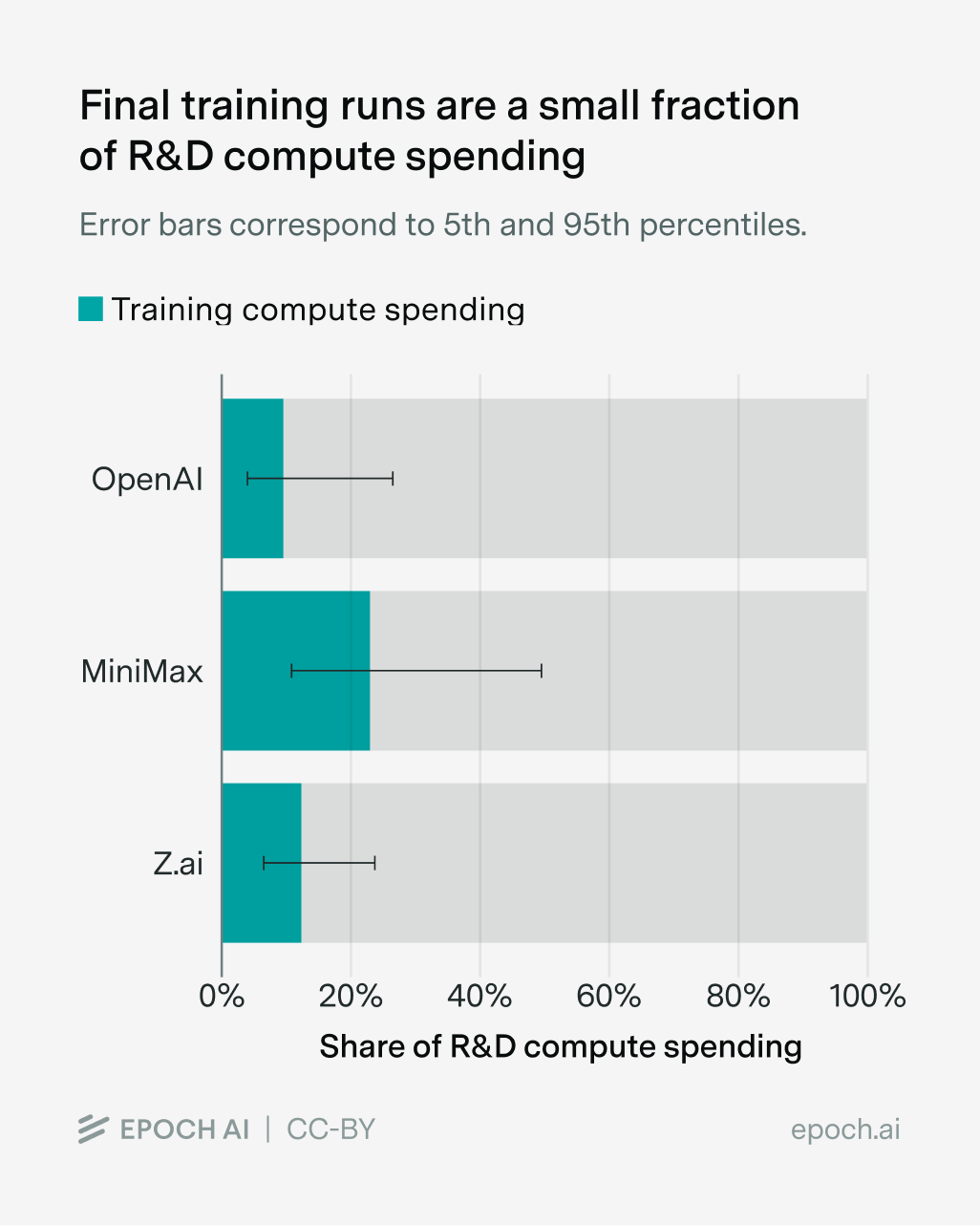
And training the final version of a model is just the last step in a much longer research and development process. Compared to final training runs, Epoch AI researchers find that AI companies burn through many times as much compute on experiments, dead ends, and models that never see the light of day.
Inference
While training a model is particularly energy-intensive, it isn’t the end of its energy use. Once trained, it is stored on a data center’s servers waiting for a user to “prompt” it with a request, which it executes in a process called “inference.” This requires some energy to perform the 100 trillion-odd calculations required to generate your response, as well as to keep the data center running and cooled.
Dealing with heat
A cheap and efficient way to arrange AI chips is to pack them close together in servers — racks of computers the size of fridges — inside enormous data centers. These densely packed chips generate intense heat. In fact, less than half of the power consumed in an AI data center goes to powering the chips themselves — with a significant share of the rest spent on cooling them.
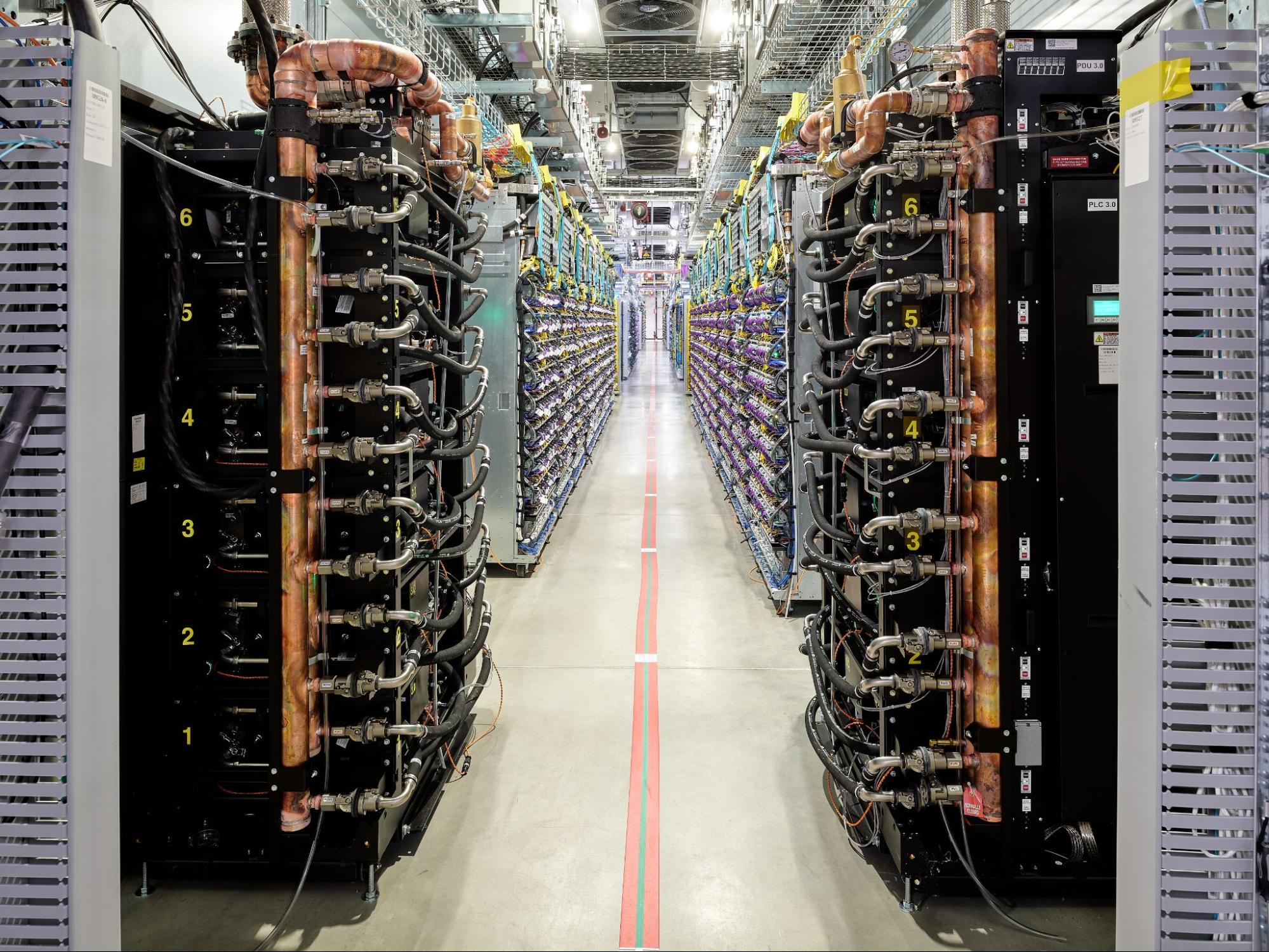
Coolant distribution units at the front of a server aisle in Google’s New Albany, Ohio, data center. Source: Google.
In modern data centers, a liquid coolant flows through metal plates to absorb heat generated by server racks. The coolant then flows out of the server rack and exchanges heat with a stream of water, which in turn releases the heat outdoors.
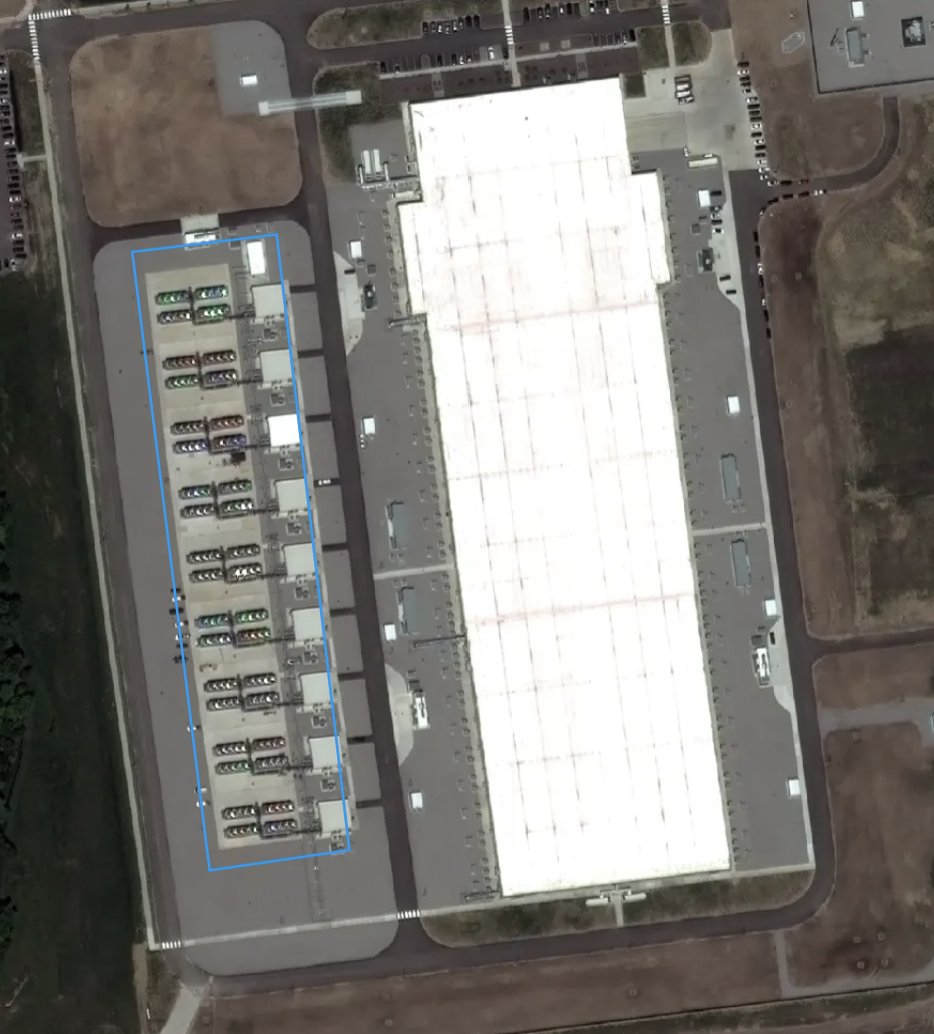
Building on the Meta Prometheus data center campus, with cooling equipment outlined in blue. Source: Epoch AI’s Data Center satellite explorer, image © 2026 Vantor.
So, how much energy does your LLM query use?
For many people, very little. The energy used to answer your chatbot query depends on the length of your prompt, which model answers it, how much it “thinks” about the query, and the length of its final output.
Free chatbots — used by over 90% of American AI users — spend limited computing power “thinking” about your query, leading to a relatively modest energy cost. If you prompt a free chatbot with a 100-word message, it takes around 0.6 watt-hours (Wh) of energy to generate your response, including a share of the upfront energy cost of developing the model.
This is a tiny contribution to most Americans’ energy footprint: 0.6 Wh is less energy than a microwave uses in 10 seconds or a 10 W lightbulb uses in five minutes. This means an average American household would need to send over 400 chatbot messages a day to add 1% to its daily energy use of around 29,000 Wh.
While the majority of individuals rely on free chatbots, which use relatively little energy, LLMs also power increasingly popular AI agents such as Claude Code. In this application, LLMs receive larger inputs, consume more computing power “thinking” about them, and produce longer outputs — using substantially more energy in the process than when deployed in chatbot form.
Individual users’ chatbot energy use is modest, but what about when you add it all up?
As of mid-2026, AI computing power (“compute” for short) uses tens of gigawatts (GW) of electric power globally, comparable to New York state’s peak power usage. Of this total demand, a large share is located in the US. This sounds like a lot, but it actually means that AI currently accounts for only a few percent of America’s annual power consumption, substantially less than air conditioning (12%) and lighting (8%). Our physical lives — the clothes we wear, the food we eat, and so on — still consume far more energy than AI services.
Climate impact
If AI energy demand isn’t yet great in the overall scheme, we might worry that it is significantly dirtier, or more carbon-intensive, than the average online service. This does not appear to be the case yet, either. Data centers account for less than 1% of total global CO2 emissions, according to a 2025 International Energy Agency report, with AI responsible for a small subset.
In the quest to rapidly build more AI data centers, AI companies have been bottlenecked by connection points to the grid. To overcome this, they have turned to on-site power generation, typically using natural gas. In 2020, data centers used roughly 60% nonrenewable energy, which has grown to roughly 65% in 2026 as new power plants rely on natural gas-fired turbines to rapidly scale up and meet the need for a reliable energy baseline, particularly during training. If that’s right, this is slightly worse than the US power grid as a whole, which uses about 57% nonrenewable energy. This may drop into 2030 as more data centers interconnect with the grid.
There is also a possibility that AI could reduce emissions, for example, by increasing the efficiency of heating and cooling systems or the energy grid as a whole. Many of these potential savings would come from traditional machine learning-based management of energy systems — a different type of AI from LLMs. However, some efficiencies could come from accelerated scientific discovery, where frontier LLMs show promise.
Local impacts
AI energy use has not yet had a significant environmental impact at the global or national level. However, at the local level, the rush to bring data centers online is causing problems for local communities.
Electricity prices
The price of electricity is primarily determined by the cost of generating electricity and the cost of delivering it to customers through the grid. Data centers could raise electricity prices if local utilities are forced to build new infrastructure to meet increased demand — absent measures ensuring that data center providers cover the associated costs. On the other hand, they could lead to lower prices if the existing local infrastructure is sufficient to meet the increased demand, with higher electricity sales allowing the utility to reduce rates.
A 2025 Lawrence Berkeley National Laboratory study found that at the state level, energy load growth was associated with lower average retail electricity prices, and states with the highest concentrations of data center power consumption, such as Virginia, Oregon, and Iowa, often experienced smaller increases in electricity prices than the national average between 2020 and 2025.
However, it’s possible that this is changing. The data center buildout contributed up to a quarter of the 76% increase in wholesale electricity prices in mid-Atlantic and Midwestern states in the first quarter of 2026 compared with the previous year, according to an independent market monitor. Some industry observers argue that these increases are the result of flawed forecasts by the regional transmission organization rather than material increases in energy load due to data centers: Texas, which has also seen significant data center demand but relies less on forecasts in its energy pricing, saw a substantially smaller price increase, in line with the national average.
Air pollution
The gas turbines used to power some data centers emit nitrogen dioxide, a pollutant that can aggravate respiratory diseases. In Memphis, Tennessee, xAI hastily assembled gas turbines, reportedly lacking pollution controls, to power its Colossus 1 data center, which was used to train Grok 4. Nitrogen dioxide concentrations in the surrounding area spiked after the construction of the power plants.
This isn’t an issue everywhere. Many data centers are located far from densely populated areas or connected to existing power grids rather than installing their own polluting power-generation facilities “behind-the-meter.”
The future
The overall energy used by AI is growing rapidly, driven by the training of larger AI models with improved capabilities used by an expanding user base. The power required to train a frontier model has roughly doubled every year, leading to a corresponding annual doubling of data center power requirements. By early 2028, the first phase of a new Meta data center is expected to come online, with a power capacity of 1.7 GW — approximately equal to Seattle’s peak power consumption.
Improvements in software and hardware efficiency mean that it is rapidly becoming cheaper — in financial and energy terms — to train and run a model at a given level of capability. But these savings are outweighed by dramatic increases in model size, which lead to more capable models and, correspondingly, greater customer demand.
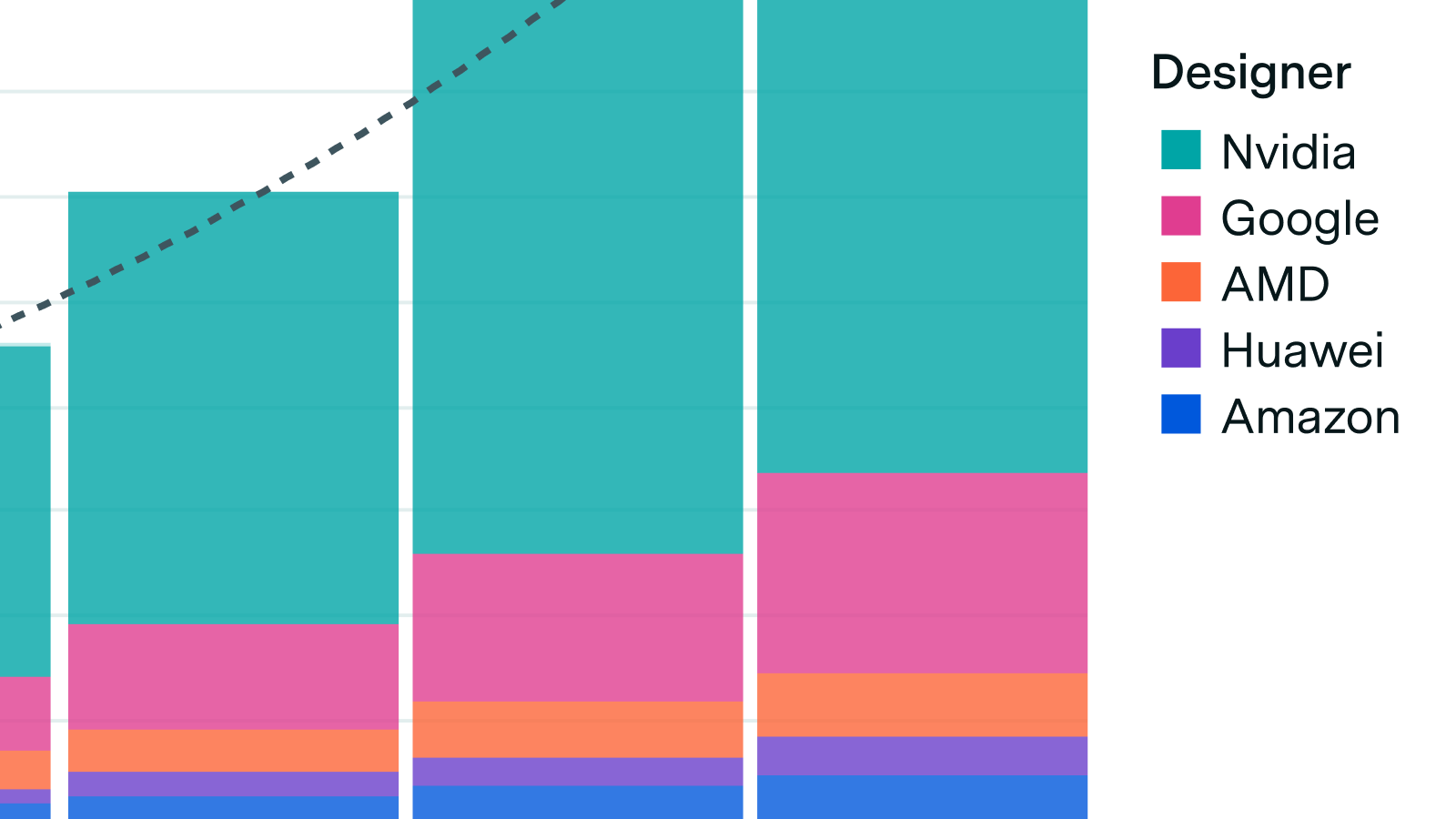
Machine learning performance versus power draw of AI accelerators. Chips further to the right are more energy-efficient. Chips higher up are more powerful overall. Newer generations tend to be both. Explore the Machine Learning Hardware data.
ChatGPT grew from 50 million weekly users in 2023 to roughly 1 billion in June 2026, and revenues of the fastest-growing frontier AI company grew roughly 10-fold per year over the same period.
Annualized revenue of major AI companies, with fitted growth rates ranging from 2.2x per year (Z.ai) to 10.6x per year (Anthropic). Explore the AI Companies data.
If the trend continues through the end of the decade, the power demanded by US AI data centers could reach 100 GW. By contrast, the entire US industrial sector consumed an average of 120 GW in 2025.
This growth in energy demand would be significant. The US hasn’t seen anything similar since the 1980s. And 2030 need not be the end of the story: Epoch AI modeling suggests that if AI drives transformative economic growth, demand for compute — and the power to run it — could keep scaling well beyond that.
Will the US manage to increase energy production to keep up with growing data center demand?
Probably. US power generation hasn’t increased in decades, but neither has demand, as evidenced by national electricity prices remaining roughly flat since the early 2000s.
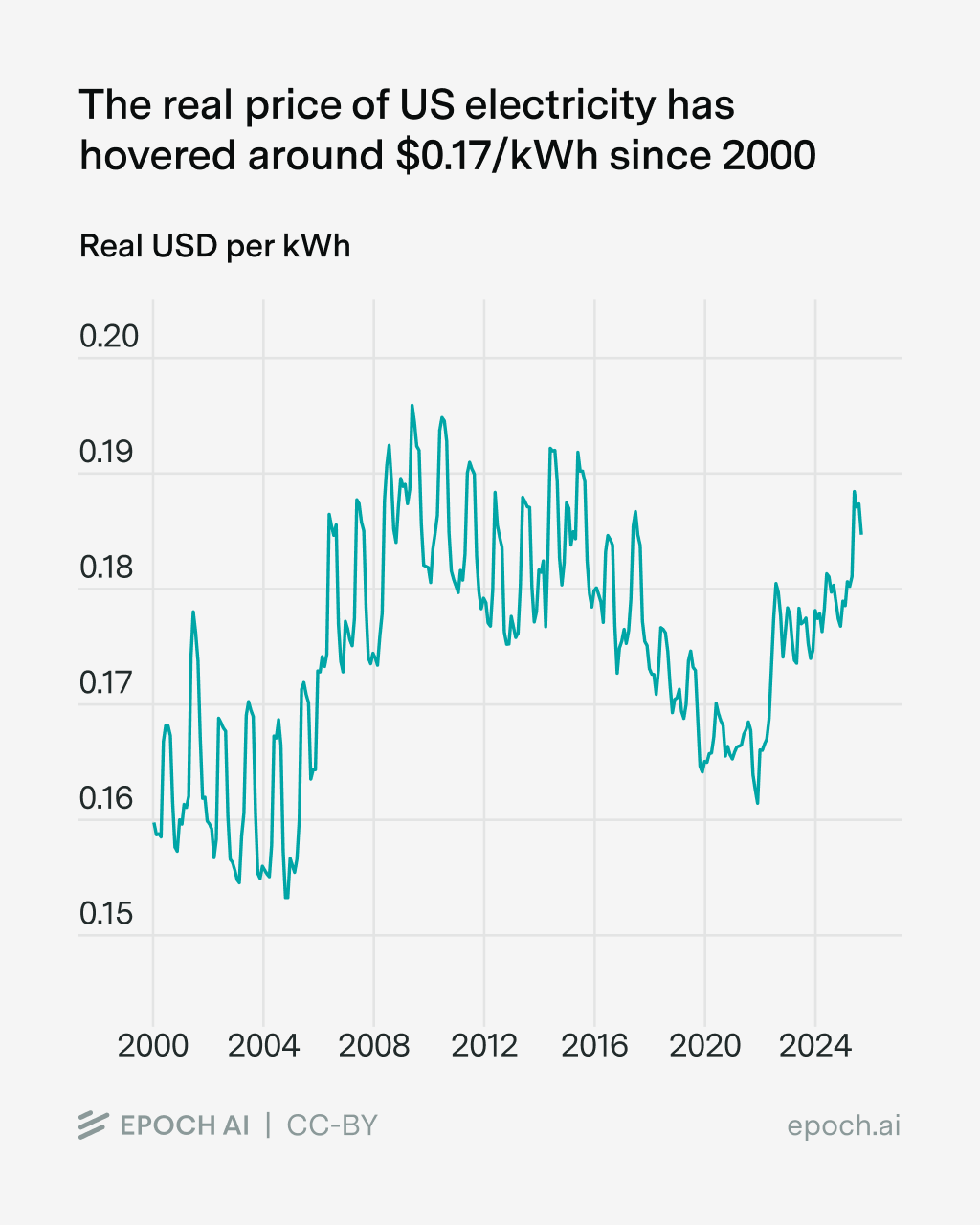
Data from the Federal Reserve Bank of St Louis, dividing average electricity prices by the Consumer Price Index (with January 2025 = 100).
There are good reasons to think that if demand increases, so will supply. Energy costs are small relative to hardware costs; if operators are prepared to pay for chips, they’ll probably be able to pay for power. They could do this by rapidly building natural gas turbines, as xAI demonstrated when it brought online a 140 MW data center in 122 days.
Solar power is also likely to play an important role, although intermittency remains a challenge. Battery storage systems could help, but they are currently limited by the fact that they discharge after a few hours.
There are more innovative proposals still. Data centers are energy-constrained in part because they require high sustained power input, particularly during training. However, if they could reduce their annual energy consumption by 0.25% by partially shutting down during peak times, the grid could recover 76 GW of spare capacity — close to the hypothetical data center power demand in 2030. Of course, if this were easy, data centers would already be doing it. But there are early proposals to solve the significant technical challenges involved.
There are limits to how much energy a single power plant can generate, and therefore how large a single data center can get. The largest US power plant has a total generating capacity of around 7 GW, but training frontier LLMs could require 10 GW by the end of the decade, if trends continue. This is unlikely to deter AI companies, which could string together multiple data centers connected by fiber-optic cable to train models in a decentralized manner.
The future is power-hungry
If the forecasted data center power demand is met and US power generation begins to increase for the first time in decades, the massive buildout would likely begin to have an appreciable impact on climate change.
Consumers won’t necessarily see heightened electricity prices if data center developers pay for the infrastructure required to meet this demand. However, it is possible that the cost of building infrastructure will be passed on to individuals, or that utilities will fail to keep up with electricity demand, leading to power shortages.
So far, popular discourse often overstates AI’s current impact on most individuals’ energy footprints. However, local and regional impacts — such as air pollution and state-level electricity price increases — are beginning to materialize. If trends continue, the AI buildout may significantly reshape the national and global energy landscape.
About the authors

Read other topic overviews
A look at the specialized hardware driving modern AI

A guide to one of the largest infrastructure projects in history