 Overview
Epoch AI has been mapping the AI chip supply chain one stage at a time. AI chip components estimates how much advanced logic wafer capacity, advanced packaging (CoWoS), and high-bandwidth memory (HBM) leading chip designers consume. AI chip sales estimates how many accelerators each designer sells every quarter. AI chip owners and AI chip users follow those chips to the companies that buy them and to the companies that use them, which are often not the same. AI data centers maps the largest facilities where the chips are installed.
The AI chip imports explorer adds a missing piece: which countries the chips end up in. Almost every advanced AI chip (a specialized processor such as a GPU or TPU, also called an accelerator) is packaged in Taiwan, so nearly every chip crosses at least one border before reaching a data center, and most countries publish monthly records of what crosses their borders. By combining these customs records with our chip sales estimates, we estimate how much AI compute arrives in each country every quarter since 2022. The explorer complements our AI data centers hub: that project locates individual facilities, while this one accounts for all cross-border chip arrivals, including those in facilities we do not track.
Key takeaways
- About 27 million H100-equivalents (H100e) of AI compute arrived worldwide between 2022 and June 2026.
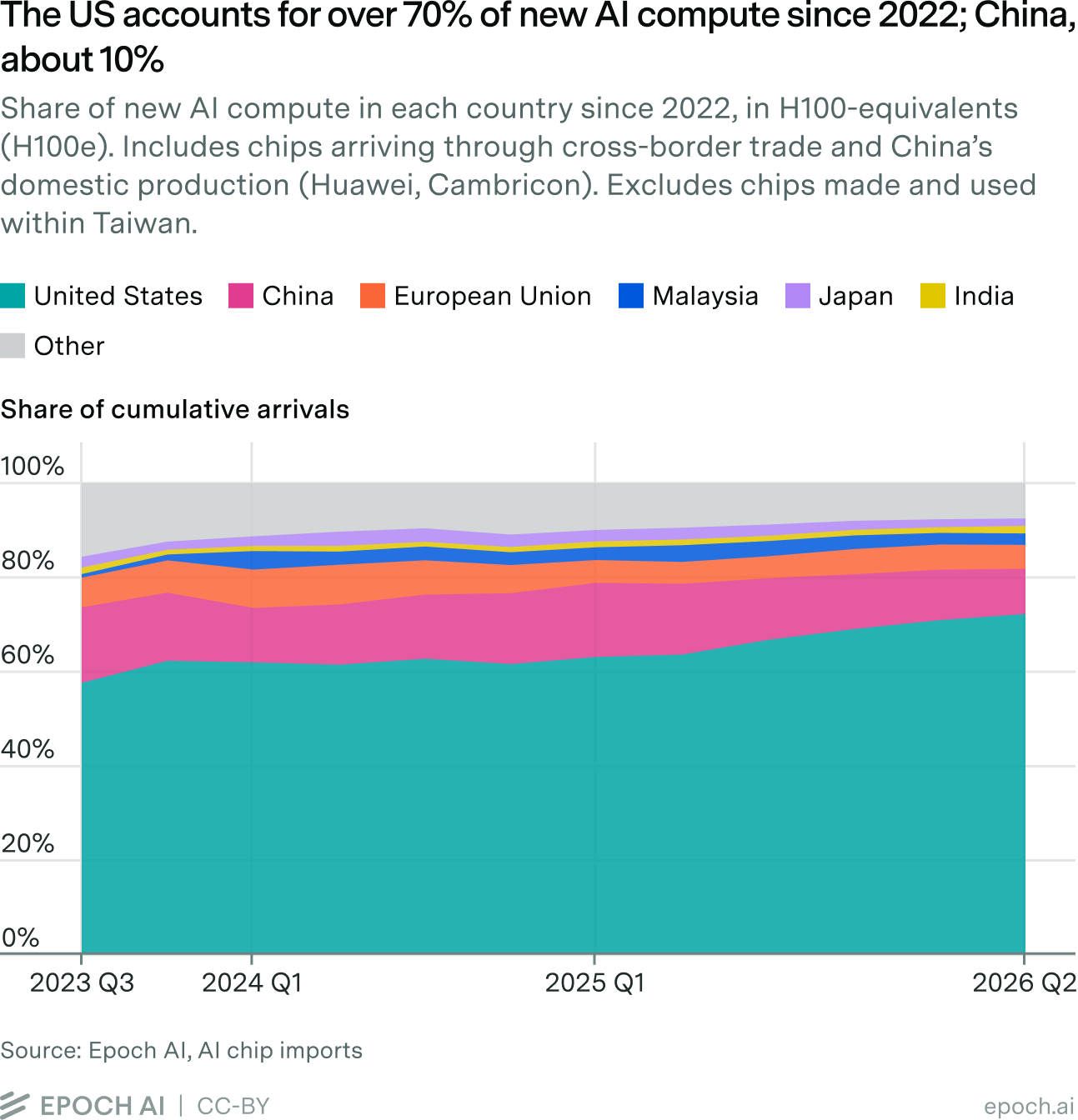
- The United States received about 72% of that compute (19.8 million H100e). It is the largest destination under every set of assumptions we tested.
- China received about 10% of compute (2.6 million H100e) but 18% of AI chips. The chips allocated to China, including China-market variants such as the H20 and domestically produced Huawei and Cambricon chips, deliver less compute per unit on average.
- The European Union is third, at about 5% (1.4 million H100e).
- Estimates outside the US are much less certain. Under alternative assumptions about what the trade contains, China’s estimate ranges from 1.9 to 4.2 million H100e.
- Customs records can also reveal hardware routed around export controls, as in this analysis of chip smuggling via Malaysia.
These are modeled estimates, not an inventory of installed chips. No customs code isolates AI accelerators, so we estimate how much of each country’s computer-hardware trade is AI-related. Some counted chips may not yet be operational, and some may later move to another country. Our methodology explains how we build the estimates and where they are weakest.
Access the data
The data is available on our website as a visualization or table, and is available for download as a ZIP file.
If you would like to ask any questions about the data, or suggest improvements, feel free to contact us at data@epoch.ai.
Use this work
Epoch’s data is free to use, distribute, and reproduce provided the source and authors are credited under the Creative Commons Attribution license.