Related work


Our estimates of how much computing power is used by the world's largest AI developers
The AI chip users explorer estimates how much compute the world’s leading AI developers use for research, training, and inference, measured in the equivalent number of Nvidia H100 GPUs (H100e). This is distinct from how much compute is owned by these companies. This work supplements our analysis of overall AI chip sales, AI chip owners, and major AI data centers.
Epoch AI’s data is free to use, distribute, and reproduce provided the source and authors are credited under the Creative Commons Attribution license.
AI developers use large fleets of processors called AI chips (a.k.a. AI accelerators or GPUs) to conduct research, train their models, and run those models to support their products. The AI chip users explorer compiles our estimates of the computing power available to some of the largest AI developers over time, measured in terms of the equivalent number of Nvidia H100 GPUs (H100e).
We focus on the leading AI developers (often called frontier developers) because tracking the compute used for frontier AI is important for understanding AI progress. The scaling of compute in frontier AI training runs, and of the total computing capacity used for AI research and development, is a crucial ingredient in the improvement of AI capabilities. While we cover overall AI compute elsewhere, this explorer focuses on how much compute is allocated to the leading AI developers. For broader commentary on trends in frontier AI compute and their implications for AI progress, see our May 2026 newsletter article Frontier labs don’t use most AI compute.
We are most interested in frontier developers, or the organizations working on the cutting edge of AI capabilities. In principle, this includes both the AI developers with the most compute resources, and lower-resourced developers that are globally competitive in model capabilities or technical progress (for example, the leading Chinese AI labs).
As of launch in the fall of 2026, we initially cover the largest US-based developers. We believe that OpenAI, Anthropic, Google DeepMind, Meta Superintelligence Labs, and SpaceXAI were the AI developers with the most compute capacity available as of 2025-2026. This largely reflects our research progress to date, not necessarily our priorities, as we are more familiar with the US-based AI industry.
H100-equivalent (H100e) compute capacity is a metric of computing power, describing an AI chip fleet in terms of the equivalent number of Nvidia H100 GPUs.
We divide the peak number of dense 8-bit operations (FP8 or INT8) each chip can perform by the Nvidia H100’s corresponding spec, and then multiply this ratio by the number of chips. For example, since a TPUv7 can perform approximately 2.3× as many operations as an H100, one million TPUv7s have a compute capacity of 2.3 million H100e. For chips that do not support 8-bit precision, we use their 16-bit (FP16 or BF16) performance instead.
We derive our estimates from company disclosures, media reports, and third-party analysts or researchers, supplemented by our analysis of the computing power owned by major tech giants and of major AI data centers. Developers rarely disclose the exact AI chips they have available, so we frequently need to model their computing power based on proxy metrics such as power capacity and monetary spending on compute. Many of our developer estimates are substantially uncertain, especially for Meta Superintelligence Labs and Google DeepMind.
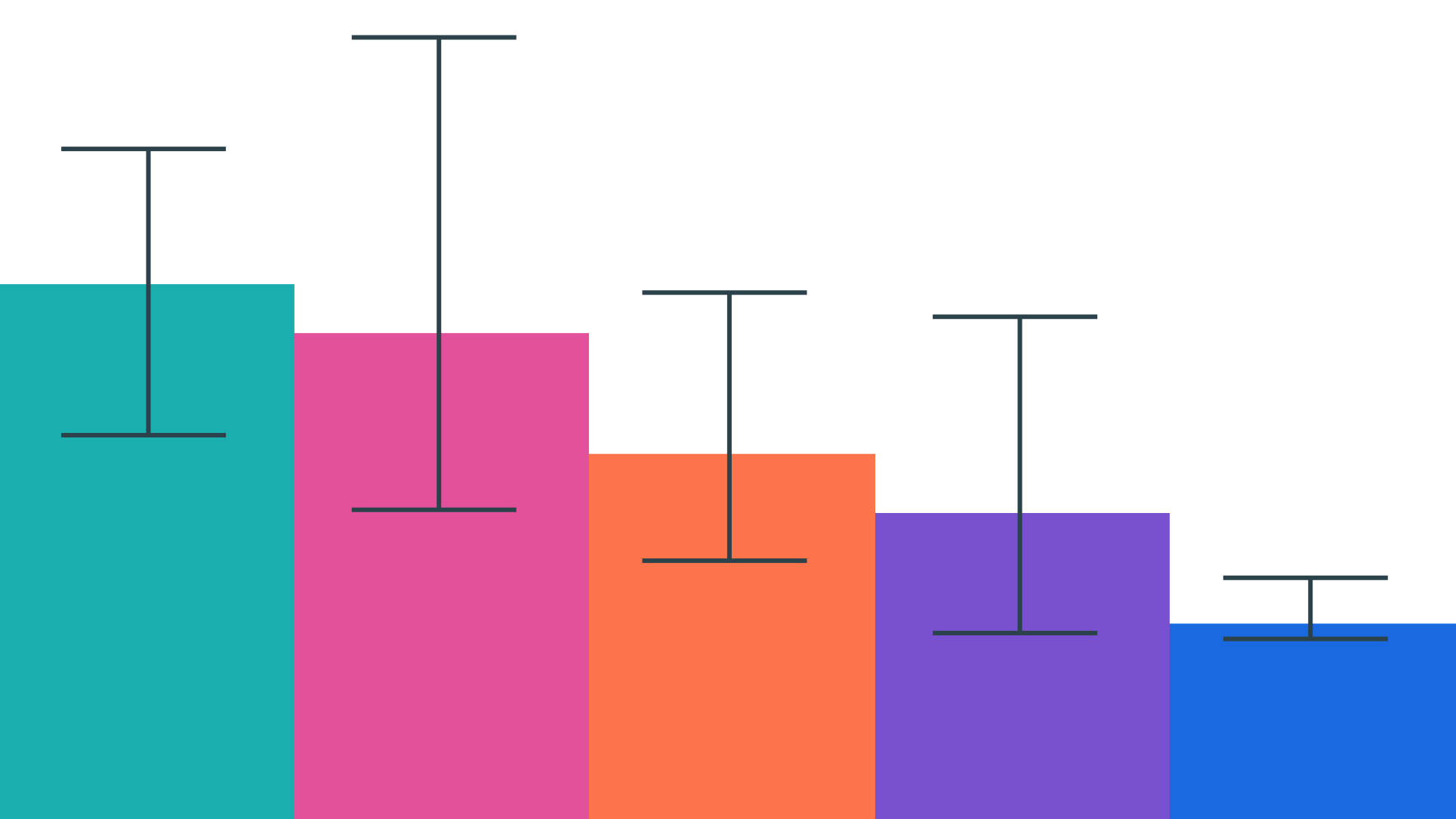
We model each developer’s compute using Monte Carlo models, which combine multiple uncertain parameters into an overall probability distribution. While we do our best to ground the uncertainty in these parameters using available evidence, there is also some guesswork involved. These models are described in detail in the Methodology. We report 90% confidence intervals (CIs) by sampling many estimates from the Monte Carlo models and finding the 5th and 95th percentiles. Our central estimates, as described by the heights of the colored bars in the chart, are the median (50th percentile) values from those models.
Not necessarily. As of 2026, Anthropic and OpenAI predominantly use AI compute capacity rented from cloud companies such as Google, Amazon, Microsoft, Oracle, and CoreWeave.
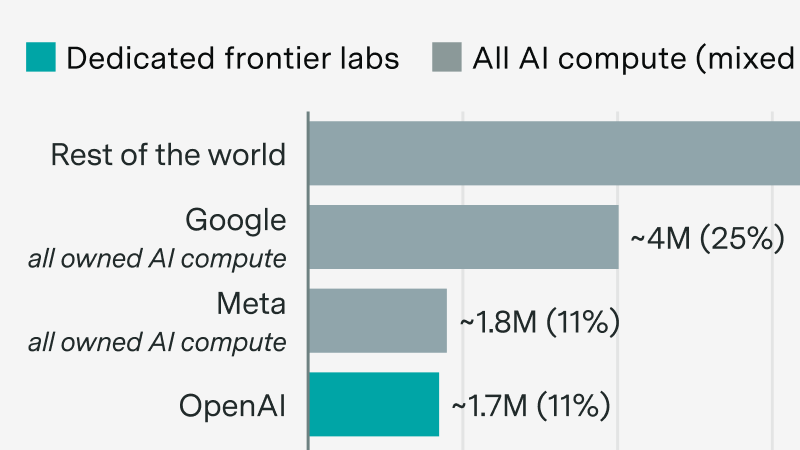
Conversely, an AI lab may not have access to much of the compute owned by its parent company. For example, a large portion of Google’s compute is not available to its AI lab, Google DeepMind, because it is rented out to other firms or allocated to other internal uses.
Our estimates of how much computing power the leading AI developers rent or use, measured in Nvidia H100-equivalents (H100e).