

Computing capacity (“compute”) is a critical ingredient for AI development, training, and deployment. How much compute exists, who owns it, and who uses it are all important influences on AI’s trajectory. Earlier this year, we launched our AI Chip Sales and AI Chip Owners explorers to track how much AI-optimized compute exists in the world, and who owns it. Today, we’re launching the AI Chip Users explorer to help clarify who actually uses this compute.
How we estimate AI compute use, and for whom
The AI Chip Users explorer estimates the compute capacity of five of the world’s top frontier AI developers: OpenAI, Google DeepMind, Anthropic, Meta Superintelligence Labs, and SpaceXAI. Estimated use includes all compute used for AI research, training, and inference by these developers. We measure in the equivalent number of Nvidia H100 GPUs (H100e), modeled using power capacity disclosures from these developers where available, along with financial filings, third-party analyst estimates, and our own analysis of major AI data centers.
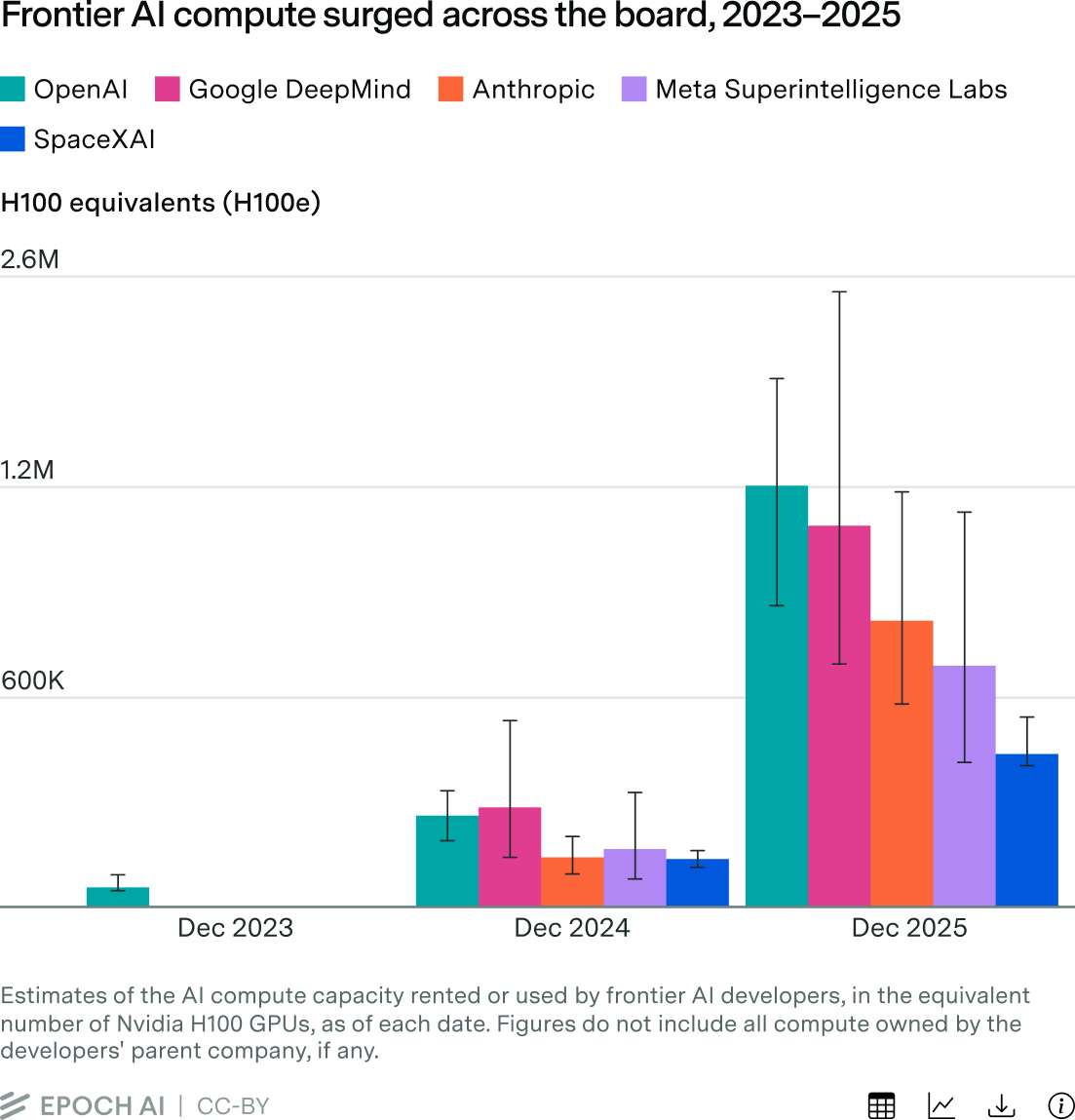
Compute usage differs from compute ownership. OpenAI and Anthropic own very little of the hardware they use, instead renting compute from cloud providers like Microsoft, Amazon, Google, Oracle, and CoreWeave. Google DeepMind and Meta Superintelligence Labs operate within parent companies, Google and Meta, that own enormous compute fleets, but not all of that capacity is allocated to their frontier AI labs.
The AI Chip Users explorer is intended as a resource for researchers, policymakers, and anyone tracking the strategic landscape of AI compute. Below, we highlight our initial findings from the project.
Frontier AI compute has grown dramatically
The clearest window into compute growth comes from OpenAI, which is the only frontier lab to have directly disclosed its compute capacity over time in terms of electrical power. OpenAI’s reports show a tripling of its compute fleet annually, from approximately 0.2 GW of power at the end of 2023, to 0.6 GW at the end of 2024 and 1.9 GW at the end of 2025. On its own, 1.9 GW is enough to simultaneously power roughly 1.5 million average American homes.
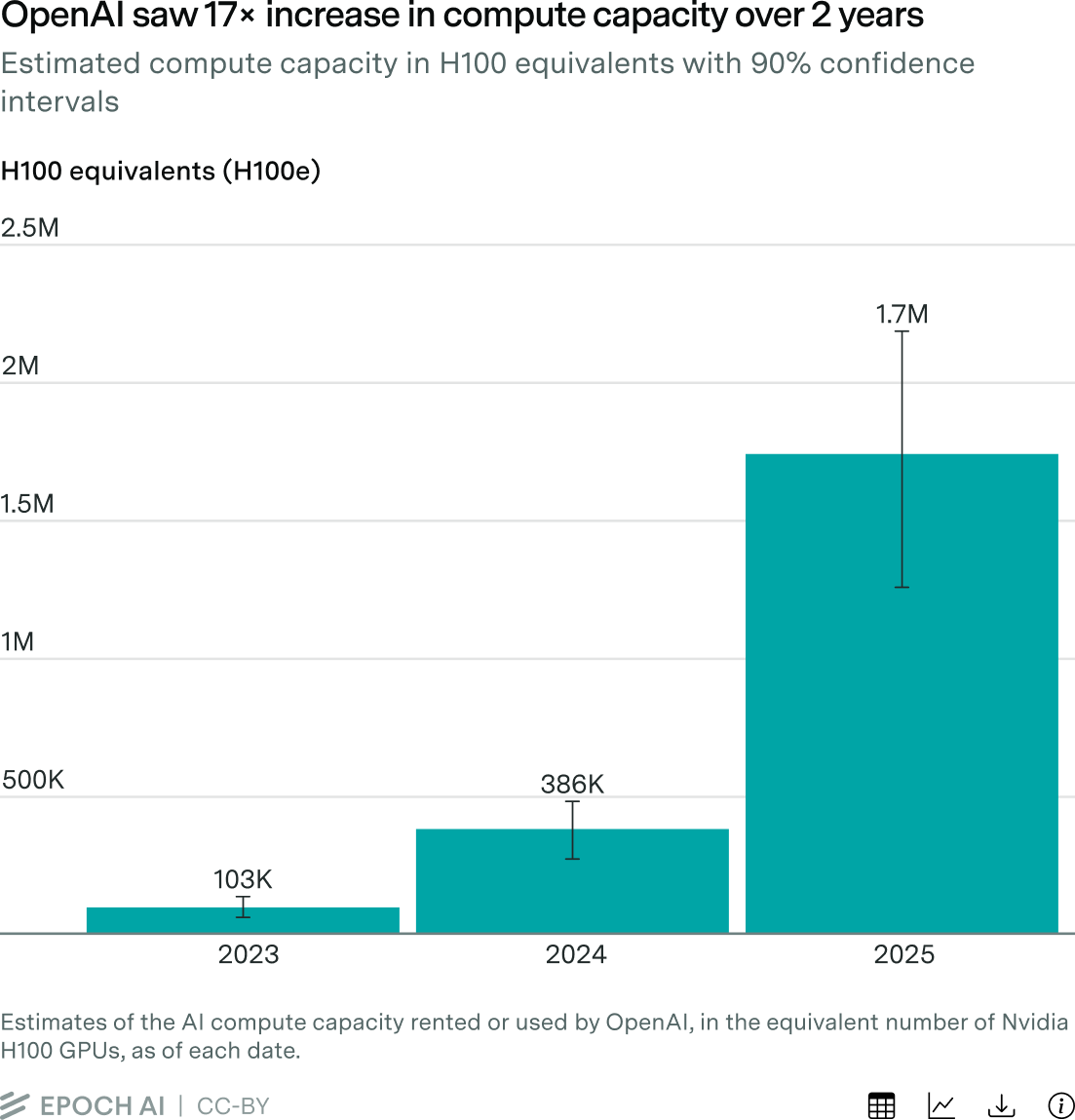
Translating that into H100-equivalents, we estimate that OpenAI quadrupled its computing power in both 2024 and 2025, for a roughly 17× increase over two years. With 1 million H100e, a lab could run dozens of large training runs on the scale of GPT-4 simultaneously.
OpenAI uses this compute for both R&D (research and training models) and for inference to serve its products to around one billion users worldwide. Based on reported figures, OpenAI’s compute in 2025 was divided roughly evenly between R&D and inference, while a higher share went to R&D in 2024.1
OpenAI and Google DeepMind probably led on compute in 2025
At the end of 2025, our median estimates across all five labs look like this:
| Lab | AI compute use, Dec 2025 (median, H100e) | 90% CI (H100e) |
|---|---|---|
| OpenAI | 1,743,000 | 1,251,000–2,185,000 |
| Google DeepMind | 1,583,000 | 1,008,000–2,549,000 |
| Anthropic | 1,190,000 | 842,000–1,717,000 |
| Meta Superintelligence Labs | 996,000 | 606,000–1,638,000 |
| SpaceXAI | 615,000 | 551,000–700,000 |
By our median estimates, OpenAI may have had a narrow lead over Google DeepMind at the end of last year, though the uncertainty intervals for both substantially overlap. DeepMind’s true figure could range from around 1 million to 2.5 million H100-equivalents. We are also uncertain about Meta Superintelligence Labs, but we estimate that it was probably not the compute leader in 2025. For DeepMind and Meta Superintelligence, these wide ranges reflect our uncertainty over how Google and Meta allocate their compute between their frontier AI labs, external cloud rentals, and other AI applications.
Meanwhile, Anthropic was almost certainly well behind OpenAI in compute in 2025, and SpaceXAI was probably fifth.
These five labs represent the frontier of AI compute as of late 2025, but the AI industry is still rapidly evolving. OpenAI has committed to spending approximately $50 billion on compute in 2026, roughly triple its 2025 compute budget. Anthropic has moved to secure more compute in response to rapidly growing demand for its models. SpaceX has rapidly scaled its data centers, but has also overhauled its business model to rent out some of this capacity to external customers, including Anthropic and Google.
To learn more, visit the AI Chip Users explorer to find the methodology, full dataset, interactive visualizations, and more analysis.
-
In earlier work, we estimated that most of OpenAI’s R&D compute went to research and experiments in 2024, rather than the final training runs, a pattern that appears in other AI labs as well
