Between April 2024 and June 2025, China recorded $3.8 billion of server imports from Malaysia, at AI server prices of $80,000–$150,000 per unit, yet Malaysia recorded only $0.6 billion of exports to China. While not proving diversion, this pattern is consistent with established cases of chip smuggling into China, in which intermediaries have routed AI servers through Malaysia and declared them on export paperwork as ordinary servers. The flow could account for roughly 150,000 H100-equivalents (H100e) of diverted compute.
| Quarter | Value recorded by China (USD) | Units recorded by China | Average price per unit (USD) |
|---|---|---|---|
| 2022 Q1 | $95,513,217 | 156,037 | $612 |
| 2022 Q2 | $124,777,743 | 188,508 | $662 |
| 2022 Q3 | $110,740,486 | 243,156 | $455 |
| 2022 Q4 | $102,067,889 | 154,114 | $662 |
| 2023 Q1 | $137,146,993 | 157,752 | $869 |
| 2023 Q2 | $129,890,576 | 222,636 | $583 |
| 2023 Q3 | $99,196,303 | 163,593 | $606 |
| 2023 Q4 | $103,707,716 | 162,652 | $638 |
| 2024 Q1 | $238,253,211 | 57,659 | $4,132 |
| 2024 Q2 | $384,533,741 | 4,549 | $84,531 |
| 2024 Q3 | $386,240,506 | 4,940 | $78,186 |
| 2024 Q4 | $925,765,754 | 7,826 | $118,294 |
| 2025 Q1 | $945,807,775 | 6,197 | $152,623 |
| 2025 Q2 | $1,107,754,767 | 11,978 | $92,482 |
| 2025 Q3 | $266,362,106 | 4,519 | $58,943 |
| 2025 Q4 | $91,154,889 | 6,977 | $13,065 |
| 2026 Q1 | $126,616,063 | 15,866 | $7,980 |
| 2026 Q2 | $268,776,900 | 19,027 | $14,126 |

The two countries report similar quantities of units moved (36,700 declared by Malaysia, 35,500 recorded by China) but disagree on what they were worth: about $17,000 each leaving Malaysia, compared with $106,000 arriving in China. This flow began a few months after the US banned exports of Nvidia’s A800/H800 GPUs to China, and then collapsed within weeks of Malaysia requiring a permit to export or transship high-performance AI chips — a move that preempted expected US actions to curb the trade.
Epoch's work is free to use, distribute, and reproduce provided the source and authors are credited under the Creative Commons BY license.
Learn more about this graph
Whenever goods cross an international border, customs officers are supposed to record a commodity code, a value, and often a piece count. We look at this data for servers, which are recorded under a six-digit product code in the globally adopted Harmonized System (HS-6 847150), and find that, between April 2024 and June 2025, China recorded $3.75 billion of Malaysian-origin servers at an average of $106,000 a machine. While HS-6 847150 includes both AI and non-AI servers, the elevated prices during this period are more consistent with AI servers, which are substantially more expensive. This period falls between two important policy events: the October 2023 export controls on Nvidia’s A800/H800 chips to China, which until then were the highest-performing GPUs still legal to sell there, and the July 2025 Directive No. 1/2025 by Malaysia’s Ministry of Investment, Trade and Industry (MITI), which required a 30-day advance notice and a permit for the export, transshipment, and transit of high-performance, US-origin AI chips. Outside this window, the imports of Malaysian-origin servers into China look completely different:
| Period | Average monthly value | Average price per machine |
|---|---|---|
| Before (Jan 2022–Mar 2024) | $42M | $760 |
| Window (Apr 2024–Jun 2025) | $250M | $105,700 |
| Transition (Jul–Aug 2025) | $126M | $77,000 |
| After (Sep 2025–Jun 2026) | $50M | $11,600 |
Our monthly data shows that it takes around four months for the elevated flow to start after the US export controls are announced and about two months for the flow to wind down. The Jul–Aug 2025 transition period shows the directive taking effect, consistent with goods already cleared, the 30-day notice period, and shipping times. We exclude these two months from the headline figure to keep the corridor and its wind-down separate; including them would increase the total to $4.0 billion and the compute estimate to roughly 160,000 H100e.
Since trade data is reported twice, once by the exporter and once by the importer, we can also check Malaysia’s own records, including the machine counts it files to the UN but does not publish nationally (see Data). They agree with China on the volume of this trade, 36,700 machines versus 35,500, and disagree by 6x on its value: about $17,000 per machine leaving Malaysia, and $106,000 per machine arriving in China. Discrepancies between reporters are common, and comparing the two sides of the same flow — a technique known as mirror trade statistics — is routinely used to fill gaps left by non-reporting countries, to measure tariff evasion, and to trace how goods reach sanctioned countries through intermediaries. A gap can also have perfectly benign explanations — in our case, possible alternative explanations are routing through Singapore or Hong Kong or reclassification under a different code — but none of the explanations we test are satisfactory (see Analysis). Furthermore, none of them can explain why other countries that also report significant imports of Malaysian-origin servers over the same period show a very different mix of products — $1,500 per unit in the US, $6,200 in Singapore, $11,700 in Hong Kong, $23,000 in Japan, against China’s $106,000.
If smuggling did take place, this picture is consistent with the incentives facing intermediaries using Malaysia as a transit hub. Export controls at the time restricted sales to China, not to Malaysia, and the US could not enforce them abroad without the cooperation of the countries through which the goods passed. Since exports are not taxed, they are not usually audited by customs authorities, so the smugglers could have declared the same machines at the price of ordinary servers to avoid drawing attention to the flow. The buyers in China, on the other hand, were breaking no Chinese law, so had less reason to lie to their own customs — and under-declaring there would have meant committing fraud over goods that were legal to bring in. This behavior would have created the price wedge we observe during the window, and the trade’s collapse once Malaysia started scrutinizing it corroborates this story.
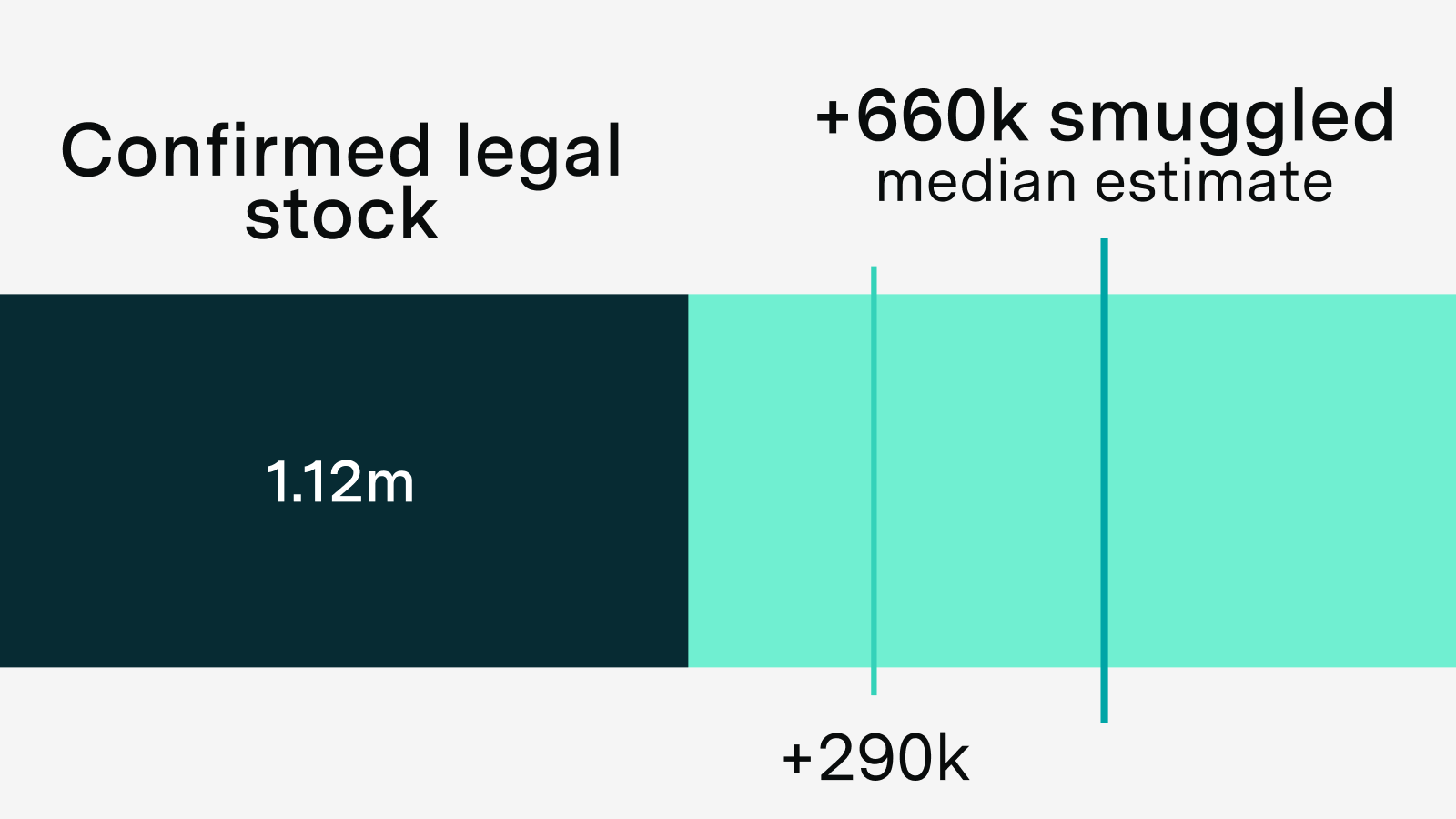
We also estimate how much compute this trade could represent. Ordinary servers are too cheap to carry more than a fraction of the $3.75 billion, so we divide it by Nvidia’s H100 chip price in Epoch AI’s Chip Sales dataset, which gives us roughly 150,000 H100-equivalents (H100e). This is a rough estimate intended to give a sense of scale. Two factors would pull it down: the customs value covers whole servers, not just their GPUs, and import prices in China may reflect a premium due to risk incurred by smugglers. A factor that may drive this up is that some of the chips moved may be more cost-efficient Blackwells. Additionally, there could potentially be smuggling through Malaysia that is undeclared or declared using fabricated prices. 150,000 H100e would be roughly a quarter of the median in Epoch AI’s modeled estimate of total smuggling.
Data
Analysis
Assumptions and limitations
Download this data
Explore this data

AI chip sales data.
Related insights