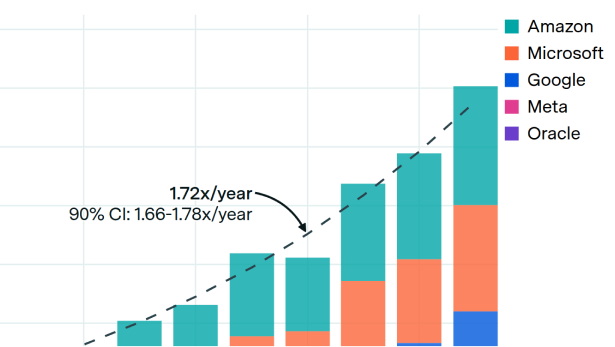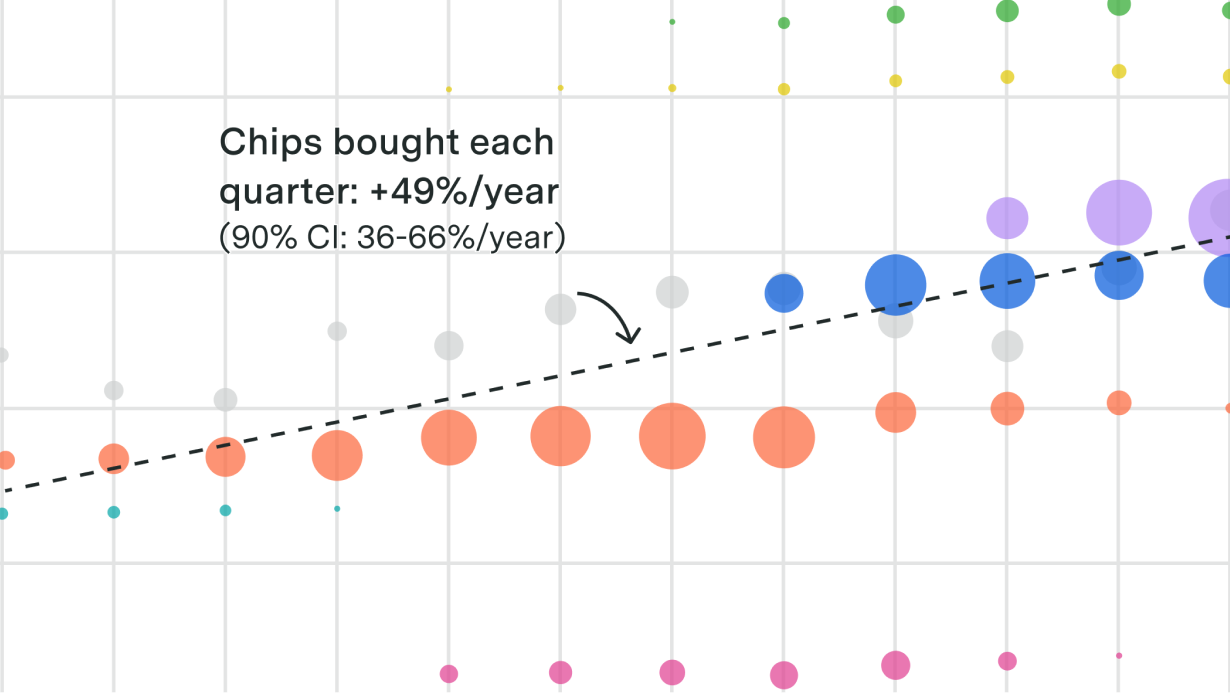

Quarterly additions of computing capacity have grown about 2.5× per year since 2024. That’s down from roughly 6× in 2023, which saw a surge in global AI training and inference capacity following the release of the initial ChatGPT and GPT-4, led by Nvidia’s new H100 GPU.
| Quarter | Nvidia (H100e) | Google (H100e) | AMD (H100e) | Amazon (H100e) | Huawei (H100e) | Cambricon (H100e) | Total (H100e) |
|---|---|---|---|---|---|---|---|
| Q1 2024 | 573,000 | 121,513 | 55,041 | 33,190 | 45,028 | 142 | 827,914 |
| Q2 2024 | 684,237 | 141,228 | 118,553 | 43,036 | 45,028 | 215 | 1,032,297 |
| Q3 2024 | 835,103 | 182,669 | 169,487 | 75,856 | 45,028 | 664 | 1,308,807 |
| Q4 2024 | 1,236,789 | 283,362 | 205,338 | 148,059 | 45,028 | 5,447 | 1,924,023 |
| Q1 2025 | 1,695,979 | 440,867 | 160,229 | 137,842 | 131,964 | 4,869 | 2,571,750 |
| Q2 2025 | 1,892,964 | 629,722 | 104,935 | 160,816 | 131,964 | 7,749 | 2,928,150 |
| Q3 2025 | 2,373,078 | 800,813 | 202,453 | 187,071 | 131,964 | 7,563 | 3,702,942 |
| Q4 2025 | 2,957,554 | 875,055 | 218,370 | 219,891 | 131,964 | 8,277 | 4,411,111 |
| Q1 2026 | 3,385,962 | 923,374 | 229,549 | 226,455 | 202,416 | 12,398 | 4,980,154 |
| Q2 2026 | 3,953,823 | 1,607,427 | 260,920 | 288,205 | 204,676 | 12,365 | 6,327,416 |

Some evidence suggests further deceleration in growth over this period, but it is not statistically significant and may also reflect a lull between generations. While Nvidia has recently started shipping its next-generation Rubin chips, it had not yet recognized any Rubin sales as of its latest fiscal quarter ending in July.
Epoch's work is free to use, distribute, and reproduce provided the source and authors are credited under the Creative Commons BY license.
Learn more about this graph
We estimate how fast the computing capacity of AI chips sold worldwide grows each quarter, using quarterly sales estimates for AI chips from six major AI chip designers: Nvidia, Google, AMD, Amazon, Huawei, and Cambricon. We measure computing capacity in H100-equivalents (H100e) and fit an exponential trend to the capacity added each quarter.
Data
Our data come from AI chip sales, which estimates how many of each AI chip model were sold each quarter, based on company financial disclosures, analyst estimates, and media reports. See the AI chip sales documentation for each chip designer’s methodology. We use the hub’s median estimates as of October 19, 2026.
Analysis
We fit a log-linear regression of H100e sales per quarter on time, using the ten quarters from Q1 2024 to Q2 2026. As in our January insight, we obtain 90% confidence intervals analytically from the standard error of the slope.
Quarterly compute capacity additions rose from 0.8 million H100e in Q1 2024 to 6.3 million in Q2 2026. The fitted trend is 2.5× per year (90% CI: 2.3× to 2.7×), a doubling time of 9.1 months (90% CI: 8.4 to 10.0 months).
We chose to analyze quarterly additions instead of cumulative capacity, which is the running sum of quarterly additions. When additions grow at a steady rate, the cumulative capacity growth rate converges to the same rate. However, these growth rates can diverge if sales surge and then slow, which happened in 2023.
Sales of both Nvidia GPUs and Google TPUs surged over the course of 2023. Their H100e sales in Q1 2024 were around 6× higher than in Q1 2023. In 2024 and 2025, since cumulative capacity was small relative to recent quarterly sales, each subsequent quarter saw a relatively large increase in cumulative stock even as growth in quarterly additions stayed stable.
By 2026, the two growth rates had converged: cumulative capacity grew 2.6× between Q2 2025 and Q2 2026, close to the 2.5× trend in quarterly additions and down from 3.5× the year before. We therefore fit the trend to quarterly additions, which measure the current pace of growth. A fit to cumulative capacity over 2024–2026 would overstate it.
While quarterly compute additions grew faster in 2023 than in subsequent years, it is unclear whether they have slowed since the beginning of 2024 or whether the growth rate has been steady. Year-over-year growth in quarterly additions fell from 2.8× in Q2 2025 to 2.2× in Q2 2026. However, quarter-to-quarter growth is noisy, partly because of generation transitions such as Nvidia’s rollout of Blackwell chips in late 2024 and early 2025. Regressing quarterly growth rates on time shows a downward trend, from about 32% to 19% per quarter, but it is not statistically significant (p = 0.26).
Assumptions and limitations
- Our data tracks chips when they are sold, not when they come online. Chip sellers like Nvidia typically recognize revenue for AI chips when they deliver them to a server assembly partner, so those chips can take several more months to become operational in a data center.
- We omit smaller designers such as Intel, Meta, Microsoft, Cerebras, and Groq, and any GPUs from Nvidia or other AI chip designers, such as gaming chips, that are not intended for data center use. We believe these volumes are minor and would not meaningfully change this trend.
- Our confidence intervals reflect only how well the trend fits our median sales estimate, not uncertainty in the underlying sales estimates.
- Our main estimate rests on only ten quarters of data, and sales tend to come in waves as new chip generations ramp up. We omit previous quarters because the pre-2024 growth rate is substantially higher, as discussed above. In addition, we do not have pre-2024 estimates for AI chip sales other than Nvidia GPUs and Google TPUs, so we cannot fit a pre-2024 growth trend for the full set of six designers.
Download this data
Explore this data

AI chip sales data.
Related insights