


Total available computing capacity from AI chips across all major designers has grown by approximately 3.3x per year since 2022, enabling larger-scale model development and consumer adoption. NVIDIA AI chips currently account for over 60% of total compute, with Google and Amazon making up much of the remainder.
| Name | Chip manufacturer | Start date | End date | Incomplete | Number of Units | Number of Units (5th percentile) | Number of Units (95th percentile) | Compute estimate in H100e (median) | H100e (5th percentile) | H100e (95th percentile) | Source / Link | Notes | Chip type | Last Modified By | Last Modified | Chip type (linked) | Chip TDP (W) | Total TDP (W) | Total TDP (W) (5th percentile) | Total TDP (W) (95th percentile) | Chip Cost (Linked) | Chip Cost (USD) | Cost Estimate (USD) |
|---|---|---|---|---|---|---|---|---|---|---|---|---|---|---|---|---|---|---|---|---|---|---|---|
| Q1 2022 - A100 | Nvidia | 2022-01-01 | 2022-03-31 | True | 147,645 | 113,423 | 191,482 | 46,554.00 | 35,763.00 | 60,376.00 | A100 | Joshua You | 2026-01-28 18:19:11+00:00 | A100 | 400 | 5.9e+7 | 4.5e+7 | 7.7e+7 | 12,000 | $12,000 | $1,771,740,000 | ||
| Q2 2022 - A100 | Nvidia | 2022-04-01 | 2022-06-30 | 226,324 | 173,378 | 293,623 | 71,362.00 | 54,668.00 | 92,582.00 | Estimates generated on: 01-28-2026 12:48 | A100 | Joshua You | 2026-01-28 18:19:11+00:00 | A100 | 400 | 9.1e+7 | 6.9e+7 | 1.2e+8 | 12,000 | $12,000 | $2,715,888,000 | ||
| Q3 2022 - A100 | Nvidia | 2022-07-01 | 2022-09-30 | 215,200 | 165,507 | 279,450 | 67,855.00 | 52,186.00 | 88,113.00 | Estimates generated on: 01-28-2026 12:48 | A100 | Joshua You | 2026-01-28 18:19:11+00:00 | A100 | 400 | 8.6e+7 | 6.6e+7 | 1.1e+8 | 12,000 | $12,000 | $2,582,400,000 | ||
| Q3 2022 - H100/H200 | Nvidia | 2022-07-01 | 2022-09-30 | 6,106 | 5,148 | 7,204 | 6,106.00 | 5,148.00 | 7,204.00 | Estimates generated on: 01-28-2026 12:48 | H100/H200 | Joshua You | 2026-01-28 18:19:11+00:00 | H100 | 700 | 4.3e+6 | 3.6e+6 | 5.0e+6 | 25,000 | $25,000 | $152,650,000 | ||
| Q4 2022 - TPU v4i | 2022-10-01 | 2022-12-31 | True | 20,656 | 12,558 | 31,242 | 1,440.00 | 875.00 | 2,178.00 | TPU v4i | Joshua You | 2026-01-28 20:04:15+00:00 | TPU v4i | 175 | 3.6e+6 | 2.2e+6 | 5.5e+6 | $2,322 | $47,963,232 | ||||
| Q4 2022 - TPU v4 | 2022-10-01 | 2022-12-31 | True | 66,457 | 49,107 | 87,062 | 9,234.00 | 6,823.00 | 12,098.00 | TPU v4 | Joshua You | 2026-01-28 20:04:10+00:00 | TPU v4 | 340 | 2.3e+7 | 1.7e+7 | 3.0e+7 | 3,900 | $3,389 | $225,222,773 | |||
| Q4 2022 - TPU v5e | 2022-10-01 | 2022-12-31 | True | 15,803 | 9,792 | 23,634 | 3,138.00 | 1,944.00 | 4,693.00 | TPU v5e | Joshua You | 2026-01-28 20:04:18+00:00 | TPU v5e | 225 | 3.6e+6 | 2.2e+6 | 5.3e+6 | 2,900 | $2,704 | $42,731,312 | |||
| Q4 2022 - A100 | Nvidia | 2022-10-01 | 2022-12-31 | 113,277 | 87,190 | 147,290 | 35,717.00 | 27,491.00 | 46,442.00 | Estimates generated on: 01-28-2026 12:48 | A100 | Joshua You | 2026-01-28 18:19:11+00:00 | A100 | 400 | 4.5e+7 | 3.5e+7 | 5.9e+7 | 12,000 | $12,000 | $1,359,324,000 | ||
| Q4 2022 - H100/H200 | Nvidia | 2022-10-01 | 2022-12-31 | 32,492 | 27,372 | 38,332 | 32,492.00 | 27,372.00 | 38,332.00 | Estimates generated on: 01-28-2026 12:48 | H100/H200 | Joshua You | 2026-01-28 18:19:11+00:00 | H100 | 700 | 2.3e+7 | 1.9e+7 | 2.7e+7 | 25,000 | $25,000 | $812,300,000 | ||
| Q4 2022 - A800 | Nvidia | 2022-10-01 | 2022-12-31 | 28,117 | 21,489 | 36,535 | 8,865.00 | 6,775.00 | 11,520.00 | Estimates generated on: 01-28-2026 12:48 | A800 | Joshua You | 2026-01-28 18:19:11+00:00 | A800 | 400 | 1.1e+7 | 8.6e+6 | 1.5e+7 | 12,000 | $12,000 | $337,404,000 | ||
| Q1 2023 - TPU v4i | 2023-01-01 | 2023-03-31 | 9,661 | 5,874 | 14,613 | 673.00 | 409.00 | 1,019.00 | Estimates generated on: 01-28-2026 12:41 | TPU v4i | Joshua You | 2026-01-28 18:00:18+00:00 | TPU v4i | 175 | 1.7e+6 | 1.0e+6 | 2.6e+6 | $2,322 | $22,432,842 | ||||
| Q1 2023 - TPU v4 | 2023-01-01 | 2023-03-31 | 118,996 | 84,982 | 160,359 | 16,535.00 | 11,809.00 | 22,283.00 | Estimates generated on: 01-28-2026 12:41 | TPU v4 | Joshua You | 2026-01-28 18:00:18+00:00 | TPU v4 | 340 | 4.0e+7 | 2.9e+7 | 5.5e+7 | 3,900 | $3,389 | $403,277,444 | |||
| Q1 2023 - TPU v5e | 2023-01-01 | 2023-03-31 | 39,100 | 18,789 | 62,708 | 7,764.00 | 3,731.00 | 12,453.00 | Estimates generated on: 01-28-2026 12:41 | TPU v5e | Joshua You | 2026-01-28 18:00:18+00:00 | TPU v5e | 225 | 8.8e+6 | 4.2e+6 | 1.4e+7 | 2,900 | $2,704 | $105,726,400 | |||
| Q1 2023 - A100 | Nvidia | 2023-01-01 | 2023-03-31 | 58,773 | 45,347 | 76,478 | 18,531.00 | 14,298.00 | 24,114.00 | Estimates generated on: 01-28-2026 12:48 | A100 | Joshua You | 2026-01-28 18:19:11+00:00 | A100 | 400 | 2.4e+7 | 1.8e+7 | 3.1e+7 | 12,000 | $12,000 | $705,276,000 | ||
| Q1 2023 - H100/H200 | Nvidia | 2023-01-01 | 2023-03-31 | 56,536 | 47,792 | 66,904 | 56,536.00 | 47,792.00 | 66,904.00 | Estimates generated on: 01-28-2026 12:48 | H100/H200 | Joshua You | 2026-01-28 18:19:11+00:00 | H100 | 700 | 4.0e+7 | 3.3e+7 | 4.7e+7 | 25,000 | $25,000 | $1,413,400,000 | ||
| Q1 2023 - A800 | Nvidia | 2023-01-01 | 2023-03-31 | 29,250 | 22,439 | 38,054 | 9,222.00 | 7,075.00 | 11,999.00 | Estimates generated on: 01-28-2026 12:48 | A800 | Joshua You | 2026-01-28 18:19:11+00:00 | A800 | 400 | 1.2e+7 | 9.0e+6 | 1.5e+7 | 12,000 | $12,000 | $351,000,000 | ||
| Q1 2023 - H800 | Nvidia | 2023-01-01 | 2023-03-31 | 7,397 | 5,980 | 9,252 | 7,397.00 | 5,980.00 | 9,252.00 | Estimates generated on: 01-28-2026 12:48 | H800 | Joshua You | 2026-01-28 18:19:11+00:00 | H800 | 700 | 5.2e+6 | 4.2e+6 | 6.5e+6 | 30,000 | $30,000 | $221,910,000 | ||
| Q2 2023 - TPU v4 | 2023-04-01 | 2023-06-30 | 65,920 | 37,126 | 97,750 | 9,160.00 | 5,159.00 | 13,583.00 | Estimates generated on: 01-28-2026 12:41 | TPU v4 | Joshua You | 2026-01-28 18:00:18+00:00 | TPU v4 | 340 | 2.2e+7 | 1.3e+7 | 3.3e+7 | 3,900 | $3,389 | $223,402,880 | |||
| Q2 2023 - TPU v5e | 2023-04-01 | 2023-06-30 | 119,810 | 80,502 | 170,140 | 23,792.00 | 15,986.00 | 33,787.00 | Estimates generated on: 01-28-2026 12:41 | TPU v5e | Joshua You | 2026-01-28 18:00:18+00:00 | TPU v5e | 225 | 2.7e+7 | 1.8e+7 | 3.8e+7 | 2,900 | $2,704 | $323,966,240 | |||
| Q2 2023 - A100 | Nvidia | 2023-04-01 | 2023-06-30 | 64,286 | 49,564 | 83,810 | 20,270.00 | 15,628.00 | 26,426.00 | Estimates generated on: 01-28-2026 12:48 | A100 | Joshua You | 2026-01-28 18:19:11+00:00 | A100 | 400 | 2.6e+7 | 2.0e+7 | 3.4e+7 | 12,000 | $12,000 | $771,432,000 | ||
| Q2 2023 - H100/H200 | Nvidia | 2023-04-01 | 2023-06-30 | 150,868 | 127,870 | 179,142 | 150,868.00 | 127,870.00 | 179,142.00 | Estimates generated on: 01-28-2026 12:48 | H100/H200 | Joshua You | 2026-01-28 18:19:11+00:00 | H100 | 700 | 1.1e+8 | 9.0e+7 | 1.3e+8 | 25,000 | $25,000 | $3,771,700,000 | ||
| Q2 2023 - A800 | Nvidia | 2023-04-01 | 2023-06-30 | 26,235 | 20,136 | 34,327 | 8,272.00 | 6,349.00 | 10,823.00 | Estimates generated on: 01-28-2026 12:48 | A800 | Joshua You | 2026-01-28 18:19:11+00:00 | A800 | 400 | 1.0e+7 | 8.1e+6 | 1.4e+7 | 12,000 | $12,000 | $314,820,000 | ||
| Q2 2023 - H800 | Nvidia | 2023-04-01 | 2023-06-30 | 32,275 | 26,007 | 39,805 | 32,275.00 | 26,007.00 | 39,805.00 | Estimates generated on: 01-28-2026 12:48 | H800 | Joshua You | 2026-01-28 18:19:11+00:00 | H800 | 700 | 2.3e+7 | 1.8e+7 | 2.8e+7 | 30,000 | $30,000 | $968,250,000 | ||
| Q3 2023 - TPU v4 | 2023-07-01 | 2023-09-30 | 11,156 | 3,260 | 19,137 | 1,550.00 | 453.00 | 2,659.00 | Estimates generated on: 01-28-2026 12:41 | TPU v4 | Joshua You | 2026-01-28 18:00:18+00:00 | TPU v4 | 340 | 3.8e+6 | 1.1e+6 | 6.5e+6 | 3,900 | $3,389 | $37,807,684 | |||
| Q3 2023 - TPU v5e | 2023-07-01 | 2023-09-30 | 248,952 | 178,583 | 334,722 | 49,438.00 | 35,464.00 | 66,470.00 | Estimates generated on: 01-28-2026 12:41 | TPU v5e | Joshua You | 2026-01-28 18:00:18+00:00 | TPU v5e | 225 | 5.6e+7 | 4.0e+7 | 7.5e+7 | 2,900 | $2,704 | $673,166,208 | |||
| Q3 2023 - A100 | Nvidia | 2023-07-01 | 2023-09-30 | 54,904 | 42,108 | 71,649 | 17,311.00 | 13,277.00 | 22,592.00 | Estimates generated on: 01-28-2026 12:48 | A100 | Joshua You | 2026-01-28 18:19:11+00:00 | A100 | 400 | 2.2e+7 | 1.7e+7 | 2.9e+7 | 12,000 | $12,000 | $658,848,000 | ||
| Q3 2023 - H100/H200 | Nvidia | 2023-07-01 | 2023-09-30 | 259,631 | 219,080 | 307,406 | 259,631.00 | 219,080.00 | 307,406.00 | Estimates generated on: 01-28-2026 12:48 | H100/H200 | Joshua You | 2026-01-28 18:19:11+00:00 | H100 | 700 | 1.8e+8 | 1.5e+8 | 2.2e+8 | 25,000 | $25,000 | $6,490,775,000 | ||
| Q3 2023 - A800 | Nvidia | 2023-07-01 | 2023-09-30 | 28,404 | 21,885 | 37,072 | 8,956.00 | 6,900.00 | 11,689.00 | Estimates generated on: 01-28-2026 12:48 | A800 | Joshua You | 2026-01-28 18:19:11+00:00 | A800 | 400 | 1.1e+7 | 8.8e+6 | 1.5e+7 | 12,000 | $12,000 | $340,848,000 | ||
| Q3 2023 - H800 | Nvidia | 2023-07-01 | 2023-09-30 | 56,780 | 45,740 | 70,293 | 56,780.00 | 45,740.00 | 70,293.00 | Estimates generated on: 01-28-2026 12:48 | H800 | Joshua You | 2026-01-28 18:19:11+00:00 | H800 | 700 | 4.0e+7 | 3.2e+7 | 4.9e+7 | 30,000 | $30,000 | $1,703,400,000 | ||
| Q4 2023 - TPU v5e | 2023-10-01 | 2023-12-31 | 387,909 | 288,740 | 506,896 | 77,033.00 | 57,339.00 | 100,662.00 | Estimates generated on: 01-28-2026 12:41 | TPU v5e | Joshua You | 2026-01-28 18:00:18+00:00 | TPU v5e | 225 | 8.7e+7 | 6.5e+7 | 1.1e+8 | 2,900 | $2,704 | $1,048,905,936 | |||
| Q4 2023 - TPU v5p | 2023-10-01 | 2023-12-31 | 14,605 | 7,476 | 22,313 | 6,775.00 | 3,468.00 | 10,350.00 | Estimates generated on: 01-28-2026 12:41 | TPU v5p | Joshua You | 2026-01-28 18:00:18+00:00 | TPU v5p | 540 | 7.9e+6 | 4.0e+6 | 1.2e+7 | 6,400 | $6,022 | $87,951,310 | |||
| Q4 2023 - A100 | Nvidia | 2023-10-01 | 2023-12-31 | 15,130 | 11,574 | 19,746 | 4,770.00 | 3,649.00 | 6,226.00 | Estimates generated on: 01-28-2026 12:48 | A100 | Joshua You | 2026-01-28 18:19:11+00:00 | A100 | 400 | 6.1e+6 | 4.6e+6 | 7.9e+6 | 12,000 | $12,000 | $181,560,000 | ||
| Q4 2023 - H100/H200 | Nvidia | 2023-10-01 | 2023-12-31 | 422,172 | 355,867 | 500,558 | 422,172.00 | 355,867.00 | 500,558.00 | Estimates generated on: 01-28-2026 12:48 | H100/H200 | Joshua You | 2026-01-28 18:19:11+00:00 | H100 | 700 | 3.0e+8 | 2.5e+8 | 3.5e+8 | 25,000 | $25,000 | $10,554,300,000 | ||
| Q4 2023 - A800 | Nvidia | 2023-10-01 | 2023-12-31 | 9,071 | 7,005 | 11,815 | 2,860.00 | 2,209.00 | 3,725.00 | Estimates generated on: 01-28-2026 12:48 | A800 | Joshua You | 2026-01-28 18:19:11+00:00 | A800 | 400 | 3.6e+6 | 2.8e+6 | 4.7e+6 | 12,000 | $12,000 | $108,852,000 | ||
| Q4 2023 - H800 | Nvidia | 2023-10-01 | 2023-12-31 | 19,971 | 16,088 | 24,769 | 19,971.00 | 16,088.00 | 24,769.00 | Estimates generated on: 01-28-2026 12:48 | H800 | Joshua You | 2026-01-28 18:19:11+00:00 | H800 | 700 | 1.4e+7 | 1.1e+7 | 1.7e+7 | 30,000 | $30,000 | $599,130,000 | ||
| Q1 2024 - TPU v5e | 2024-01-01 | 2024-03-31 | 416,458 | 306,998 | 548,495 | 82,702.00 | 60,965.00 | 108,923.00 | Estimates generated on: 01-28-2026 12:41 | TPU v5e | Joshua You | 2026-01-28 18:00:18+00:00 | TPU v5e | 225 | 9.4e+7 | 6.9e+7 | 1.2e+8 | 2,900 | $2,704 | $1,126,102,432 | |||
| Q1 2024 - TPU v5p | 2024-01-01 | 2024-03-31 | 83,106 | 59,277 | 110,342 | 38,550.00 | 27,497.00 | 51,184.00 | Estimates generated on: 01-28-2026 12:41 | TPU v5p | Joshua You | 2026-01-28 18:00:18+00:00 | TPU v5p | 540 | 4.5e+7 | 3.2e+7 | 6.0e+7 | 6,400 | $6,022 | $500,464,332 | |||
| Q1 2024 - H100/H200 | Nvidia | 2024-01-01 | 2024-03-31 | 550,503 | 466,753 | 647,115 | 550,503.00 | 466,753.00 | 647,115.00 | Estimates generated on: 01-28-2026 12:48 | H100/H200 | Joshua You | 2026-01-28 18:19:23+00:00 | H100 | 700 | 3.9e+8 | 3.3e+8 | 4.5e+8 | 25,000 | $25,000 | $13,762,575,000 | ||
| Q1 2024 - H20 | Nvidia | 2024-01-01 | 2024-03-31 | 139,117 | 107,118 | 181,766 | 20,807.00 | 16,021.00 | 27,186.00 | Estimates generated on: 01-28-2026 12:48 | H20 | Joshua You | 2026-01-28 18:19:23+00:00 | H20 | 400 | 5.6e+7 | 4.3e+7 | 7.3e+7 | 12,000 | $12,000 | $1,669,404,000 | ||
| FY24 Q1 - MI250X | AMD | 2024-01-01 | 2024-03-31 | 30,367 | 20,483 | 42,440 | 5,877.00 | 3,964.00 | 8,213.00 | MI250X | Joshua You | 2026-01-28 17:14:46+00:00 | Instinct MI250X | 500 | 1.5e+7 | 1.0e+7 | 2.1e+7 | 10,000 | $10,000 | $303,670,000 | |||
| FY24 Q1 - MI300X | AMD | 2024-01-01 | 2024-03-31 | 34,445 | 24,841 | 47,284 | 45,514.00 | 32,825.00 | 62,480.00 | MI300X | Joshua You | 2026-01-28 17:14:46+00:00 | Instinct MI300X | 750 | 2.6e+7 | 1.9e+7 | 3.5e+7 | 12,500 | $12,500 | $430,562,500 | |||
| FY24 Q1 - MI300A | AMD | 2024-01-01 | 2024-03-31 | 3,537 | 1,098 | 6,369 | 3,505.00 | 1,088.00 | 6,311.00 | MI300A | Joshua You | 2026-01-28 17:14:46+00:00 | Instinct MI300A | 760 | 2.7e+6 | 8.3e+5 | 4.8e+6 | 6,700 | $6,700 | $23,697,900 | |||
| Q1 2024 Ascend 910B | Huawei | 2024-01-01 | 2024-03-31 | 100,000 | 87,500 | 125,000 | 35,378.75 | 27,362.75 | 45,990.50 | see methodology | Ascend 910B | Joshua You | 2026-01-28 17:14:46+00:00 | Ascend 910B | 400 | 4.0e+7 | 3.5e+7 | 5.0e+7 | 15,000 | $15,000 | $1,500,000,000 | ||
| Q1 2024 Ascend 910C | Huawei | 2024-01-01 | 2024-03-31 | 12,500 | 6,250 | 25,000 | 9,649.00 | 4,876.75 | 18,995.25 | see methodology | Ascend 910C | Joshua You | 2026-01-28 17:14:46+00:00 | Ascend 910C | 700 | 8.8e+6 | 4.4e+6 | 1.8e+7 | 20,000 | $20,000 | $250,000,000 | ||
| Q1 2024 Trainium1/Inferentia | Amazon | 2024-01-01 | 2024-03-31 | 250,000 | 48,000.00 | see AI Chip Sales methodology | More speculative | Trainium1 | Joshua You | 2026-01-28 17:14:46+00:00 | Trainium1 | 0.0e+0 | 0.0e+0 | 0.0e+0 | $0 | ||||||||
| Q1 2024 Trainium2 | Amazon | 2024-01-01 | 2024-03-31 | 125,000 | 84,250.00 | see AI Chip Sales methodology | Trainium2 | Joshua You | 2026-01-28 17:14:46+00:00 | Trainium2 | 500 | 6.3e+7 | 0.0e+0 | 0.0e+0 | 4,000 | $4,000 | $500,000,000 | ||||||
| Q2 2024 - TPU v5e | 2024-04-01 | 2024-06-30 | 374,682 | 255,369 | 527,867 | 74,406.00 | 50,712.00 | 104,826.00 | Estimates generated on: 01-28-2026 12:41 | TPU v5e | Joshua You | 2026-01-28 18:00:18+00:00 | TPU v5e | 225 | 8.4e+7 | 5.7e+7 | 1.2e+8 | 2,900 | $2,704 | $1,013,140,128 | |||
| Q2 2024 - TPU v5p | 2024-04-01 | 2024-06-30 | 144,688 | 98,256 | 197,652 | 67,116.00 | 45,578.00 | 91,685.00 | Estimates generated on: 01-28-2026 12:41 | TPU v5p | Joshua You | 2026-01-28 18:00:18+00:00 | TPU v5p | 540 | 7.8e+7 | 5.3e+7 | 1.1e+8 | 6,400 | $6,022 | $871,311,136 | |||
| Q2 2024 - H100/H200 | Nvidia | 2024-04-01 | 2024-06-30 | 648,803 | 552,079 | 761,640 | 648,803.00 | 552,079.00 | 761,640.00 | Estimates generated on: 01-28-2026 12:48 | H100/H200 | Joshua You | 2026-01-28 18:19:23+00:00 | H100 | 700 | 4.5e+8 | 3.9e+8 | 5.3e+8 | 25,000 | $25,000 | $16,220,075,000 | ||
| Q2 2024 - H20 | Nvidia | 2024-04-01 | 2024-06-30 | 223,789 | 172,854 | 290,498 | 33,472.00 | 25,853.00 | 43,450.00 | Estimates generated on: 01-28-2026 12:48 | H20 | Joshua You | 2026-01-28 18:19:23+00:00 | H20 | 400 | 9.0e+7 | 6.9e+7 | 1.2e+8 | 12,000 | $12,000 | $2,685,468,000 | ||
| FY24 Q2 - MI250X | AMD | 2024-04-01 | 2024-06-30 | 6,645 | 1,363 | 12,299 | 1,286.00 | 263.00 | 2,380.00 | MI250X | Joshua You | 2026-01-28 17:14:46+00:00 | Instinct MI250X | 500 | 3.3e+6 | 6.8e+5 | 6.1e+6 | 10,000 | $10,000 | $66,450,000 | |||
| FY24 Q2 - MI300X | AMD | 2024-04-01 | 2024-06-30 | 80,701 | 63,192 | 102,794 | 106,636.00 | 83,501.00 | 135,829.00 | MI300X | Joshua You | 2026-01-28 17:14:46+00:00 | Instinct MI300X | 750 | 6.1e+7 | 4.7e+7 | 7.7e+7 | 12,500 | $12,500 | $1,008,762,500 | |||
| FY24 Q2 - MI300A | AMD | 2024-04-01 | 2024-06-30 | 10,490 | 3,895 | 17,706 | 10,395.00 | 3,860.00 | 17,545.00 | MI300A | Joshua You | 2026-01-28 17:14:46+00:00 | Instinct MI300A | 760 | 8.0e+6 | 3.0e+6 | 1.3e+7 | 6,700 | $6,700 | $70,283,000 | |||
| Q2 2024 Ascend 910B | Huawei | 2024-04-01 | 2024-06-30 | 100,000 | 87,500 | 125,000 | 35,378.75 | 27,362.75 | 45,990.50 | see methodology | Ascend 910B | Joshua You | 2026-01-28 17:14:46+00:00 | Ascend 910B | 400 | 4.0e+7 | 3.5e+7 | 5.0e+7 | 15,000 | $15,000 | $1,500,000,000 | ||
| Q2 2024 Ascend 910C | Huawei | 2024-04-01 | 2024-06-30 | 12,500 | 6,250 | 25,000 | 9,649.00 | 4,876.75 | 18,995.25 | see methodology | Ascend 910C | Joshua You | 2026-01-28 17:14:46+00:00 | Ascend 910C | 700 | 8.8e+6 | 4.4e+6 | 1.8e+7 | 20,000 | $20,000 | $250,000,000 | ||
| Q2 2024 Trainium1/Inferentia | Amazon | 2024-04-01 | 2024-06-30 | 250,000 | 48,000.00 | see AI Chip Sales methodology | More speculative | Trainium1 | Joshua You | 2026-01-28 17:14:46+00:00 | Trainium1 | 0.0e+0 | 0.0e+0 | 0.0e+0 | $0 | ||||||||
| Q2 2024 Trainium2 | Amazon | 2024-04-01 | 2024-06-30 | 125,000 | 84,250.00 | see AI Chip Sales methodology | Trainium2 | Joshua You | 2026-01-28 17:14:46+00:00 | Trainium2 | 500 | 6.3e+7 | 0.0e+0 | 0.0e+0 | 4,000 | $4,000 | $500,000,000 | ||||||
| Q3 2024 - TPU v5e | 2024-07-01 | 2024-09-30 | 358,295 | 216,030 | 535,043 | 71,152.00 | 42,900.00 | 106,251.00 | Estimates generated on: 01-28-2026 12:41 | TPU v5e | Joshua You | 2026-01-28 18:00:18+00:00 | TPU v5e | 225 | 8.1e+7 | 4.9e+7 | 1.2e+8 | 2,900 | $2,704 | $968,829,680 | |||
| Q3 2024 - TPU v5p | 2024-07-01 | 2024-09-30 | 160,263 | 99,699 | 231,251 | 74,341.00 | 46,247.00 | 107,270.00 | Estimates generated on: 01-28-2026 12:41 | TPU v5p | Joshua You | 2026-01-28 18:00:18+00:00 | TPU v5p | 540 | 8.7e+7 | 5.4e+7 | 1.2e+8 | 6,400 | $6,022 | $965,103,786 | |||
| Q3 2024 - TPU v6e | 2024-07-01 | 2024-09-30 | 40,118 | 16,353 | 72,160 | 37,219.00 | 15,172.00 | 66,946.00 | Estimates generated on: 01-28-2026 12:41 | TPU v6e | Joshua You | 2026-01-28 18:00:18+00:00 | TPU v6e | 380 | 1.5e+7 | 6.2e+6 | 2.7e+7 | 4,300 | $4,059 | $162,838,962 | |||
| Q3 2024 - H100/H200 | Nvidia | 2024-07-01 | 2024-09-30 | 791,332 | 675,899 | 930,021 | 791,332.00 | 675,899.00 | 930,021.00 | Estimates generated on: 01-28-2026 12:48 | H100/H200 | Joshua You | 2026-01-28 18:19:23+00:00 | H100 | 700 | 5.5e+8 | 4.7e+8 | 6.5e+8 | 25,000 | $25,000 | $19,783,300,000 | ||
| Q3 2024 - H20 | Nvidia | 2024-07-01 | 2024-09-30 | 274,454 | 212,258 | 354,333 | 41,050.00 | 31,747.00 | 52,997.00 | Estimates generated on: 01-28-2026 12:48 | H20 | Joshua You | 2026-01-28 18:19:23+00:00 | H20 | 400 | 1.1e+8 | 8.5e+7 | 1.4e+8 | 12,000 | $12,000 | $3,293,448,000 | ||
| FY24 Q3 - MI250X | AMD | 2024-07-01 | 2024-09-30 | 4,449 | 1,589 | 7,692 | 861.00 | 307.00 | 1,488.00 | MI250X | Joshua You | 2026-01-28 17:14:46+00:00 | Instinct MI250X | 500 | 2.2e+6 | 7.9e+5 | 3.8e+6 | 10,000 | $10,000 | $44,490,000 | |||
| FY24 Q3 - MI300X | AMD | 2024-07-01 | 2024-09-30 | 94,469 | 75,488 | 118,566 | 124,829.00 | 99,749.00 | 156,671.00 | MI300X | Joshua You | 2026-01-28 17:14:46+00:00 | Instinct MI300X | 750 | 7.1e+7 | 5.7e+7 | 8.9e+7 | 12,500 | $12,500 | $1,180,862,500 | |||
| FY24 Q3 - MI300A | AMD | 2024-07-01 | 2024-09-30 | 43,514 | 32,854 | 55,701 | 43,119.00 | 32,556.00 | 55,194.00 | MI300A | Joshua You | 2026-01-28 17:14:46+00:00 | Instinct MI300A | 760 | 3.3e+7 | 2.5e+7 | 4.2e+7 | 6,700 | $6,700 | $291,543,800 | |||
| Q3 2024 Ascend 910B | Huawei | 2024-07-01 | 2024-09-30 | 100,000 | 87,500 | 125,000 | 35,378.75 | 27,362.75 | 45,990.50 | see methodology | Ascend 910B | Joshua You | 2026-01-28 17:14:46+00:00 | Ascend 910B | 400 | 4.0e+7 | 3.5e+7 | 5.0e+7 | 15,000 | $15,000 | $1,500,000,000 | ||
| Q3 2024 Ascend 910C | Huawei | 2024-07-01 | 2024-09-30 | 12,500 | 6,250 | 25,000 | 9,649.00 | 4,876.75 | 18,995.25 | see methodology | Ascend 910C | Joshua You | 2026-01-28 17:14:46+00:00 | Ascend 910C | 700 | 8.8e+6 | 4.4e+6 | 1.8e+7 | 20,000 | $20,000 | $250,000,000 | ||
| Q3 2024 Trainium1/Inferentia | Amazon | 2024-07-01 | 2024-09-30 | 250,000 | 48,000.00 | see AI Chip Sales methodology | More speculative | Trainium1 | Joshua You | 2026-01-28 17:14:46+00:00 | Trainium1 | 0.0e+0 | 0.0e+0 | 0.0e+0 | $0 | ||||||||
| Q3 2024 Trainium2 | Amazon | 2024-07-01 | 2024-09-30 | 125,000 | 84,250.00 | see AI Chip Sales methodology | Trainium2 | Joshua You | 2026-01-28 17:14:46+00:00 | Trainium2 | 500 | 6.3e+7 | 0.0e+0 | 0.0e+0 | 4,000 | $4,000 | $500,000,000 | ||||||
| Q4 2024 - TPU v5e | 2024-10-01 | 2024-12-31 | 301,209 | 184,490 | 443,005 | 59,815.00 | 36,637.00 | 87,974.00 | Estimates generated on: 01-28-2026 12:41 | TPU v5e | Joshua You | 2026-01-28 18:00:18+00:00 | TPU v5e | 225 | 6.8e+7 | 4.2e+7 | 1.0e+8 | 2,900 | $2,704 | $814,469,136 | |||
| Q4 2024 - TPU v5p | 2024-10-01 | 2024-12-31 | 134,277 | 85,830 | 191,898 | 62,287.00 | 39,814.00 | 89,015.00 | Estimates generated on: 01-28-2026 12:41 | TPU v5p | Joshua You | 2026-01-28 18:00:18+00:00 | TPU v5p | 540 | 7.3e+7 | 4.6e+7 | 1.0e+8 | 6,400 | $6,022 | $808,616,094 | |||
| Q4 2024 - TPU v6e | 2024-10-01 | 2024-12-31 | 173,436 | 117,773 | 241,602 | 160,903.00 | 109,262.00 | 224,144.00 | Estimates generated on: 01-28-2026 12:41 | TPU v6e | Joshua You | 2026-01-28 18:00:18+00:00 | TPU v6e | 380 | 6.6e+7 | 4.5e+7 | 9.2e+7 | 4,300 | $4,059 | $703,976,724 | |||
| Q4 2024 - H100/H200 | Nvidia | 2024-10-01 | 2024-12-31 | 681,252 | 580,308 | 796,953 | 681,252.00 | 580,308.00 | 796,953.00 | Estimates generated on: 01-28-2026 12:48 | H100/H200 | Joshua You | 2026-01-28 18:19:23+00:00 | H100 | 700 | 4.8e+8 | 4.1e+8 | 5.6e+8 | 25,000 | $25,000 | $17,031,300,000 | ||
| Q4 2024 - H20 | Nvidia | 2024-10-01 | 2024-12-31 | 325,386 | 251,072 | 424,357 | 48,668.00 | 37,553.00 | 63,471.00 | Estimates generated on: 01-28-2026 12:48 | H20 | Joshua You | 2026-01-28 18:19:23+00:00 | H20 | 400 | 1.3e+8 | 1.0e+8 | 1.7e+8 | 12,000 | $12,000 | $3,904,632,000 | ||
| Q4 2024 - B200 | Nvidia | 2024-10-01 | 2024-12-31 | 201,198 | 171,886 | 234,850 | 508,333.00 | 434,276.00 | 593,355.00 | Estimates generated on: 01-28-2026 12:48 | B200 | Joshua You | 2026-01-28 18:19:23+00:00 | B200 | 1,200 | 2.4e+8 | 2.1e+8 | 2.8e+8 | 37,000 | $37,000 | $7,444,326,000 | ||
| FY24 Q4 - MI250X | AMD | 2024-10-01 | 2024-12-31 | 3,580 | 1,787 | 5,691 | 692.00 | 345.00 | 1,101.00 | MI250X | Joshua You | 2026-01-28 17:14:46+00:00 | Instinct MI250X | 500 | 1.8e+6 | 8.9e+5 | 2.8e+6 | 10,000 | $10,000 | $35,800,000 | |||
| FY24 Q4 - MI300X | AMD | 2024-10-01 | 2024-12-31 | 115,303 | 92,687 | 142,968 | 152,359.00 | 122,474.00 | 188,915.00 | MI300X | Joshua You | 2026-01-28 17:14:46+00:00 | Instinct MI300X | 750 | 8.6e+7 | 7.0e+7 | 1.1e+8 | 12,500 | $12,500 | $1,441,287,500 | |||
| FY24 Q4 - MI300A | AMD | 2024-10-01 | 2024-12-31 | 52,315 | 40,045 | 65,563 | 51,839.00 | 39,681.00 | 64,966.00 | MI300A | Joshua You | 2026-01-28 17:14:46+00:00 | Instinct MI300A | 760 | 4.0e+7 | 3.0e+7 | 5.0e+7 | 6,700 | $6,700 | $350,510,500 | |||
| Q4 2024 Ascend 910B | Huawei | 2024-10-01 | 2024-12-31 | 100,000 | 87,500 | 125,000 | 35,378.75 | 27,362.75 | 45,990.50 | see methodology | Ascend 910B | Joshua You | 2026-01-28 17:14:46+00:00 | Ascend 910B | 400 | 4.0e+7 | 3.5e+7 | 5.0e+7 | 15,000 | $15,000 | $1,500,000,000 | ||
| Q4 2024 Ascend 910C | Huawei | 2024-10-01 | 2024-12-31 | 12,500 | 6,250 | 25,000 | 9,649.00 | 4,876.75 | 18,995.25 | see methodology | Ascend 910C | Joshua You | 2026-01-28 17:14:46+00:00 | Ascend 910C | 700 | 8.8e+6 | 4.4e+6 | 1.8e+7 | 20,000 | $20,000 | $250,000,000 | ||
| Q4 2024 Trainium1/Inferentia | Amazon | 2024-10-01 | 2024-12-31 | 250,000 | 48,000.00 | see AI Chip Sales methodology | More speculative | Trainium1 | Joshua You | 2026-01-28 17:14:46+00:00 | Trainium1 | 0.0e+0 | 0.0e+0 | 0.0e+0 | $0 | ||||||||
| Q4 2024 Trainium2 | Amazon | 2024-10-01 | 2024-12-31 | 125,000 | 84,250.00 | see AI Chip Sales methodology | Trainium2 | Joshua You | 2026-01-28 17:14:46+00:00 | Trainium2 | 500 | 6.3e+7 | 0.0e+0 | 0.0e+0 | 4,000 | $4,000 | $500,000,000 | ||||||
| Q1 2025 - TPU v5e | 2025-01-01 | 2025-03-31 | 95,802 | 61,479 | 137,977 | 19,024.00 | 12,208.00 | 27,400.00 | Estimates generated on: 01-28-2026 12:41 | TPU v5e | Joshua You | 2026-01-28 18:00:18+00:00 | TPU v5e | 225 | 2.2e+7 | 1.4e+7 | 3.1e+7 | 2,900 | $2,704 | $259,048,608 | |||
| Q1 2025 - TPU v5p | 2025-01-01 | 2025-03-31 | 96,124 | 43,153 | 149,207 | 44,589.00 | 20,017.00 | 69,213.00 | Estimates generated on: 01-28-2026 12:41 | TPU v5p | Joshua You | 2026-01-28 18:00:18+00:00 | TPU v5p | 540 | 5.2e+7 | 2.3e+7 | 8.1e+7 | 6,400 | $6,022 | $578,858,728 | |||
| Q1 2025 - TPU v6e | 2025-01-01 | 2025-03-31 | 405,292 | 301,983 | 526,267 | 376,006.00 | 280,162.00 | 488,240.00 | Estimates generated on: 01-28-2026 12:41 | TPU v6e | Joshua You | 2026-01-28 18:00:18+00:00 | TPU v6e | 380 | 1.5e+8 | 1.1e+8 | 2.0e+8 | 4,300 | $4,059 | $1,645,080,228 | |||
| Q1 2025 - H100/H200 | Nvidia | 2025-01-01 | 2025-03-31 | 328,883 | 274,294 | 392,144 | 328,883.00 | 274,294.00 | 392,144.00 | Estimates generated on: 01-28-2026 12:48 | H100/H200 | Joshua You | 2026-01-28 18:19:23+00:00 | H100 | 700 | 2.3e+8 | 1.9e+8 | 2.7e+8 | 25,000 | $25,000 | $8,222,075,000 | ||
| Q1 2025 - H20 | Nvidia | 2025-01-01 | 2025-03-31 | 362,365 | 298,201 | 439,700 | 54,199.00 | 44,602.00 | 65,766.00 | Estimates generated on: 01-28-2026 12:48 | H20 | Joshua You | 2026-01-28 18:19:23+00:00 | H20 | 400 | 1.4e+8 | 1.2e+8 | 1.8e+8 | 12,000 | $12,000 | $4,348,380,000 | ||
| Q1 2025 - B200 | Nvidia | 2025-01-01 | 2025-03-31 | 520,940 | 444,056 | 608,605 | 1,316,170.00 | 1,121,922.00 | 1,537,659.00 | Estimates generated on: 01-28-2026 12:48 | B200 | Joshua You | 2026-01-28 18:19:23+00:00 | B200 | 1,200 | 6.3e+8 | 5.3e+8 | 7.3e+8 | 37,000 | $37,000 | $19,274,780,000 | ||
| FY25 Q1 - MI300X | AMD | 2025-01-01 | 2025-03-31 | 85,189 | 62,759 | 114,284 | 112,567.00 | 82,928.00 | 151,012.00 | MI300X | Joshua You | 2026-01-28 17:14:46+00:00 | Instinct MI300X | 750 | 6.4e+7 | 4.7e+7 | 8.6e+7 | 12,500 | $12,500 | $1,064,862,500 | |||
| FY25 Q1 - MI300A | AMD | 2025-01-01 | 2025-03-31 | 4,565 | 2,176 | 7,468 | 4,523.00 | 2,156.00 | 7,400.00 | MI300A | Joshua You | 2026-01-28 17:14:46+00:00 | Instinct MI300A | 760 | 3.5e+6 | 1.7e+6 | 5.7e+6 | 6,700 | $6,700 | $30,585,500 | |||
| FY25 Q1 - MI325X | AMD | 2025-01-01 | 2025-03-31 | 32,645 | 19,876 | 52,390 | 43,137.00 | 26,264.00 | 69,226.00 | MI325X | Joshua You | 2026-01-28 17:14:46+00:00 | Instinct MI325X | 1,000 | 3.3e+7 | 2.0e+7 | 5.2e+7 | 15,000 | $15,000 | $489,675,000 | |||
| Q1 2025 Ascend 910B | Huawei | 2025-01-01 | 2025-03-31 | 50,000 | 37,500 | 66,500 | 16,816.50 | 11,946.50 | 23,883.25 | see methodology | Ascend 910B | Joshua You | 2026-01-28 17:14:46+00:00 | Ascend 910B | 400 | 2.0e+7 | 1.5e+7 | 2.7e+7 | 15,000 | $15,000 | $750,000,000 | ||
| Q1 2025 Ascend 910C | Huawei | 2025-01-01 | 2025-03-31 | 150,000 | 125,000 | 175,000 | 115,147.25 | 97,198.50 | 136,010.75 | see methodology | Ascend 910C | Joshua You | 2026-01-28 17:14:46+00:00 | Ascend 910C | 700 | 1.1e+8 | 8.8e+7 | 1.2e+8 | 20,000 | $20,000 | $3,000,000,000 | ||
| Q1 2025 Trainium2 | Amazon | 2025-01-01 | 2025-03-31 | 425,000 | 286,450.00 | see AI Chip Sales methodology | Trainium2 | Joshua You | 2026-01-28 17:14:46+00:00 | Trainium2 | 500 | 2.1e+8 | 0.0e+0 | 0.0e+0 | 4,000 | $4,000 | $1,700,000,000 | ||||||
| Q2 2025 - TPU v5p | 2025-04-01 | 2025-06-30 | 31,833 | 8,721 | 53,426 | 14,766.00 | 4,045.00 | 24,782.00 | Estimates generated on: 01-28-2026 12:41 | TPU v5p | Joshua You | 2026-01-28 18:00:18+00:00 | TPU v5p | 540 | 1.7e+7 | 4.7e+6 | 2.9e+7 | 6,400 | $6,022 | $191,698,326 | |||
| Q2 2025 - TPU v6e | 2025-04-01 | 2025-06-30 | 659,478 | 512,391 | 815,915 | 611,825.00 | 475,367.00 | 756,958.00 | Estimates generated on: 01-28-2026 12:41 | TPU v6e | Joshua You | 2026-01-28 18:00:18+00:00 | TPU v6e | 380 | 2.5e+8 | 1.9e+8 | 3.1e+8 | 4,300 | $4,059 | $2,676,821,202 | |||
| Q2 2025 - H100/H200 | Nvidia | 2025-04-01 | 2025-06-30 | 227,846 | 186,151 | 278,409 | 227,846.00 | 186,151.00 | 278,409.00 | Estimates generated on: 01-28-2026 12:48 | H100/H200 | Joshua You | 2026-01-28 18:19:23+00:00 | H100 | 700 | 1.6e+8 | 1.3e+8 | 1.9e+8 | 25,000 | $25,000 | $5,696,150,000 | ||
| Q2 2025 - H20 | Nvidia | 2025-04-01 | 2025-06-30 | 153,073 | 128,948 | 180,663 | 22,895.00 | 19,286.00 | 27,021.00 | Estimates generated on: 01-28-2026 12:48 | H20 | Joshua You | 2026-01-28 18:19:23+00:00 | H20 | 400 | 6.1e+7 | 5.2e+7 | 7.2e+7 | 12,000 | $12,000 | $1,836,876,000 | ||
| Q2 2025 - B200 | Nvidia | 2025-04-01 | 2025-06-30 | 436,018 | 373,418 | 508,893 | 1,101,612.00 | 943,451.00 | 1,285,734.00 | Estimates generated on: 01-28-2026 12:48 | B200 | Joshua You | 2026-01-28 18:19:23+00:00 | B200 | 1,200 | 5.2e+8 | 4.5e+8 | 6.1e+8 | 37,000 | $37,000 | $16,132,666,000 | ||
| Q2 2025 - B300 | Nvidia | 2025-04-01 | 2025-06-30 | 215,467 | 182,592 | 253,869 | 544,384.00 | 461,324.00 | 641,408.00 | Estimates generated on: 01-28-2026 12:48 | B300 | Joshua You | 2026-01-28 18:19:23+00:00 | B300 | 1,400 | 3.0e+8 | 2.6e+8 | 3.6e+8 | 43,000 | $43,000 | $9,265,081,000 | ||
| FY25 Q2 - MI300X | AMD | 2025-04-01 | 2025-06-30 | 45,748 | 31,143 | 65,451 | 60,450.00 | 41,152.00 | 86,485.00 | MI300X | Joshua You | 2026-01-28 17:14:46+00:00 | Instinct MI300X | 750 | 3.4e+7 | 2.3e+7 | 4.9e+7 | 12,500 | $12,500 | $571,850,000 | |||
| FY25 Q2 - MI325X | AMD | 2025-04-01 | 2025-06-30 | 26,771 | 15,984 | 43,643 | 35,374.00 | 21,121.00 | 57,668.00 | MI325X | Joshua You | 2026-01-28 17:14:46+00:00 | Instinct MI325X | 1,000 | 2.7e+7 | 1.6e+7 | 4.4e+7 | 15,000 | $15,000 | $401,565,000 | |||
| FY25 Q2 - MI350X | AMD | 2025-04-01 | 2025-06-30 | 4,089 | 1,764 | 6,953 | 9,533.00 | 4,114.00 | 16,212.00 | MI350X | Joshua You | 2026-01-28 17:14:46+00:00 | Instinct MI350X | 1,000 | 4.1e+6 | 1.8e+6 | 7.0e+6 | 23,500 | $23,500 | $96,091,500 | |||
| Q2 2025 Ascend 910B | Huawei | 2025-04-01 | 2025-06-30 | 50,000 | 37,500 | 66,500 | 16,816.50 | 11,946.50 | 23,883.25 | see methodology | Ascend 910B | Joshua You | 2026-01-28 17:14:46+00:00 | Ascend 910B | 400 | 2.0e+7 | 1.5e+7 | 2.7e+7 | 15,000 | $15,000 | $750,000,000 | ||
| Q2 2025 Ascend 910C | Huawei | 2025-04-01 | 2025-06-30 | 150,000 | 125,000 | 175,000 | 115,147.25 | 97,198.50 | 136,010.75 | see methodology | Ascend 910C | Joshua You | 2026-01-28 17:14:46+00:00 | Ascend 910C | 700 | 1.1e+8 | 8.8e+7 | 1.2e+8 | 20,000 | $20,000 | $3,000,000,000 | ||
| Q2 2025 Trainium2 | Amazon | 2025-04-01 | 2025-06-30 | 425,000 | 286,450.00 | see AI Chip Sales methodology | Trainium2 | Joshua You | 2026-01-28 17:14:46+00:00 | Trainium2 | 500 | 2.1e+8 | 0.0e+0 | 0.0e+0 | 4,000 | $4,000 | $1,700,000,000 | ||||||
| Q3 2025 - TPU v6e | 2025-07-01 | 2025-09-30 | 729,491 | 563,130 | 921,157 | 676,779.00 | 522,439.00 | 854,596.00 | Estimates generated on: 01-28-2026 12:41 | TPU v6e | Joshua You | 2026-01-28 18:00:18+00:00 | TPU v6e | 380 | 2.8e+8 | 2.1e+8 | 3.5e+8 | 4,300 | $4,059 | $2,961,003,969 | |||
| Q3 2025 - TPU v7 | 2025-07-01 | 2025-09-30 | 51,254 | 23,949 | 78,369 | 119,499.00 | 55,837.00 | 182,716.00 | Estimates generated on: 01-28-2026 12:41 | TPU v7 | Joshua You | 2026-01-28 18:00:18+00:00 | TPU v7 | 960 | 4.9e+7 | 2.3e+7 | 7.5e+7 | 13,000 | $11,737 | $601,568,198 | |||
| Q3 2025 - H100/H200 | Nvidia | 2025-07-01 | 2025-09-30 | 126,826 | 103,574 | 155,230 | 126,826.00 | 103,574.00 | 155,230.00 | Estimates generated on: 01-28-2026 12:48 | H100/H200 | Joshua You | 2026-01-28 18:19:23+00:00 | H100 | 700 | 8.9e+7 | 7.3e+7 | 1.1e+8 | 25,000 | $25,000 | $3,170,650,000 | ||
| Q3 2025 - H20 | Nvidia | 2025-07-01 | 2025-09-30 | 17,168 | 14,497 | 20,328 | 2,567.00 | 2,168.00 | 3,040.00 | Estimates generated on: 01-28-2026 12:48 | H20 | Joshua You | 2026-01-28 18:19:23+00:00 | H20 | 400 | 6.9e+6 | 5.8e+6 | 8.1e+6 | 12,000 | $12,000 | $206,016,000 | ||
| Q3 2025 - B200 | Nvidia | 2025-07-01 | 2025-09-30 | 347,023 | 297,528 | 404,125 | 876,763.00 | 751,715.00 | 1,021,033.00 | Estimates generated on: 01-28-2026 12:48 | B200 | Joshua You | 2026-01-28 18:19:23+00:00 | B200 | 1,200 | 4.2e+8 | 3.6e+8 | 4.8e+8 | 37,000 | $37,000 | $12,839,851,000 | ||
| Q3 2025 - B300 | Nvidia | 2025-07-01 | 2025-09-30 | 541,067 | 460,762 | 637,915 | 1,367,022.00 | 1,164,129.00 | 1,611,710.00 | Estimates generated on: 01-28-2026 12:48 | B300 | Joshua You | 2026-01-28 18:19:23+00:00 | B300 | 1,400 | 7.6e+8 | 6.5e+8 | 8.9e+8 | 43,000 | $43,000 | $23,265,881,000 | ||
| FY25 Q3 - MI300X | AMD | 2025-07-01 | 2025-09-30 | 45,815 | 28,082 | 67,319 | 60,539.00 | 37,108.00 | 88,954.00 | MI300X | Joshua You | 2026-01-28 17:14:46+00:00 | Instinct MI300X | 750 | 3.4e+7 | 2.1e+7 | 5.0e+7 | 12,500 | $12,500 | $572,687,500 | |||
| FY25 Q3 - MI325X | AMD | 2025-07-01 | 2025-09-30 | 19,754 | 8,036 | 35,747 | 26,102.00 | 10,619.00 | 47,235.00 | MI325X | Joshua You | 2026-01-28 17:14:46+00:00 | Instinct MI325X | 1,000 | 2.0e+7 | 8.0e+6 | 3.6e+7 | 15,000 | $15,000 | $296,310,000 | |||
| FY25 Q3 - MI350X | AMD | 2025-07-01 | 2025-09-30 | 36,291 | 27,124 | 47,410 | 84,612.00 | 63,241.00 | 110,536.00 | MI350X | Joshua You | 2026-01-28 17:14:46+00:00 | Instinct MI350X | 1,000 | 3.6e+7 | 2.7e+7 | 4.7e+7 | 23,500 | $23,500 | $852,838,500 | |||
| FY25 Q3 - MI355X | AMD | 2025-07-01 | 2025-09-30 | 12,387 | 7,954 | 17,491 | 31,503.00 | 20,230.00 | 44,483.00 | MI355X | Joshua You | 2026-01-28 17:14:46+00:00 | Instinct MI355X | 1,400 | 1.7e+7 | 1.1e+7 | 2.4e+7 | 27,500 | $27,500 | $340,642,500 | |||
| Q3 2025 Ascend 910B | Huawei | 2025-07-01 | 2025-09-30 | 50,000 | 37,500 | 66,500 | 16,816.50 | 11,946.50 | 23,883.25 | see methodology | Ascend 910B | Joshua You | 2026-01-28 17:14:46+00:00 | Ascend 910B | 400 | 2.0e+7 | 1.5e+7 | 2.7e+7 | 15,000 | $15,000 | $750,000,000 | ||
| Q3 2025 Ascend 910C | Huawei | 2025-07-01 | 2025-09-30 | 150,000 | 125,000 | 175,000 | 115,147.25 | 97,198.50 | 136,010.75 | see methodology | Ascend 910C | Joshua You | 2026-01-28 17:14:46+00:00 | Ascend 910C | 700 | 1.1e+8 | 8.8e+7 | 1.2e+8 | 20,000 | $20,000 | $3,000,000,000 | ||
| Q3 2025 Trainium2 | Amazon | 2025-07-01 | 2025-09-30 | 575,000 | 387,550.00 | see AI Chip Sales methodology | Trainium2 | Joshua You | 2026-01-28 17:14:46+00:00 | Trainium2 | 500 | 2.9e+8 | 0.0e+0 | 0.0e+0 | 4,000 | $4,000 | $2,300,000,000 | ||||||
| Q4 2025 - TPU v6e | 2025-10-01 | 2025-12-31 | True | 256,066 | 195,196 | 330,866 | 237,563.00 | 181,091.00 | 306,958.00 | TPU v6e | Joshua You | 2026-01-28 20:04:01+00:00 | TPU v6e | 380 | 9.7e+7 | 7.4e+7 | 1.3e+8 | 4,300 | $4,059 | $1,039,371,894 | |||
| Q4 2025 - TPU v7 | 2025-10-01 | 2025-12-31 | True | 29,162 | 13,626 | 44,589 | 67,991.00 | 31,769.00 | 103,959.00 | TPU v7 | Joshua You | 2026-01-28 20:04:09+00:00 | TPU v7 | 960 | 2.8e+7 | 1.3e+7 | 4.3e+7 | 13,000 | $11,737 | $342,274,394 | |||
| Q4 2025 - H100/H200 | Nvidia | 2025-10-01 | 2025-12-31 | True | 23,295 | 19,005 | 28,561 | 23,295.00 | 19,005.00 | 28,561.00 | H100/H200 | Joshua You | 2026-01-28 18:19:23+00:00 | H100 | 700 | 1.6e+7 | 1.3e+7 | 2.0e+7 | 25,000 | $25,000 | $582,375,000 | ||
| Q4 2025 - B200 | Nvidia | 2025-10-01 | 2025-12-31 | True | 96,588 | 82,715 | 112,414 | 244,032.00 | 208,983.00 | 284,017.00 | B200 | Joshua You | 2026-01-28 18:19:23+00:00 | B200 | 1,200 | 1.2e+8 | 9.9e+7 | 1.3e+8 | 37,000 | $37,000 | $3,573,756,000 | ||
| Q4 2025 - B300 | Nvidia | 2025-10-01 | 2025-12-31 | True | 180,066 | 153,492 | 212,325 | 454,944.00 | 387,803.00 | 536,446.00 | B300 | Joshua You | 2026-01-28 18:19:23+00:00 | B300 | 1,400 | 2.5e+8 | 2.1e+8 | 3.0e+8 | 43,000 | $43,000 | $7,742,838,000 | ||
| Q4 2025 Ascend 910B | Huawei | 2025-10-01 | 2025-12-31 | 50,000 | 37,500 | 66,500 | 16,816.50 | 11,946.50 | 23,883.25 | see methodology | Ascend 910B | Joshua You | 2026-01-28 17:14:46+00:00 | Ascend 910B | 400 | 2.0e+7 | 1.5e+7 | 2.7e+7 | 15,000 | $15,000 | $750,000,000 | ||
| Q4 2025 Ascend 910C | Huawei | 2025-10-01 | 2025-12-31 | 150,000 | 125,000 | 175,000 | 115,147.25 | 97,198.50 | 136,010.75 | see methodology | Ascend 910C | Joshua You | 2026-01-28 17:14:46+00:00 | Ascend 910C | 700 | 1.1e+8 | 8.8e+7 | 1.2e+8 | 20,000 | $20,000 | $3,000,000,000 | ||
| Q4 2025 Trainium2 | Amazon | 2025-10-01 | 2025-12-31 | 575,000 | 387,550.00 | see AI Chip Sales methodology | Trainium2 | Joshua You | 2026-01-28 17:14:46+00:00 | Trainium2 | 500 | 2.9e+8 | 0.0e+0 | 0.0e+0 | 4,000 | $4,000 | $2,300,000,000 |
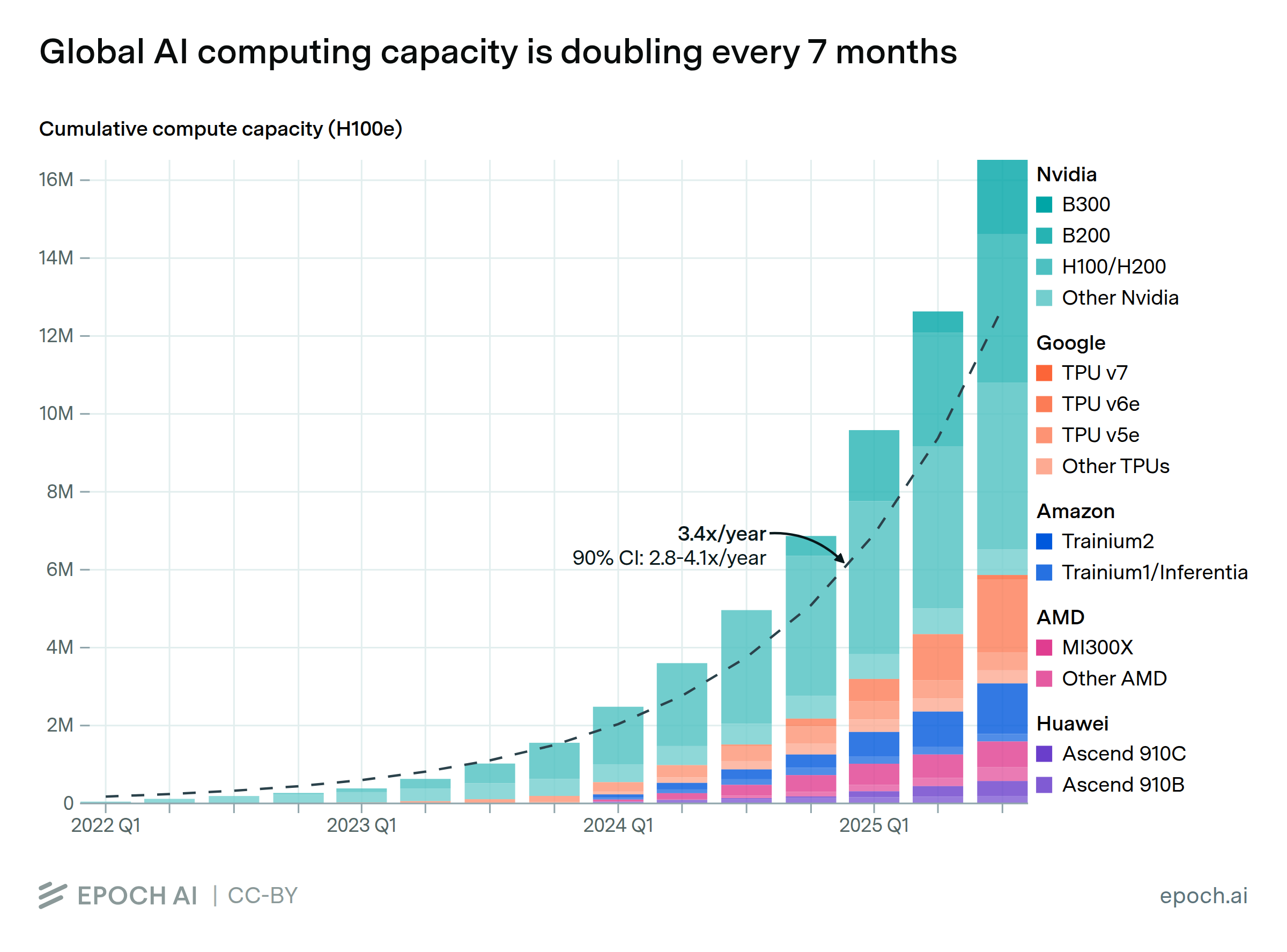
These estimates are inferred based on revenue data, other financial disclosures, and analyst reports. Data coverage varies by manufacturer: Nvidia and Google data begin in 2022 while others start in 2024.
Epoch's work is free to use, distribute, and reproduce provided the source and authors are credited under the Creative Commons BY license.
Learn more about this graph
We fit a trend to the quarterly quantities of AI compute sold, as measured in H100-equivalents. We find that computing capacity has been growing by 3.3x per year, equivalent to a doubling time of 7 months.
Data
Our data comes from the AI Chip Sales datahub. This data is primarily obtained via financial documents and chip information collected in the ML Hardware datahub. See the AI Chip Sales documentation for more details.
Analysis
We fit a simple log-linear regression model to estimate an exponential trend in the number of H100 equivalents sold quarterly. 90% confidence intervals are obtained analytically, using standard errors on our estimate of the slope coefficient.
We estimate that global computing capacity has been growing by 3.3x per year since 2022 (90% CI: 2.7x to 4.1x). This is equivalent to a doubling time of 7 months (90% CI: 6 to 8 months).
Limitations
While we have data for Nvidia as early as 2022Q1, and for Google beginning from 2022Q4, other chip manufacturer data only starts in 2024Q1. We do not attempt to correct for the missing data in our cumulative totals, since these other manufacturers account for less than 10% of total chip production as of 2024Q1, and we believe this quantity was smaller in earlier years. The effect on estimated growth rate is likely minimal.
Our data tracks chip sales, not deployments. Actual quantities of available compute may differ on the margin due to depreciation and lags between sales and deployment. We do not account for depreciation, but its effects are negligible since compute quantities are growing far faster than they depreciate.
Download this data
Explore this data

AI chip sales data.
Related insights