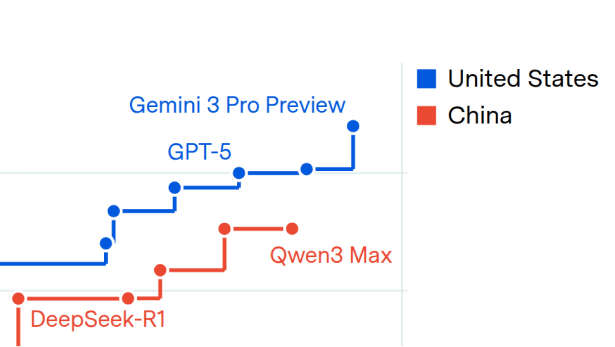
China is building many AI data center campuses with hundreds of megawatts of capacity, drawing on the country’s abundant energy resources. Huawei is one of the leaders in this effort, developing both AI chips and the data centers to run them. However, Huawei makes far fewer chips than Nvidia, and its best chips are less energy-efficient than Nvidia’s, which are export-controlled by the US. These constraints limit the computing power that Chinese data centers can deploy.
Huawei’s AI data center in Horinger, Inner Mongolia is an informative case study. Despite being one of the largest data centers in China by AI computing capacity, it has less than one-tenth the capacity of the world’s largest AI data center, Colossus 2 in Tennessee. This report examines the Horinger facility and Huawei’s broader AI infrastructure plans using satellite imagery and public sources, and explains how this data center falls short of the global frontier.
Huawei’s AI infrastructure ambition
Huawei’s recent deployments are a good starting point for understanding its plans for AI infrastructure. Throughout 2025, Huawei chose several data center sites across China to deploy its Ascend 910C, the most capable domestic AI chip to be produced in large volumes that year. We have identified four sites owned by Huawei itself, and four others owned by China Telecom, China Mobile, China Unicom, and the Shenzhen Longgang government.1 All of these locations appear to have at least one CloudMatrix384 “supernode,” which consists of 16 server racks with a total of 384 Ascend 910C chips.
| Site | Date that CloudMatrix384 deployment was reported | Scale |
|---|---|---|
| Huawei Wuhu | April 2025 | 5 of 6 operational buildings are estimated to house Ascend 910C |
| China Telecom Shaoguan | April 2025 | Unknown; at least one CloudMatrix384 supernode |
| Huawei Gui’an (High-end Park and Machang) | May 2025 | 3 of 7 operational buildings are estimated to house Ascend 910C |
| Huawei Ulanqab | May 2025 | 1 of 4 operational buildings are estimated to house Ascend 910C |
| Huawei Horinger (our focus here) | July 2025 | 3 of 5 operational buildings are estimated to house Ascend 910C |
| China Mobile Horinger | July 2025 | Unknown; at least one CloudMatrix384 supernode |
| China Unicom Hohhot | July 2025 | Unknown; at least one CloudMatrix384 supernode |
| Shenzhen Futian Hetao | December 2025 | Unknown; at least one CloudMatrix384 supernode |
The Ascend 910C is a powerful chip, but it falls short of the best US-designed chips from Nvidia in both performance and efficiency. Huawei has not definitively reported its performance specifications, but evidence points to a theoretical peak performance of 1.504 × 10¹⁵ operations per second (OP/s) in 8-bit integer format.2 That’s about 0.76 H100-equivalent (H100e) units, since the Nvidia H100 performs up to 1.979 × 10¹⁵ OP/s in 8-bit format. The H100e unit is based on the chip’s theoretical maximum operations per second in any 8-bit format, and thus doesn’t capture every aspect of performance for AI training and inference.3
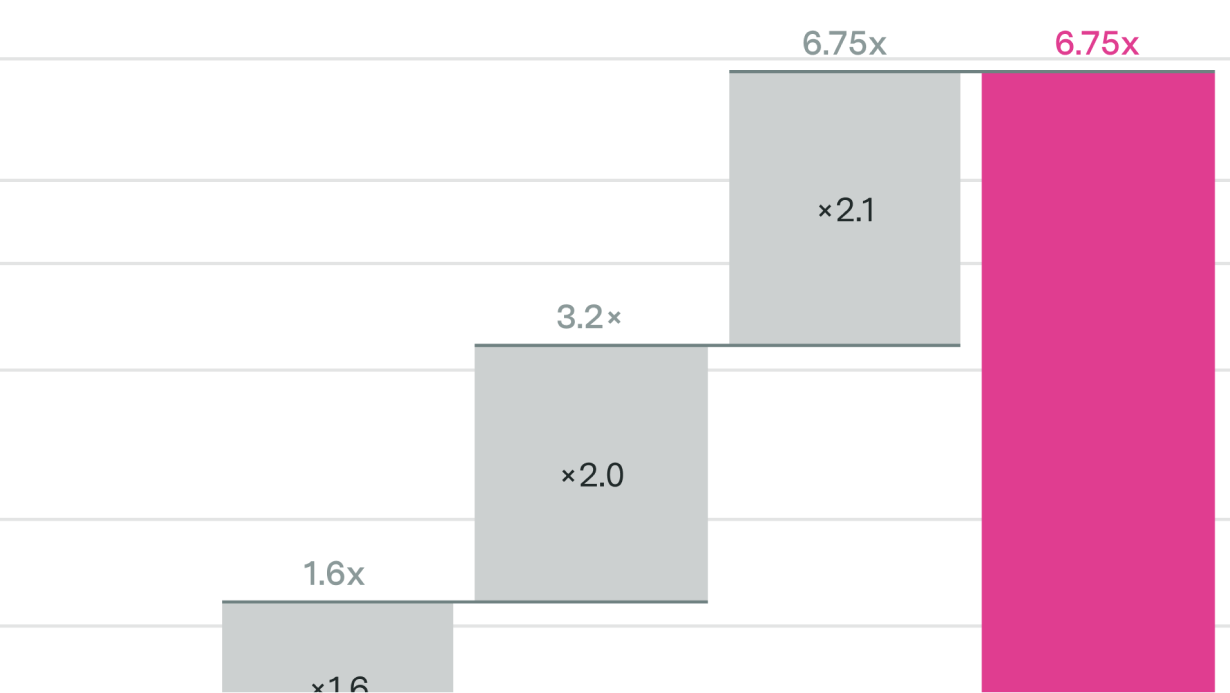
Nvidia’s B200 and B300 chips perform far better in 8-bit format than the Ascend 910C, at 5 × 10¹⁵ OP/s, or about 2.5 H100-equivalents. They are also about 2.5 times more energy-efficient. So although China has abundant energy for data centers, the efficiency gap creates a relative disadvantage for their home-grown AI infrastructure, as a given amount of power capacity can only support 40% of the compute of leading US facilities.4,5
Huawei is nevertheless capitalizing on China’s energy advantage to pursue an ambitious expansion of its AI infrastructure. We estimate that across all Huawei data centers, 12 buildings are likely to be running Ascend 910C chips today, with many more planned that could house next-generation chips. Early renderings of the Horinger campus show at least 27 data center buildings planned at that location alone, with one source reporting up to 50 buildings. Renderings of a similar Huawei campus in Wuhu show 45 buildings.
The Horinger campus: up to 286 megawatts of IT power capacity for AI
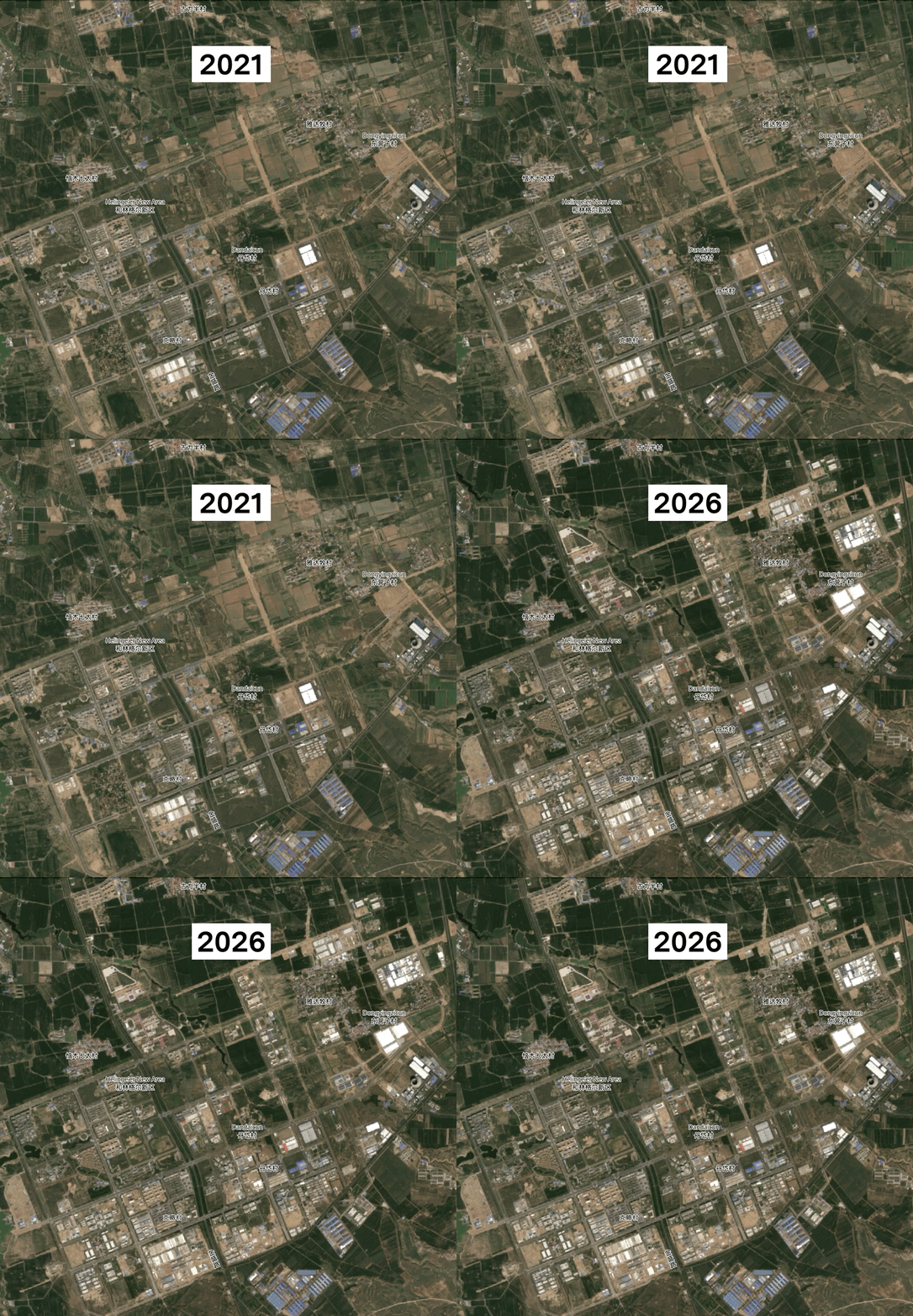
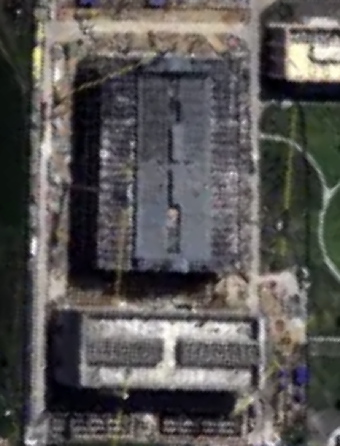
The Huawei Horinger campus is located within the Horinger New Area. Horinger County (Chinese: 和林格尔县) is in the Chinese autonomous region of Inner Mongolia, and the New Area is part of the “East Data West Computing” initiative launched in 2022. Satellite imagery shows that villages have been razed to make way for data centers there:
The Huawei campus is split into three parts near the perimeter of the New Area, a configuration dubbed “same-city three centers” (Chinese: 同城三中心). These serve as three availability zones for Huawei’s general cloud compute offering: West, South, and North. The campus is unusually specialized for AI, with “hypernode” servers that are primarily designed for large-model training and inference. Hypernode servers are only available in Huawei’s Southwest-Guiyang 1 (Gui-an), North China 3 (Horinger), and East China 2 (Wuhu) regions. It’s unclear how much of the campus is specialized for AI, but this suggests a large portion.
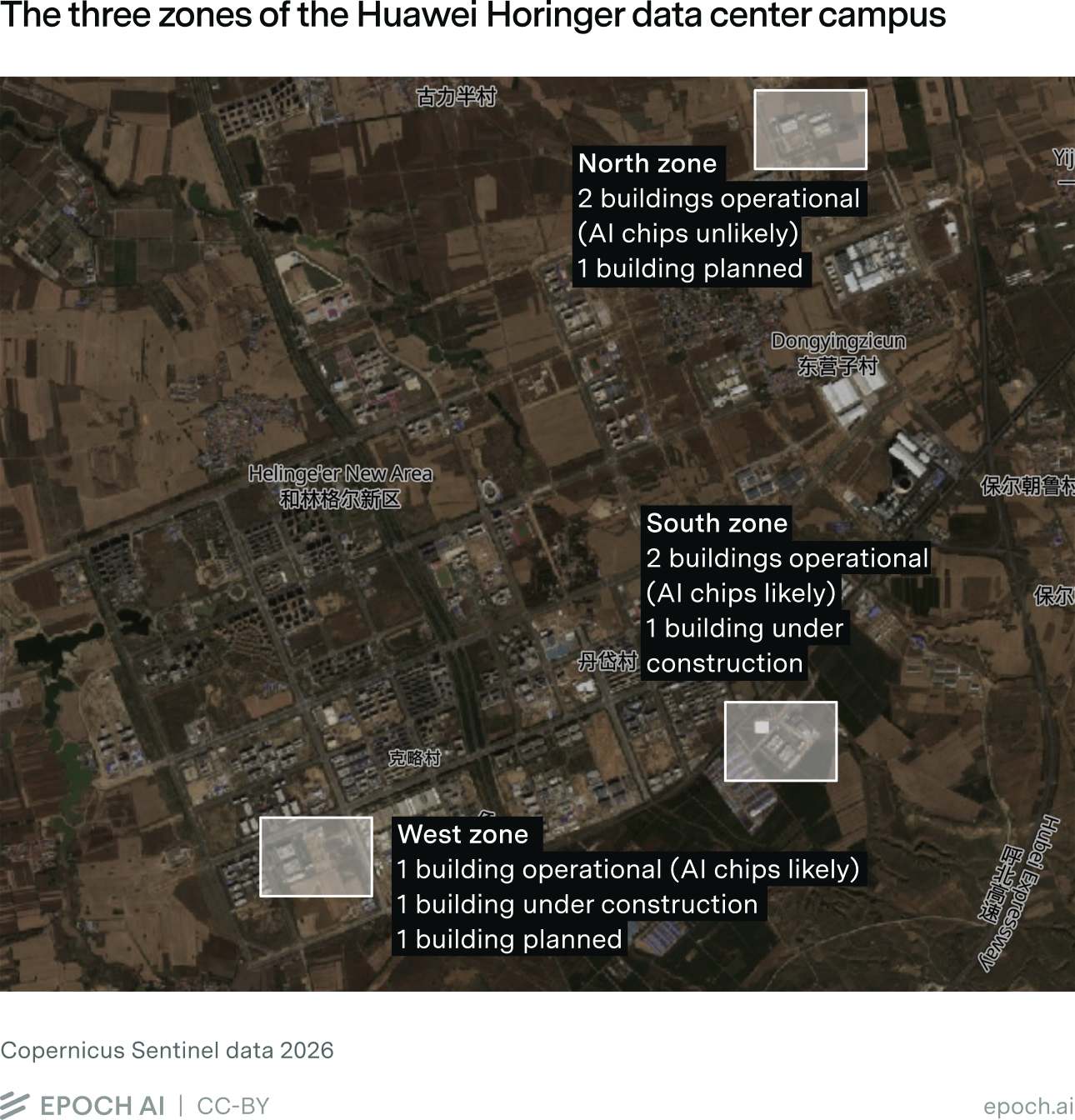
We acquired commercial high-resolution satellite images of these zones to help estimate the power capacity of the buildings. Our primary method is a cooling equipment model: based on the type, size, and number of cooling units visible, we estimate their heat rejection capacity and, in turn, the buildings’ IT power capacity.
The satellite imagery revealed that each zone contains nearly identical three-story buildings, which match the published renderings. However, the North zone has far fewer cooling towers than the West and South zones, suggesting that its buildings are unlikely to house powerful AI chips. Less cooling for the same-sized building suggests a lower power density, and modern AI servers tend to be more than 10 times as power-dense as the industry average.6
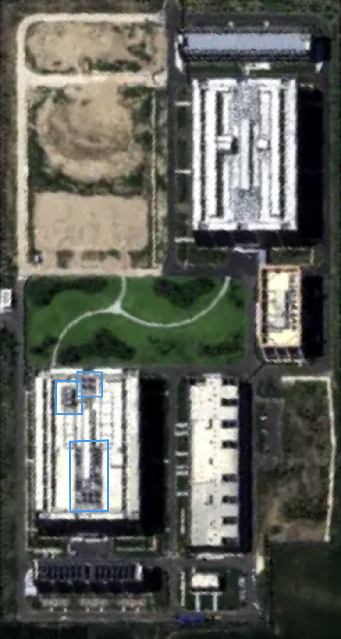
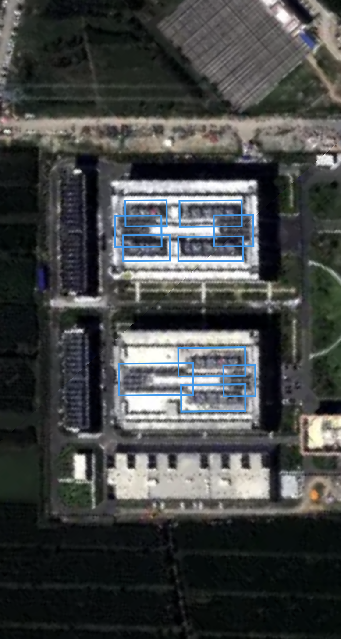
Excluding the low-density North zone, we were left with four apparently complete buildings with dense cooling infrastructure: two in the South and two in the West. Our cooling model estimates a total of 286 megawatts (MW) of IT power capacity across these four buildings. Estimates based on other sources are in a similar range: 304 MW from substation details and 230 MW from backup generator capacity.7
Even if the campus supports this power capacity, how can we tell whether the buildings are operational? This is hard to establish with certainty, but we’ve observed several clues. As a prerequisite, the buildings appear more or less complete from the outside, including cooling, backup generators, and carparks, with no signs of ongoing construction. Second, one satellite image shows what appears to be condensed water vapor above at least one evaporative cooling tower at one building, suggesting the building is operating. Third, multiple cooling tower fans have colored “ghosts” in another image, which indicates that the fans are moving.8 Further verification may be possible using thermal satellite imagery.
Only one of the four buildings, in the West zone, has yet to show any signs of operation. A public disclosure implies it was complete but not yet operational as of September 2026. We estimate it will become operational by December, while the other three are already up and running.
As we’ll discuss in the next section, it’s unlikely that 100% of the 286 MW power capacity is devoted to Ascend 910C chips, given the limited availability of AI chips in China. High power density alone does not guarantee that AI chips are present. Nevertheless, our best estimate is that most of the capacity is installed, and most of the installed chips are Ascend 910C.
AI compute: 7% of the global frontrunner
The physical scale of the Huawei Horinger campus is impressive, but its compute capacity is more important for assessing China’s AI capabilities. Calculating compute based on power is straightforward: divide the power capacity by the power per server, then multiply that by the performance per server. However, we need to account for how many racks are occupied, and how power capacity is allocated to different types of servers.
Filling an entire data center campus with one type of chip is not unheard of,9 but a mixture of chips is more common, especially for public clouds serving a variety of customers and applications.10 Furthermore, some portion of the Huawei Horinger campus may remain idle while the facilities await additional chips. The reported rack occupancy rate of the entire Horinger area was about 76% as of September 2026. In the absence of more specific information, we assumed Huawei Horinger has the same rack occupancy rate.11
It is possible but unlikely that Huawei Horinger uses export-controlled Nvidia chips. As the champion of China’s domestic AI chip industry, Huawei has a strong incentive to deploy its own chips rather than Nvidia’s. Horinger is also a public cloud deployment, making it more open to scrutiny than private deployments and increasing the risk that any use of export-controlled chips would be discovered.
Assuming no export-controlled chips are involved, we allocated the power capacity of the occupied racks based on Huawei chip sales over time, assuming a four-month lag from sale to deployment. This resulted in a mix of Ascend 910C and 910B chips in the first building (mostly 910C), and 100% 910C in the other three buildings.12 Given that one building is not operational yet, we find that about 105,000 Ascend 910C chips and 8,000 Ascend 910B chips are operational to date. That corresponds to 81,000 H100-equivalents (90% CI: 36,000 to 141,000). Full calculations are available in this spreadsheet.
We believe this estimate is plausible given what we know about total chip production and deployments at other data centers. According to the chip sales estimates, 907,000 Ascend 910C and 600,000 Ascend 910B chips had been sold by the end of March 2026. Satellite imagery indicates that the third AI building at Horinger was operational by August 2026. With a four-month lag between sale and deployment, our estimate suggests Huawei Horinger had used 11% of the total 910C stock by August.
We know of three other Huawei campuses reportedly deploying CloudMatrix384 systems (which contain Ascend 910C chips): Wuhu, Gui’an, and Ulanqab. There are also at least four reported non-Huawei campuses using the chips. The Huawei Gui’an campus had reportedly deployed over 110,000 Ascend chips as early as November 2024, likely 910Bs, which demonstrates that Huawei deploys large portions of its own chip supply to its data centers. Even if the Ascend 910C deployment is spread over many more unreported sites, it’s plausible that Horinger is one of the largest deployments.
At 81,000 H100-equivalents, Huawei Horinger is a large AI data center by today’s standards, and probably one of the largest in China. We have done a broad search of Chinese AI data centers across major hubs, and reviewed several top contenders in depth. Of those, only VNET Bayin Ulanqab and Huawei Wuhu are likely to match or slightly exceed Huawei Horinger.
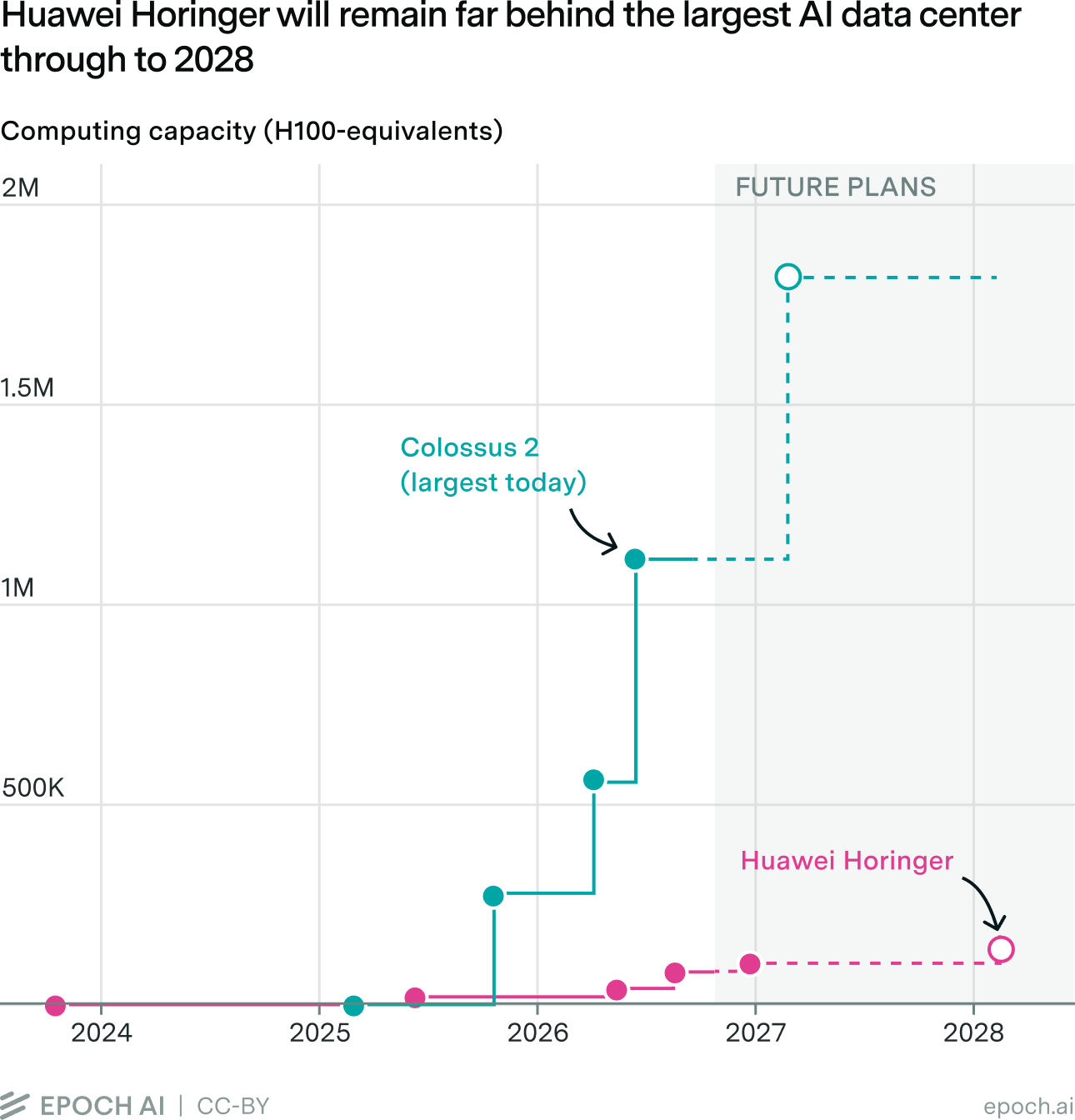
However, Huawei Horinger is much further from the largest AI data center in the world. That title goes to SpaceX’s Colossus 2 in Tennessee. Colossus 2 has about 14 times as much computing capacity as Huawei Horinger.
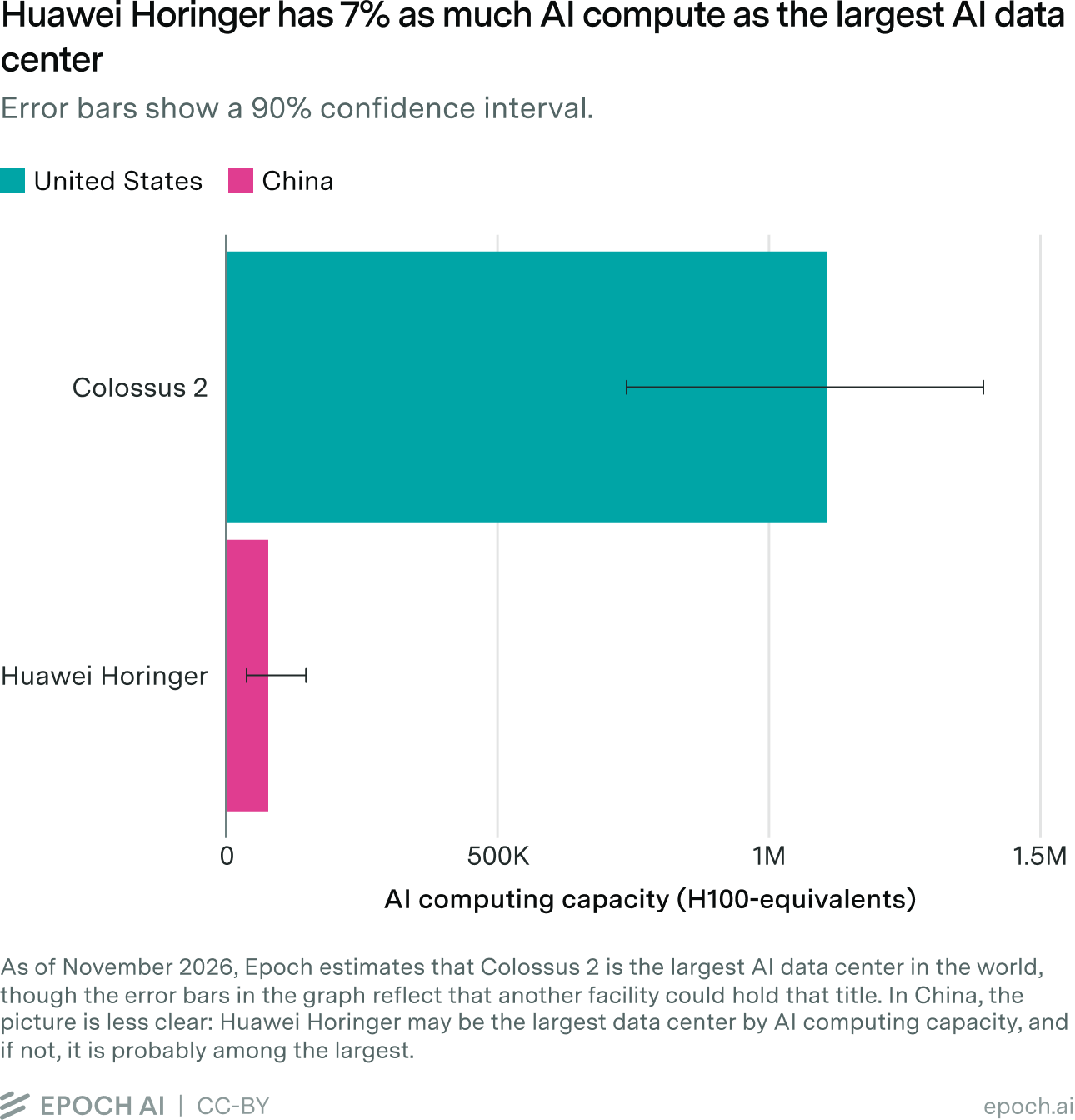
This comparison comes with some caveats. First, the AI compute in a data center campus is often separated into multiple densely-networked clusters, and the total capacity cannot necessarily be combined to train one AI model.13 However, large R&D experiments could be run even if the compute at Huawei Horinger is split into many clusters. Just 10% of Huawei Horinger’s estimated AI compute, at 8,100 H100e, is enough to train a DeepSeek-V4-Pro scale model in one month.14 In a very optimistic scenario, if all of Huawei Horinger’s current compute was combined for a single training run, a model the scale of GPT-6 Astra would take one year to train.15
Next phase: 70% more computing power by early 2028
The buildout at Huawei Horinger is far from complete. As discussed above, one of the four buildings has yet to become operational, and at least three new buildings are planned beyond the six already built, based on renderings and construction sites seen in satellite imagery.
One of these new buildings is already underway in the South zone, and based on the pace of construction, we expect it to be operational in February 2028.16 Assuming the new building is as AI-focused as the existing buildings, the campus could grow its total AI compute by over 70% by early 2028.
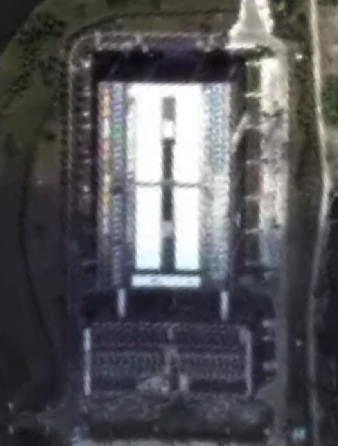
This compute growth will come from adding power capacity, not from improvements in chip efficiency. One public announcement said the new building will support 100,000 AI accelerator cards and deploy Huawei’s next-generation Ascend 950 chips. However, the Ascend 950 appears to be less energy-efficient than the Ascend 910C.17 Huawei plans to ship hundreds of thousands of Ascend 950 chips by the end of 2026, starting with the 950PR variant before ramping up production of the 950DT. Since we expect this building to become operational by early 2028, we assume it will have about 76,000 950DT chips (assuming 76% occupancy rate), requiring 135 MW of IT power.18
The electric grid appears capable of handling this expansion. Plans call for five transformers to be added to the existing three at each zone substation. Assuming N+1 redundancy, this means the power capacity of the whole campus could eventually increase by up to 3.5 times.
With over 70% more computing power by the start of 2028, Huawei Horinger would reach about 141,000 H100e (90% CI: 65,000 to 227,000). But this would still leave it at about the same share, or a smaller one, of Colossus 2’s capacity, which we expect to reach at least 1.8 million H100e by 2028.19 This does not necessarily mean the overall frontier of Chinese data centers will fall further behind. For instance, Huawei’s sister campus in Wuhu will grow slightly faster, reaching a projected 151,000 H100e by December 2027.
Huawei Horinger likely serves a diverse range of users
Although we believe the Huawei Horinger data center is primarily filled with AI chips, it likely has a diverse set of end users and applications. One local announcement describes the second building at the West zone as enhancing capabilities for data aggregation and fintech service hosting. Huawei itself is a major customer of Huawei Cloud,20 and allocated about 60,000 H100e to driver-assistant software as of April 2026.21
Huawei Horinger likely also supports the training or deployment of large language models. One possible customer is Zhipu (Z.AI), which reportedly served its GLM-5.3-Flash model on 100,000 Chinese chips in August 2026. Huawei is a leading domestic AI chipmaker, making its chips a likely choice for Zhipu. However, we don’t know where these chips were hosted. Another potential customer is iFLYTEK, which has reportedly set up operations in the Horinger New Area.
What this means for Chinese AI
China appears to have no shortage of energy for data centers. Many AI-optimized facilities are being built with hundreds of megawatts of capacity and filled with domestically-produced chips. However, AI data centers in the US support 2.5 times more AI compute per unit of power, and the largest among them have already reached 1,000 MW. The Huawei Horinger data center is a key example of this gap, with just 7% of the computing capacity of Colossus 2 in Tennessee. This makes it even more impressive that China has produced such capable AI models in the past two years. But China’s compute constraints are unlikely to ease in the next two years, which suggests that their AI capabilities and deployment capacity will continue to lag behind those of the US.
Note: some sources are withheld from this article to protect their availability. Those sources are available to researchers on request at info@epoch.ai.
-
Most of these sites are not yet listed on the AI Data Centers explorer, as we are still researching them.

-
Version 1 of the CloudMatrix-Infer paper reports a 752 TOP/s theoretical INT8 peak for one Ascend 910C die, corroborated by a measured kernel performance of 597–622 TOP/s. Since the package contains two dies, this implies 1,504 TOP/s (1.504 × 10¹⁵ OP/s) per chip. Although the paper elsewhere states 1,054 TOP/s, this appears more likely to be a typo because it conflicts with the per-die results and the expected 2:1 ratio between INT8 and BF16 performance. The removal of all compute specifications in later versions of the paper seems to be a disclosure redaction rather than a correction. The 16-bit performance of the Ascend 910C is better documented, though it varies between 700–800 TFLOP/s due to subvariants of the chip. Compared to the 990 16-bit TFLOP/s of the H100, this also implies about 0.76 H100-equivalents.
-
Unlike the Nvidia H100, the Ascend 910C does not natively support 8-bit floating point (FP8) format, which is useful for AI training. So even taken in terms of FLOP/s, 0.76 H100-equivalents arguably oversells the performance of the 910C.
-
Another factor is power usage effectiveness, but US data centers averaged a PUE 1.49 to China’s 1.40 in 2025, which still puts China at 43% of the best energy efficiency.
-
Of course, this is also why diversion and resale of Nvidia’s leading chips to China is so prevalent.
-
The Uptime Institute Global Data Center Survey 2026 said that data centers have centered on 4-5 kW average rack design density for more than a decade prior, whereas an Nvidia GB200 NVL72 rack is around 132 kW.
-
Substations were initially planned with three 100 megavolt-amp transformers per zone. Assuming N+1 redundancy per zone, 95% power factor, and a peak IT power overhead of 1.25 (based on a typical average power usage effectiveness of 1.15 in Inner Mongolia), we get (3 -1) * 100 MVA * 0.95 / 1.25 ~= 152 MW per zone, or 304 MW across two zones. For backup generators, similar buildings at the Huawei Wuhu campus have between 30 and 33 non-standby backup generators, 1.8 MW each: so 32 * 1.8 MW * 4 buildings ~= 230 MW.
-
The principle is that fans sometimes reflect glare into the satellite image sensor, and the sensor captures red, green, and blue wavelengths at slightly different points in time. When a fan is moving, the glare can occur precisely when only one of these wavelengths is captured, making the glare appear in one bright color.
-
To our knowledge, Colossus 2 consists entirely of Nvidia Blackwell servers, though there is a mix of the GB200 and its slightly-improved successor, GB300. Based on reporting, the main two buildings at Microsoft Fairwater Atlanta are likely almost entirely B200 servers, while Anthropic-Amazon New Carlisle is almost entirely Trainium2 servers.
-
The Alibaba ASI cluster contains many different chip types, which we believe are most likely in one geographic location for efficiency reasons. The types of chips named in Figure 4 of the paper range from a 2.8% share (Nvidia A100) to a 29% share (codename XPU-E). The Nvidia H20 makes up 16.9% of the cluster. Meanwhile, the AWS Ohio region offers over 150 types of instances. These include instances with Nvidia B200 or Trainium2, but also many CPU instances suited to non-AI workloads.
-
In contrast, AI data centers in the US reportedly have rack occupancy rates close to 100%.
-
We considered that the Nvidia H20 might be available, but the only mention of an H20 instance in Huawei’s documentation states that instance is limited to the Ulanqab and Wuhu regions. Other Nvidia chips that were legally available in China, like the A800 and H800, seem too old relative to the construction of this campus. We also considered non-Huawei domestic AI chips, but those are either developed by Huawei’s competitors and therefore less likely (e.g. Alibaba’s T-Head), or not produced in large volume (e.g. Siyuan 590).
-
For example, SpaceX described Colossus 2 in its S-1 filing as having an “initial cluster” and “second cluster” (p.76). Another example is Microsoft Project Osmium, which we believe houses the 25,000 Nvidia A100 cluster that trained the model underlying the first version of ChatGPT, as part of a larger data center campus.
-
Calculation: 8,100 H100s * 20% model FLOPs utilization rate * 1.979e15 FLOP per second * 30 days * 24 hours/day * 60 minutes/hour * 60 seconds/minute ~= 8.3e24 FLOP. DeepSeek-V4-Pro used an estimated 9.7e24 FLOP.
-
GPT-6 Astra training compute is uncertain, but we use Epoch AI’s median estimate of 1e27 FLOP for illustration. Calculation: 1e27 FLOP / (81,000 H100s * 20% model FLOPs utilization rate * 1.979e15 FLOP per second * 24 hours/day * 60 minutes/hour * 60 seconds/minute) ~= 361 days.
-
The first three high-density buildings took around two years to complete after land clearing started, and construction on the new building appeared to begin in March 2026.
-
The most efficient form factor for the Ascend 950DT, the Atlas 950 SuperPoD, reportedly delivers 58.8 PFLOP/s at FP8 precision, with a power usage of 114 kW (adding 1.14x estimated overhead to 100 kW server power): an energy efficiency of 516 GFLOP/J. The Ascend 910C has 1.504 PFLOP/s in INT8 format and uses 1.56 kW of IT power per chip: an efficiency of 964 GFLOP/J. The same gap applies in FP16 format. However, note that the Ascend 950 has native FP4 and FP8 support, which benefits AI training, while the 910C does not.
-
76,000 chips / 64 chips per server * 114 kW per server ~= 135 MW. At a sister data center in Wuhu, a similar new building is approaching completion, and the quantity of cooling and backup generator equipment there appears to be more than enough to support this power capacity.
-
This is the last projection we’ve made for Colossus 2, up to February 2027, for three buildings. There is almost certainly more capacity planned by 2028, because satellite imagery shows two more buildings under construction.
-
A report from Huawei lists RMB 32,161 million of external cloud revenue, and RMB 72,075 million of cloud revenue including internal sales. That implies about 55% of cloud revenue is internal sales.
-
One source says that the computing power of Huawei Qiankun, Huawei’s smart car solutions brand, had grown to 60 EFLOPS. The FLOPS for “intelligent computing” in China is conventionally in FP16 format. So 60 EFLOPS means {60e18 FP16 FLOP/s} ÷ {990e12 FP16 FLOP/s per H100e} ~= 60,000 H100e.
About the authors
Related work