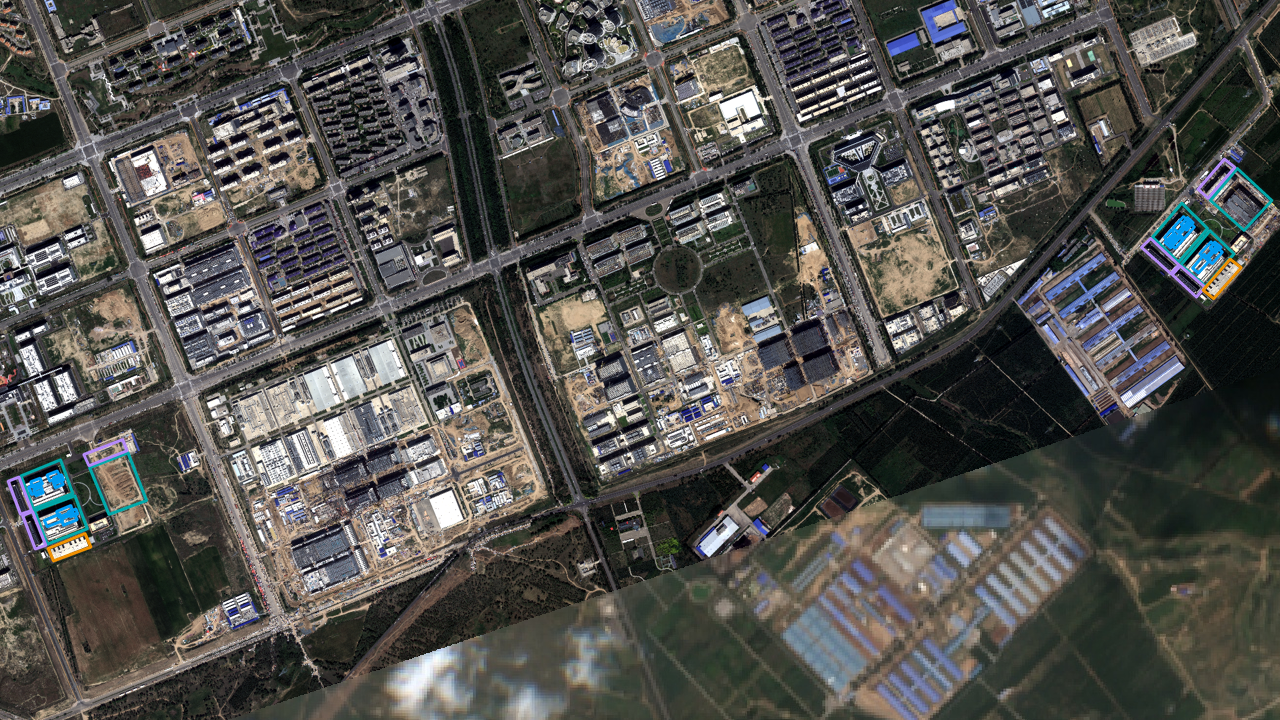
Hohhot, Inner Mongolia, China
Huawei Horinger is an operational AI data center with AI chips owned by Huawei. It hosts an estimated 81k H100-equivalents of AI compute, supported by 170 MW of IT power at a capital cost of $6.4 B. In Q1 2028, we project it to rise to 141k H100e AI compute, 351 MW IT power and a cost of $13.3 B. We estimate that it uses Huawei Ascend 910C and Huawei Ascend 910B chips.
The timeline of IT power and AI compute capacity is based on satellite imagery, our cooling equipment power model, company disclosures, chip availability, and chip efficiency.
One report suggests the Horinger campus could eventually grow to as many as 50 buildings under an unconfirmed Phase 2.

Satellite imagery
CURRENT COMPUTE
81kH100e
1.60e208-bit OP/s
PROJECTED
141kH100e
2.79e208-bit OP/s
CURRENT IT POWER
170MW
PROJECTED IT POWER
351MW
CURRENT COST
$6.4B
PROJECTED COST
$13.3B
Full breakdown
| Model | Manufacturer | Type | Units | Capacity (MW) | Units (Q4 '26) | Capacity (MW, Q4 '26) |
|---|---|---|---|---|---|---|
| Unknown evaporative cooling tower | Unknown | Evaporative cooling tower | 30 | 115.2 | 18 | 63.2 |
| Unknown air-cooled chiller | Unknown | Air-cooled chiller | 99 | 47.3 | 124 | 59.3 |
| Total | 129 | 162.6 | 142 | 122.4 |
Land clearing begins simultaneously for all three zones (West, North, and South) after an official ceremony. The West and South zones later have the cooling capacity indicative of AI workloads, while the North Zone does not.
In the West Zone, Building 1 is structurally complete. In the South Zone, Building 4 is structurally complete except for several cooling towers to be installed later. Buildings 2 (West Zone) and 5 (South Zone) have shells under construction.
In the South Zone, paving and landscaping around Building 4 is mostly complete, while Building 5 still needs cooling and backup generators to be installed.
In the West Zone, Building 1 is operational, based on its structural completion and colored motion artifacts on some of the cooling tower fans.
Building 1 appears to have condensed water vapor above some cooling towers, suggesting they are still operating. Cooling towers have been added to Building 4, but we do not see any condensed water vapor, and there is still a crane over the building. So we don't think Building 4 is operational at full capacity yet.
Building 4 is operational, based on its structural completion, the colored motion artifacts on some of the cooling tower fans, and cars parked out front (between the main building and the backup generator enclosure). Building 5 is almost structurally complete, but there is still some work to do in front of the backup generator enclosure.
In the West Zone, Building 2 is structurally complete but still has some construction equipment around it.
In the South Zone, Building 5 is operational, based on its structural completion, and the colored motion artifacts on the some of the cooling tower fans. Building 6 (South Zone) is under construction. In the West Zone, Building 3 has not begun construction.
In the West Zone, Building 2 is operational (estimate). A local government announcement said a "completion acceptance filing" was completed for Building 2 around September 23, 2026, "marking a critical step toward the project's entry into operation". We assume this corresponds to structural completion, since there was minimal construction activity by August 18th. We then allow 3 more months for a full fit-out of AI servers.
Building 6 (South Zone) is operational (estimate). This was the only new building under construction as of August 2026. We estimate the operational date based on an average of (1) previous buildings taking about 2 years on average from starting the building shell to becoming operational at ~full capacity, (2) a similar building at the Huawei Wuhu campus taking an estimated 550 days to become fully operational. Building 6 can reportedly support 100,000 AI accelerator cards and will deploy Huawei Ascend 950 chips. Based on the timing, we assume it has capacity for 100,000 Ascend 950DT chips (Ascend 950DT is ramping a few months later than 950PR). As with the other buildings, we multiply this capacity by the reported rack occupancy rate for the Horinger New Area (about 76%).
View our calculations for this data center, or read more about our methodology.