Executive summary
The AI boom has driven US investment in computing equipment to roughly $400 billion per year, nearly triple its 2023 level. Yet the measured impact on GDP growth has remained modest. The conventional explanation is that much of this investment is spent on imported technology goods, which are subtracted from GDP. In this report, we show that this explanation is incomplete: GDP statistics have a blind spot around the value American firms, most notably Nvidia, create by designing AI chips that are manufactured and sold abroad. This has led to a substantial underestimation of AI’s contribution to US GDP.
We detail:
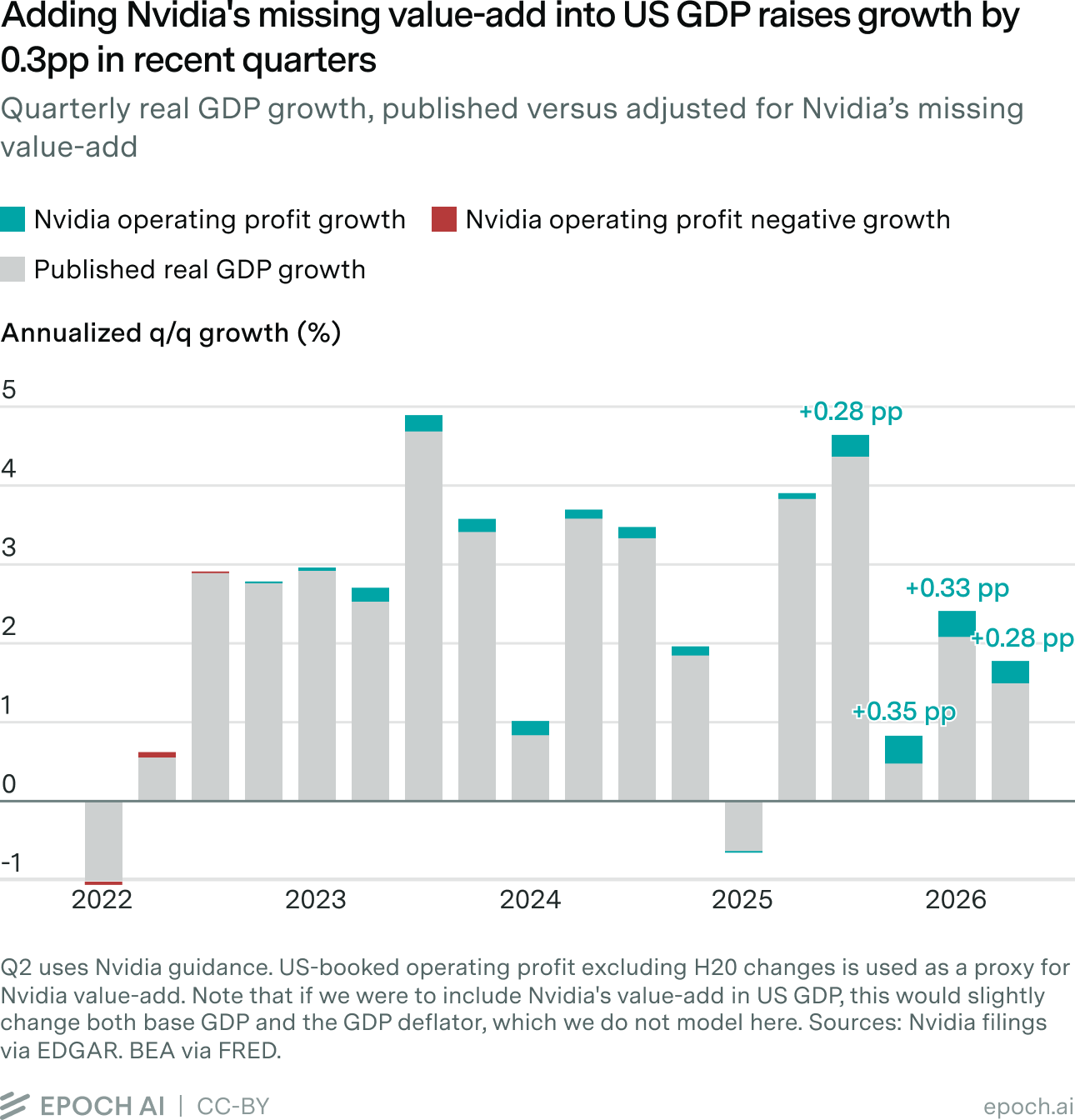
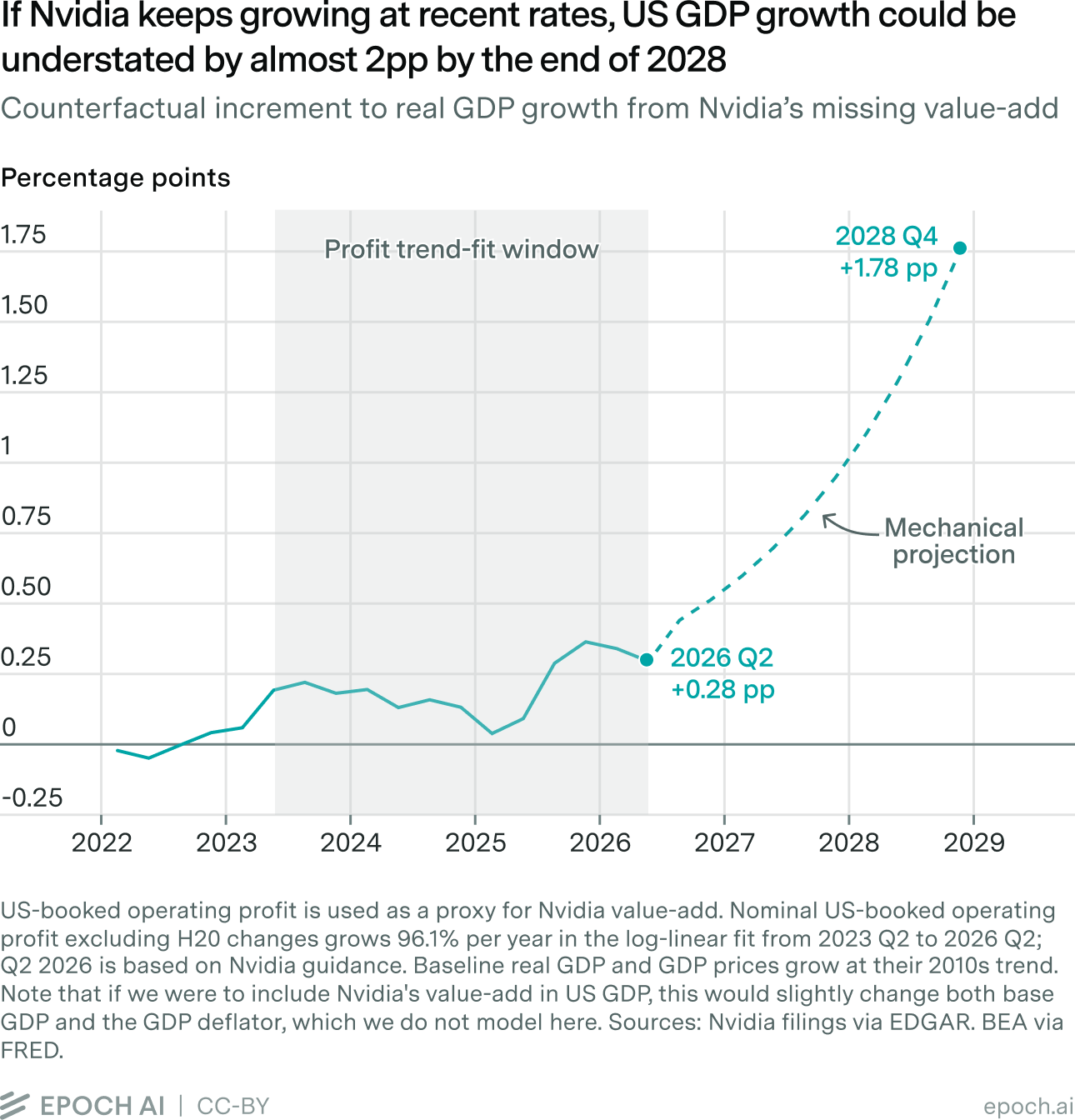
- The size of the underestimation: US GDP growth over the last year has been underestimated by about 0.3 percentage points. If Nvidia’s growth continues at its current pace, this gap could widen to almost two percentage points of growth per year by 2028.
- The cause of the underestimation: GDP statistics miss most of the value created by fabless chipmakers like Nvidia, whose products are designed in the US but manufactured, assembled, and sold abroad. Because no physical goods leave the US, no goods export is recorded, and because no foreign buyer pays explicitly for the IP, no IP export is recorded either.
- How we know the value is missing: We reviewed every category where Nvidia’s value-add could plausibly be recorded, including goods exports, IP exports, service exports, and merchanting, and it appears in none of them. We confirmed this analysis with the Bureau of Economic Analysis.
- Why this matters now: This blind spot is not new, and it applies to other factoryless manufacturers besides Nvidia. Historically, the value that slipped through was small. Nvidia’s rapid growth has changed that.
- How to correct the underestimation: International guidelines updated in 2025 already call for recording factoryless manufacturers’ overseas sales as goods exports. We also outline an alternative: recording their markups as IP exports. This would depart from international standards, but it would sidestep political resistance to counting overseas production as US manufacturing. Either change could take years to implement. Until then, GDP growth will remain understated.
Introduction
The standard official estimate of US GDP does not capture most of Nvidia’s value-add to the US economy. As a result, it misplaces tens of billions of dollars. If we use Nvidia’s US-booked operating income as a proxy for the missing value-add, annualized US GDP growth estimates for recent quarters have been consistently underestimated by about 0.3 percentage points. For context, last quarter’s US GDP growth rate was estimated at 1.5%, so this is a significant gap.
If this measurement issue continues unaddressed, the effects could grow even larger. Extrapolating the exponential growth rate of Nvidia’s operating income, consistent with the broader exponential growth of the AI industry, suggests that GDP growth — not the level of GDP, but even the growth rate — could be underestimated by almost two percentage points by the end of 2028.1
In this report, we explain why Nvidia’s outsourcing of chip manufacturing causes GDP statistics to miss most of Nvidia’s value-add. We then discuss how the measurement issue produced by Nvidia’s value chain compares to those produced by other firms’ international value chains and other measures of national output. Finally, we review the various National Income and Product Accounts (NIPA) entries in which one could plausibly expect to see Nvidia’s value-add recorded, confirming that it is not recorded in any of them, and discuss where it might naturally be recorded if the national accounts are corrected in the future.
How US GDP misses most of Nvidia’s value-add
We can start by reviewing how GDP is usually defined in the US. Economic value created in the US can be decomposed as follows:2

When a data center running Nvidia chips is built on US soil, the cost of building it is correctly recorded as domestic spending. However, Nvidia’s value-add is currently left out of GDP because finished chip servers enter the US at a price that includes Nvidia’s value-add, and as a result, this value is subtracted from GDP as an import. This subtraction would be appropriate if the value added by Nvidia’s IP, while the server was being constructed abroad, were also recorded as a US export. But this never happens, so Nvidia’s contribution to GDP goes missing.3
There are roughly three steps to getting Nvidia chips into American data centers:
- Nvidia sends chip designs to foreign contractors like TSMC, who manufacture and package chips for them.
- Nvidia sells these chips to foreign chip server makers, called Original Equipment Manufacturers (OEMs) or Original Design Manufacturers (ODMs).
- These foreign server makers sell chip servers to American data center owners, such as Microsoft.
Hypothetically, suppose Nvidia pays foreign contractors $10,000 to manufacture each chip, foreign server makers pay Nvidia $40,000 per completed chip, and US data center owners pay foreign server makers $50,000 per chip (now assembled within servers). This is illustrated in the diagram below:
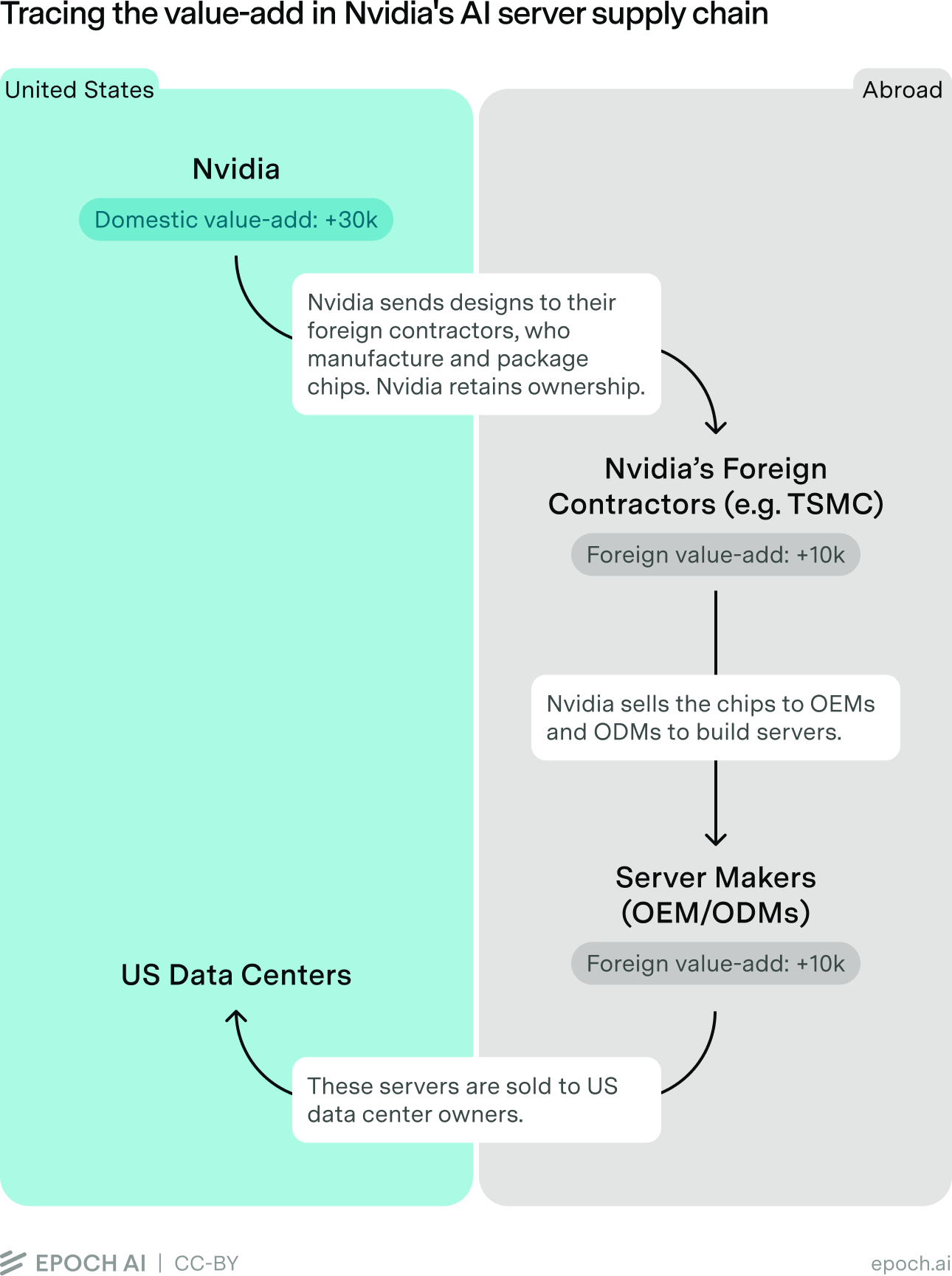
In this world, Nvidia adds $30,000 in value per chip by designing chips, and the total foreign value-add is $20,000. Nvidia’s foreign contractors add $10,000 in value, and foreign server makers add another $10,000. So in theory, we should see $30,000 in exports and $50,000 in imports.4 But that is not what we see in practice:
| What we should see | What we actually see | |
|---|---|---|
| Domestic spending (by US data center owners) | +$50k | +$50k |
| Exports (Nvidia’s value-add) | +$30k | $0 |
| Imports (Nvidia + foreign value-add) | −$50k | −$50k |
| Total domestic value-add | +$30k | $0 |
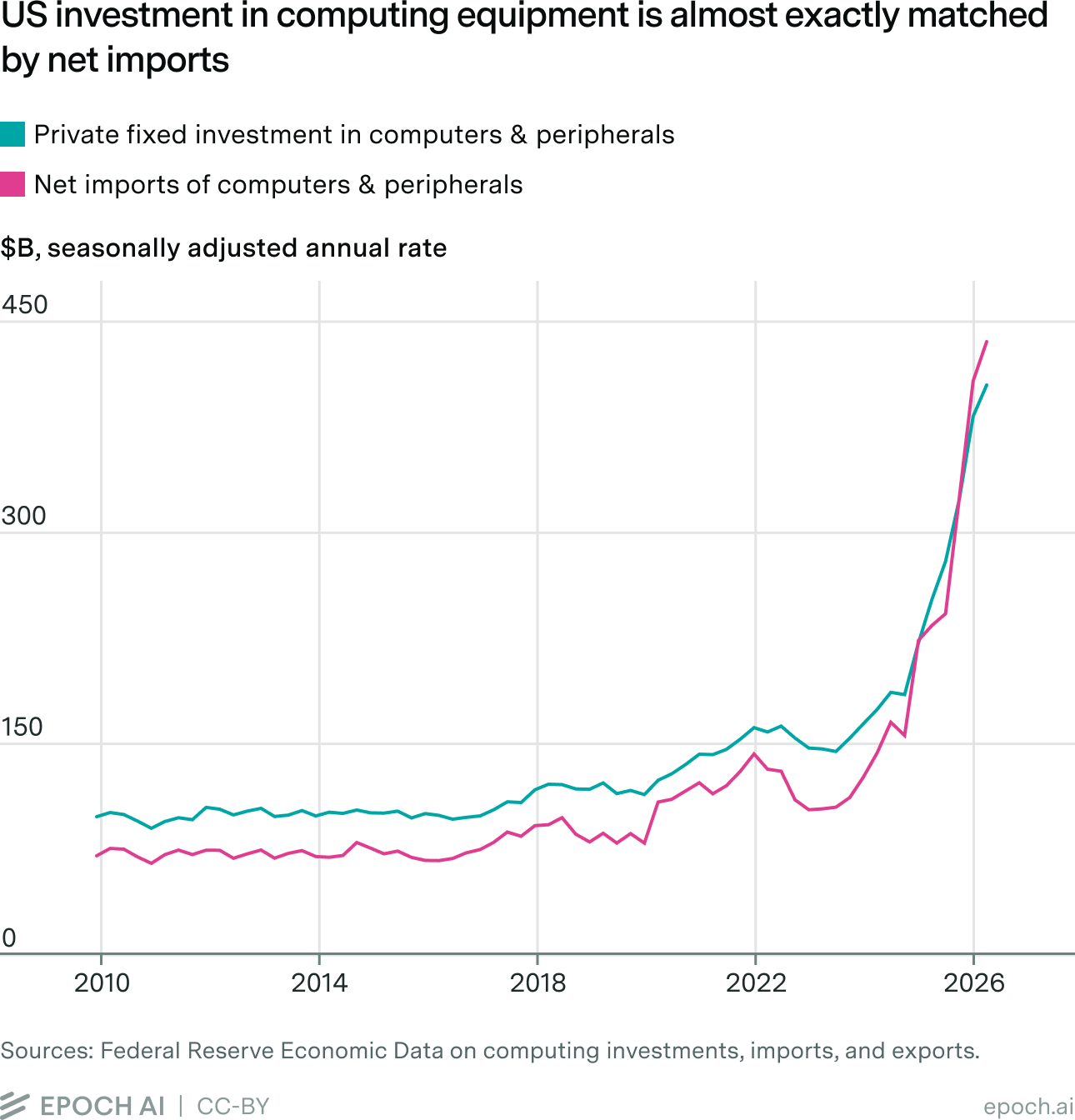
As a result, while we have seen soaring US private investment in computing equipment, net imports of computing equipment (imports minus exports) have increased nearly in lockstep. Since the accounting subtracts one from the other, the computer chip manufacturing boom registers as adding roughly zero value to the US economy. In fact, this almost exact cancellation is what drew our attention to this GDP mismeasurement issue in the first place.
In short, Nvidia’s value-add to imports is counted, but its value-add to exports is not.5
We asked the Bureau of Economic Analysis (BEA) to confirm this analysis. In their words (emphasis added):
Recognizing transactions in goods on a change-in-economic-ownership basis is more challenging than recognizing transactions on a cross-border basis. For example, information on purchases of material inputs by the contractor from foreign entities and information on sales of transformed goods to foreign purchasers sent from the country of the contractor to a third country is not collected on US customs documentation, as the goods do not cross the US border, or available from other sources.
The discrepancy with international guidelines
As the BEA documented in 2014, to accord with the then-recent update to the International Monetary Fund’s Balance of Payments and International Investment Position Manual (BPM-6), products made abroad by US factoryless producers and then sold abroad should be included in US goods exports. In particular, if Nvidia pays TSMC $20,000 to manufacture a chip in Taiwan and sells it for $50,000 to an ODM in Mexico, this should be classified as
- a $20,000 export from Taiwan to the US followed by
- a $50,000 export from the US to Mexico,
adding $30,000 to US net exports. In other words, we should do our export accounting as if, before being sold to the ODM in Mexico, the chip had been delivered to Nvidia’s US premises.
Nevertheless, the BEA made “no plans to introduce changes to core US economic accounts” due to data collection difficulties and following objections to the Office of Management and Budget that, by expanding the reported value of US exports to include goods manufactured overseas, the change would interfere with efforts to promote manufacturing work on US soil. As of June 2026, the BEA’s “International Economic Accounts: Concepts and Methods” manual does not classify as an export the exchange “when goods that are owned by US residents but have been processed overseas are sold to a foreign buyer” (p. 76).
How other analyses have missed this issue
We are far from the first to observe
- that AI-related investments are large in comparison to GDP growth, and
- that these capital expenditures have nevertheless largely failed to raise GDP growth on net, because so much of the capital has been imported.
This report from J.P. Morgan last year, for instance, finds that “AI-driven capital spending – especially in software and computing – has become a major growth engine, fueling an impressive 1 percentage point (ppt) boost to GDP growth in the second quarter of 2025 alone”, but that “[m]uch investment goes toward imported technology goods, which subtracts from GDP, and efforts to reshore manufacturing capacity will involve a long transition process.” Likewise, this report from EY documents large investment figures but finds that “after accounting for trade in… computer equipment, GenAI’s net contribution to GDP [has been] modest”.
What seems to have gone unnoticed is the accounting failure outlined above: that much of the surge in computer equipment imports has really been a surge in exported and re-imported American value-add, primarily from Nvidia.
The scope of the problem
How much does this issue apply to other companies?
Many other American tech companies outsource their manufacturing to foreign firms, but usually, the American firm’s value-add is mostly counted in US GDP.
For example, when Apple pays Foxconn to manufacture an iPhone abroad and then sells it in the US, the value Apple added in Cupertino by designing the phone is reasonably well captured. This is because the phone is sold at a markup after entering the US, and only what Apple paid Foxconn for it is counted as an import. When Apple sells its iPhone in a foreign country, it usually sells to a foreign Apple affiliate, which returns the markup to Apple US in what is recorded as an “IP export”.
The measurement gap only arises under specific conditions: when a US factoryless manufacturer (1) has its product manufactured abroad, (2) sells it abroad, (3) after transforming it, and (4) without being compensated explicitly for its IP. These circumstances do apply to fabless chipmakers beyond Nvidia, but Nvidia accounts for such an outsized share of the chip design market, and has been growing at such an outsized rate, that the GDP measurement gap would barely change if we expanded our analysis to include the top five US fabless chipmakers.
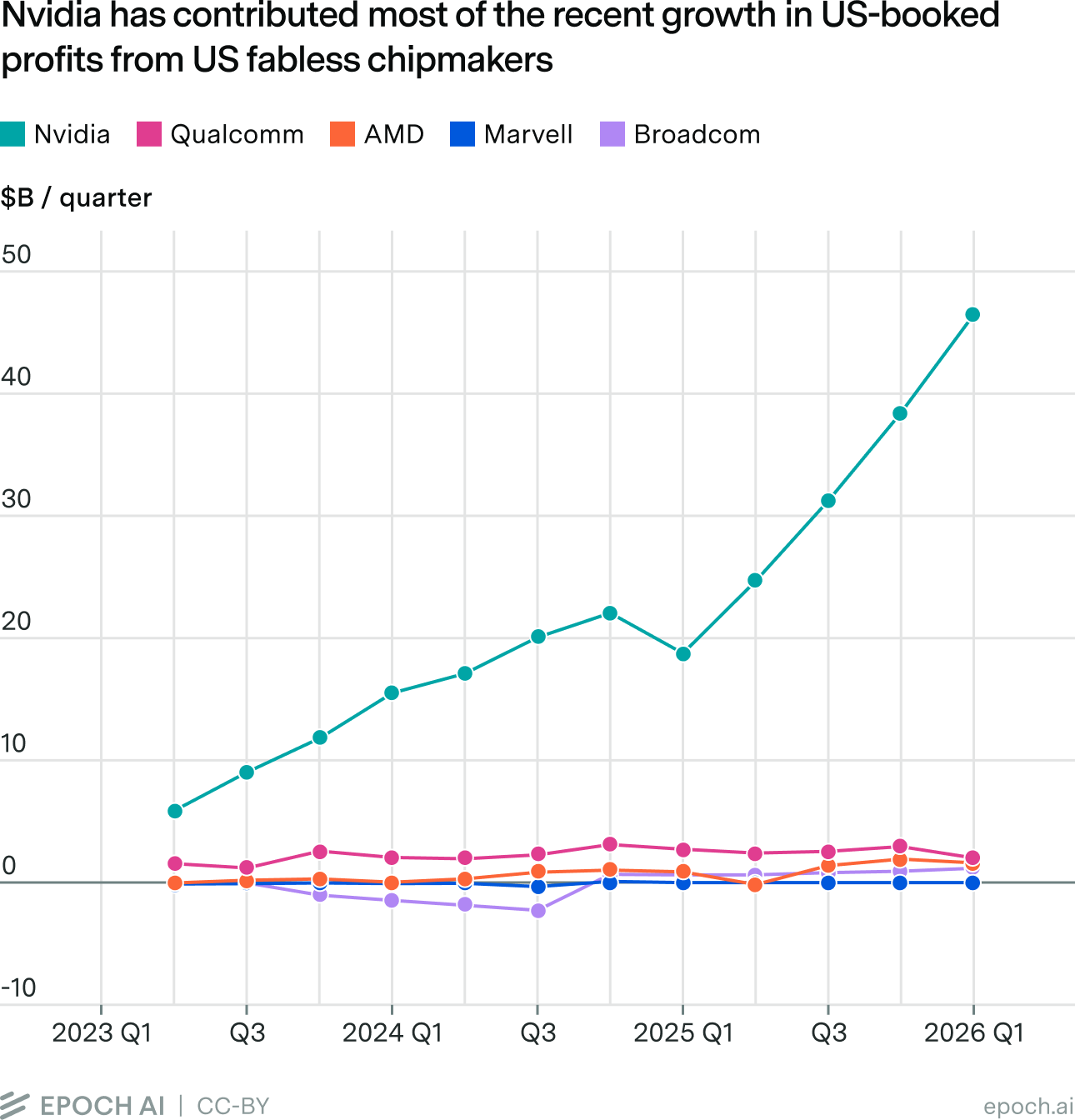
While these circumstances can arise in industries other than fabless chip manufacturing, the issue currently appears to be highly concentrated in this industry. The BEA divides the US economy into 414 detail-level industry categories, and determining whether any of them harbor mismeasurement for reasons similar to those that apply to fabless chipmakers is beyond the scope of this report. However, as a preliminary check, we used a ChatGPT 5.6 Sol agent to analyze each category. Its estimates, which we spot-checked, attributed a $140 billion gap to semiconductor and related device manufacturing versus roughly $4 billion across all other industries combined.
The $140 billion is consistent with our estimates, graphed above, which attribute a measurement gap to Nvidia throughout 2025 averaging ~$30 billion per quarter, and much smaller gaps to other firms in the semiconductor industry. The surprisingly small $4 billion gap attributed to the broader economy should not be taken as a reliable quantitative estimate, but it offers some evidence that the precise pattern of overseas factoryless manufacturing we discuss here does not currently generate large GDP measurement issues outside the semiconductor industry.
GDP versus GDI
Another way to calculate GDP is to look at incomes instead of expenses. In theory, this should always produce the same number: technicalities aside, expenditures (by people in the US and abroad) on goods produced in the US equal the total received in wages, profits, and taxes for production done in the US. In the US national accounts, this sum of incomes is called “gross domestic income”, or GDI. This type of measure of domestic production is also sometimes called an “income-side measure of GDP”, as distinguished from the “expenditure-side measure of GDP” outlined above.
Notably, the value that a fabless chipmaker like Nvidia creates by designing chips in the US does appear in US GDI. For example, income is recorded when the chipmaker pays its employees for work done in the US, its investors for profits earned in the US on US IP, and the US federal and local governments.
But GDI is arguably mismeasured in even bigger ways — for instance, by Americans underreporting their income to the IRS.6 In fact, despite including some sources of US production that GDP leaves out (such as Nvidia’s value-add), GDI in recent years has been lower than GDP: 0.9% lower in Q1 2026.7 As a result, GDP is by far the more widely used and publicized series.
This helps to put the Nvidia measurement gap in scope. Persistently underestimating GDP itself by 0.3% would be a large measurement issue — we expect it would be today’s largest measurement issue attributable to a single firm — but well within the range of the measurement issues our national accounts already contend with. When a measurement issue persists over time, without shrinking or growing, measured GDP and GDI may depart from the true level of output even while GDP and GDI growth closely track output growth. Because the importance of the “Nvidia gap” has arisen so quickly with the boom in AI infrastructure investment, however, published estimates of GDP growth over the past year have been ~0.3 percentage points too low. And GDP growth estimates will stay biased downward as long as Nvidia’s share of US output — or the share of fabless chipmakers in general — continues to rise.
Validating that the value-add is missing from the economic statistics
To examine in more detail how such a large sum has been left out of the economic statistics, we reviewed the NIPA categories — and underlying international transactions accounts (ITA) categories — to which Nvidia’s value-add could plausibly have belonged. As we show below, the BEA’s documentation in each case excludes this value-add, and the recorded numbers do not match Nvidia’s scale and pattern.
General goods exports
A natural category to examine is “exports of general merchandise”, which is built from trade data that includes a “chip exports/imports” category, as well as related categories for “computers” and “computer accessories”.
But the data series for these categories are compiled by the US Census Bureau based on customs records, which only capture physical chip exports that cross the US border. As explained above, Nvidia sells its chips while they are still overseas, so customs records do not record these sales as exports.
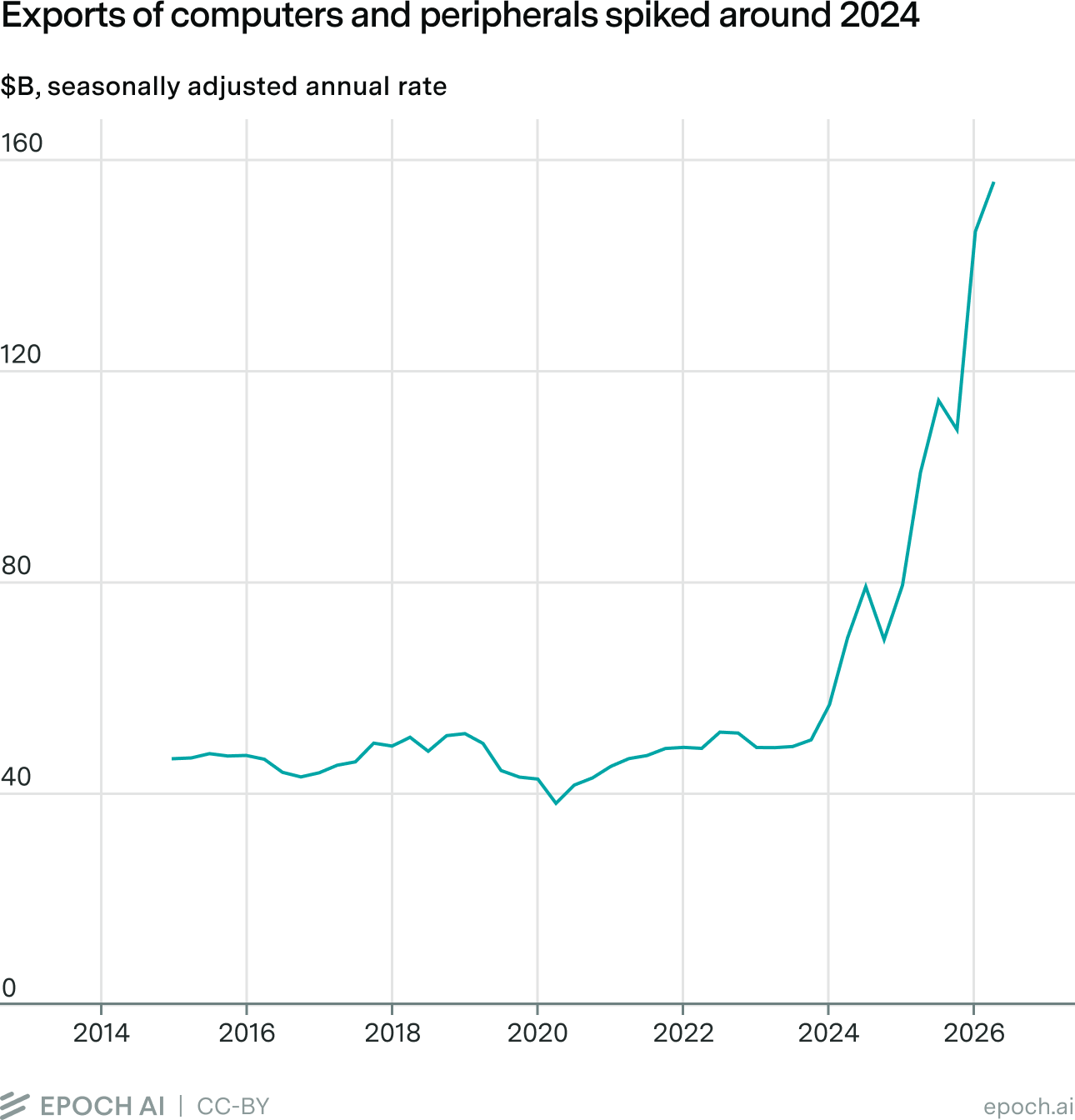
The exports of computers and peripherals did spike sharply around 2024:
But around the same time, we observe a much larger spike in computers and peripherals imports:
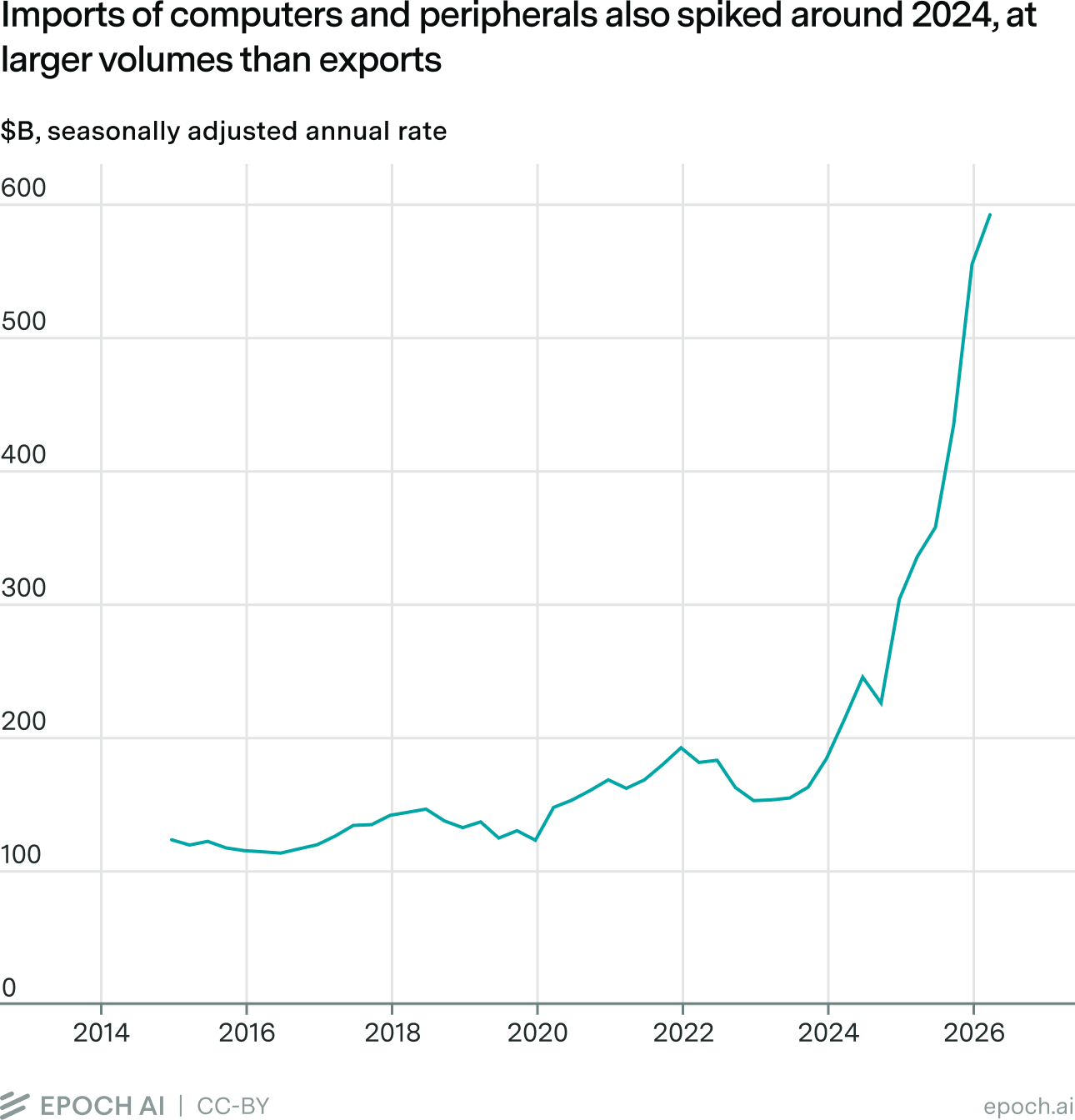
This pattern is explained by the fact that many foreign-made GPUs and components are imported into the US from Asia, then re-exported to other countries like Mexico for server assembly, before being reimported into the US at a much higher value. For example, this is what Foxconn has been doing to meet the demand of OpenAI’s Stargate data center project. So most of the growth in US exports of computers and peripherals is due to re-exports of foreign-made goods.
IP exports
As outlined above, the process of producing Nvidia chips for a US data center begins when Nvidia sends chip designs to foreign contractors. So another natural place Nvidia’s value-add might belong is IP exports. For example, we can look at surveys like BE-125 and BE-120, which the BEA uses to track when a US firm sells or licenses IP to a foreign firm (among other things).
But Nvidia does not sell or license its IP to its chip-making contractors. TSMC does not pay Nvidia to get its chip designs. The money only ever flows the other way: Nvidia pays TSMC to manufacture chips. Practically all of Nvidia’s revenue comes from the sale of software, GPUs, and networking gear rather than IP sales. As a result, Nvidia’s value-add does not show up in the IP export data.
The data does show a spike from 2023 to 2025, around when Nvidia was taking off:
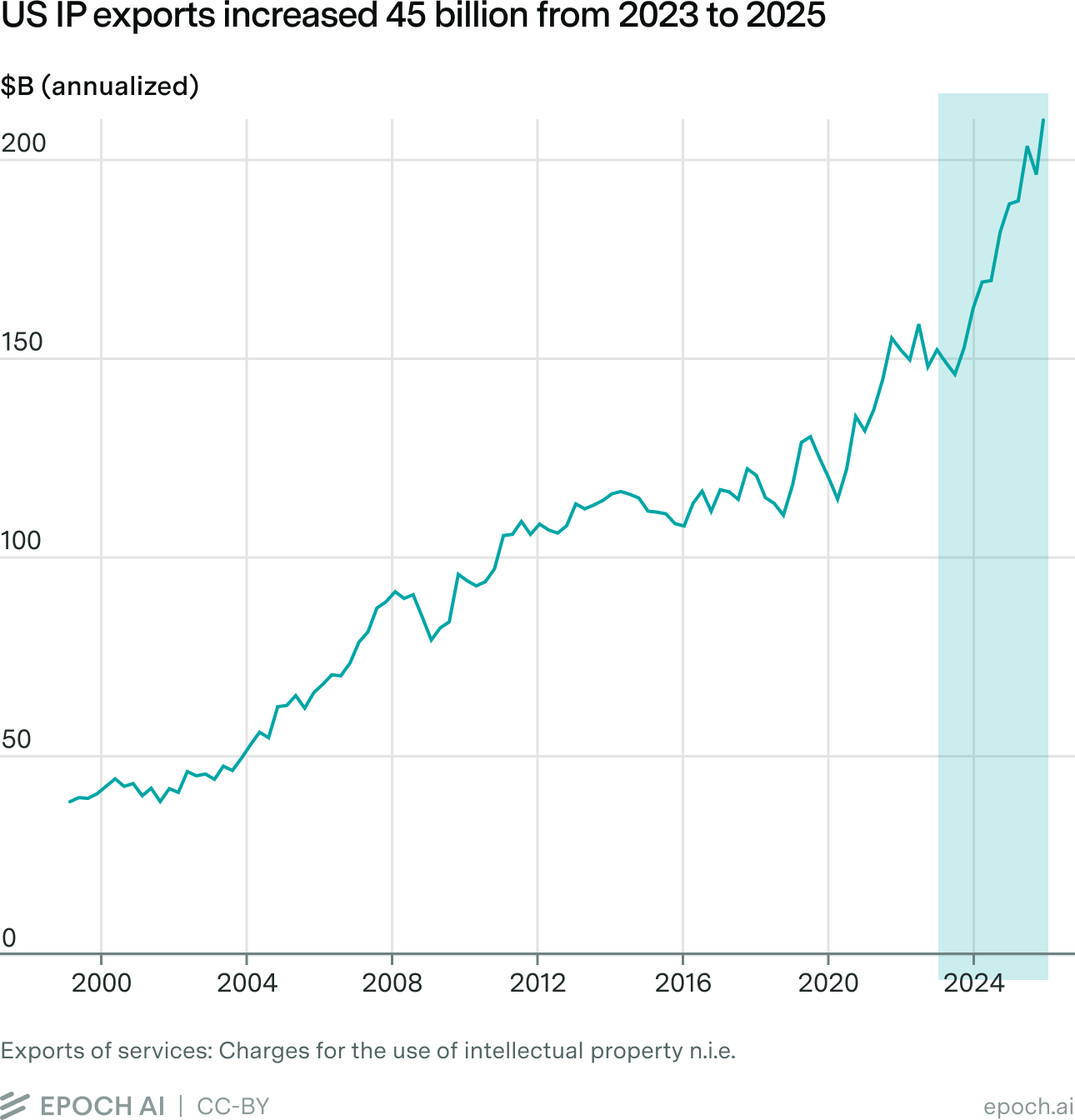
But this $45 billion spike cannot be attributed to Nvidia. Around 65% of it comes from tax havens like Ireland, Switzerland, and Luxembourg, whereas most of Nvidia’s contractors are in Taiwan.
Also, though $45 billion over two years sounds like a lot, it is small compared to Nvidia’s value-add. Between January 2025 and January 2026 alone, Nvidia made around $120 billion in pre-tax income in the US.
Other service exports
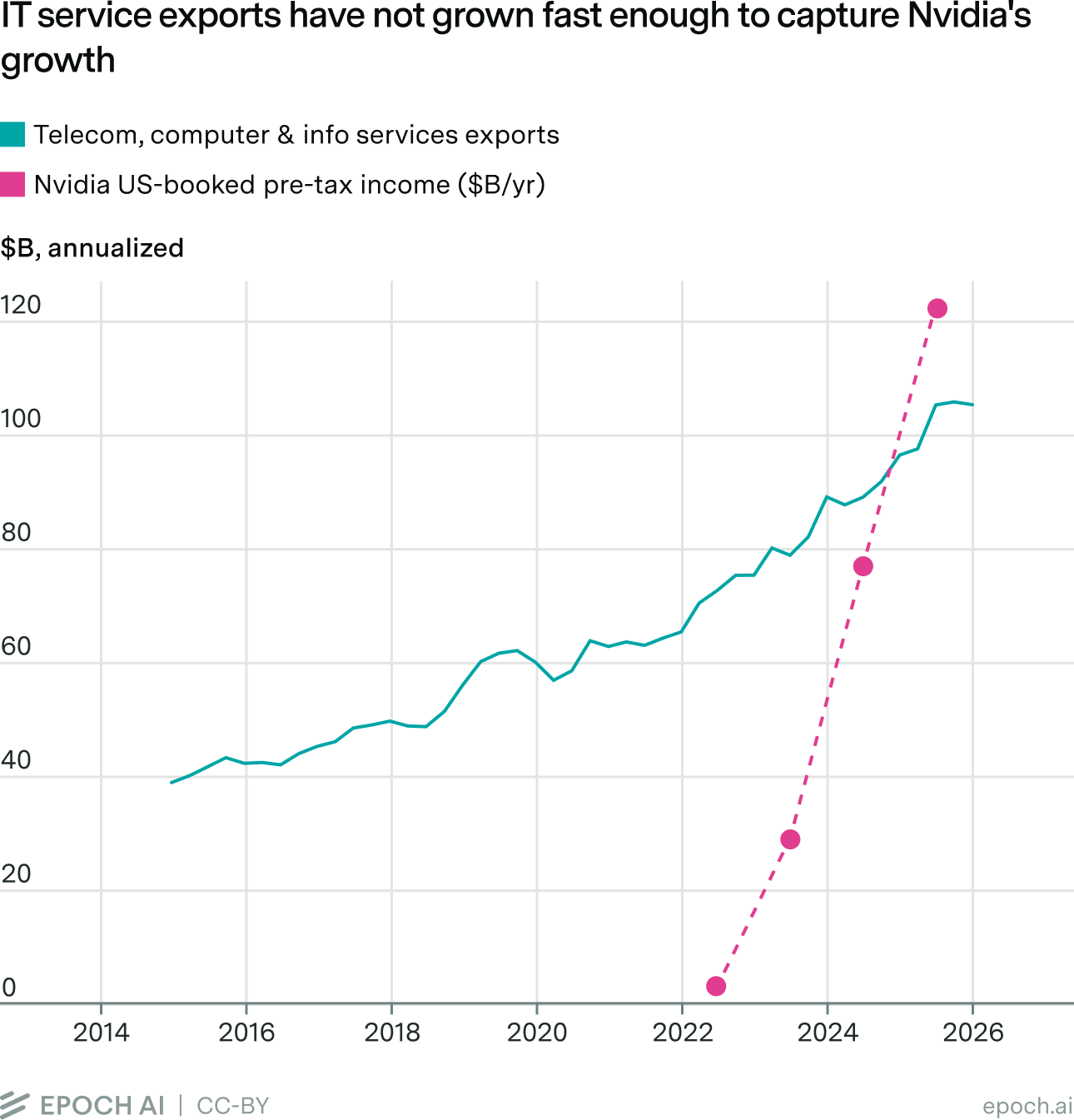
Nvidia’s value-add could conceivably have been categorized as an export of some other kind of service. Some service export categories sound especially plausible, like “telecommunications, computer, and information services” or “other business services”. These look at sales of software, cloud hosting, and R&D exports, among other things.
But Nvidia’s value-add appears in none of these categories because its overseas sales are goods — finished chips — not services. Moreover, exports of computer-related services do not show a spike around 2024, which one would expect to see given Nvidia’s growth.
Merchanting
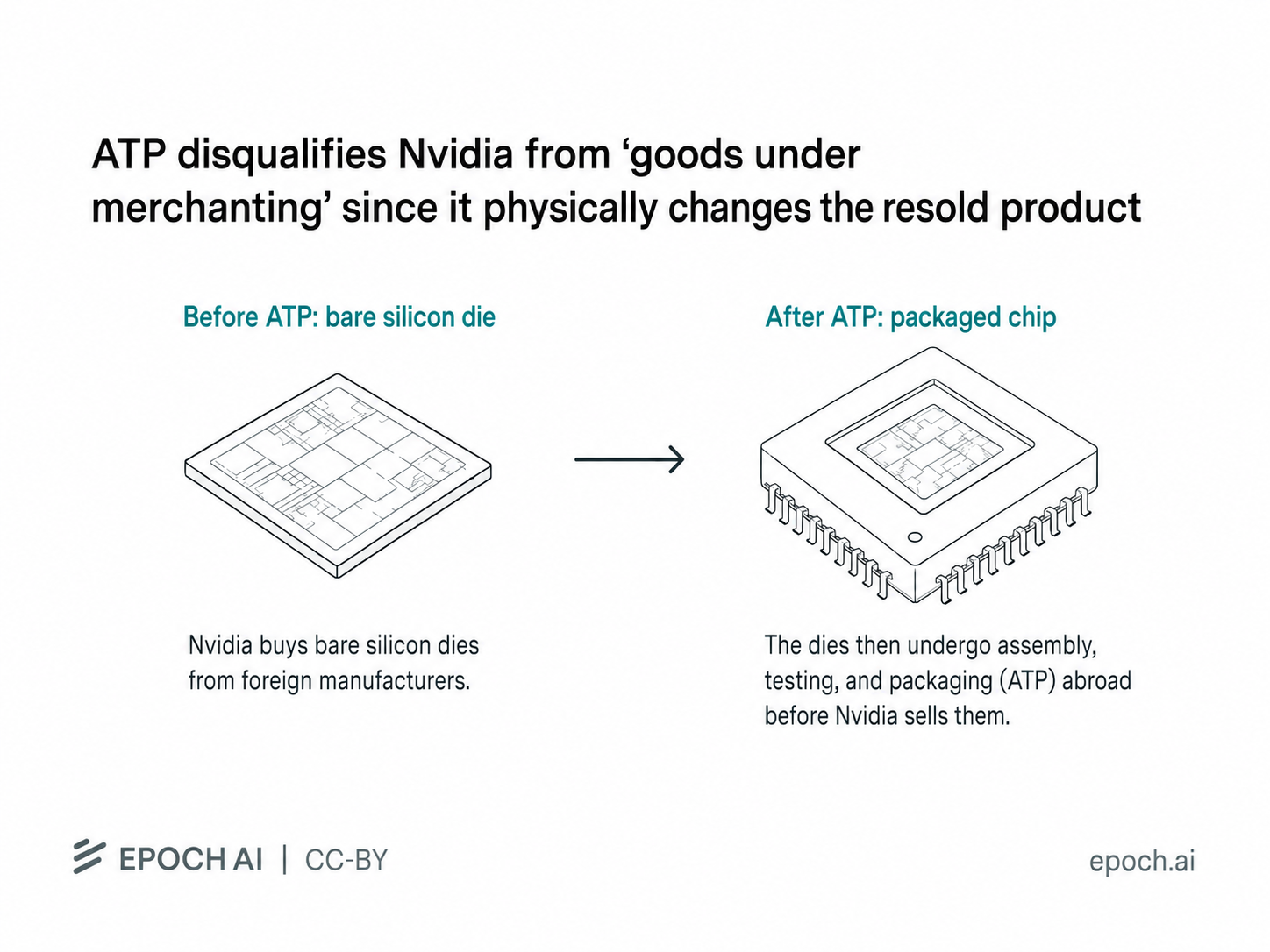
Another plausible home for the missing value-add would be the somewhat cryptically named “net exports of goods under merchanting” category. This data series looks at cases where a US firm buys goods abroad and resells them abroad at a markup, without transforming them, such that the goods never enter the US. In the quintessential case, merchanting captures a US firm’s compensation for its “export” of the remote logistical services involved in buying a good, deciding how long to hold it, and finding a buyer. This might sound not entirely dissimilar to Nvidia’s case, where logic dies are purchased from TSMC and then resold to server makers at a higher price.
But the relevant economic manuals specify that for something to be a “good under merchanting”, it must be resold in the same condition as it was purchased. As a conservative rule, this makes sense. If an American firm buys a product in a foreign country and improves it there before selling it at a higher price, it is not clear to what extent the difference represents value that was created on US soil — the value of sorting out the logistics, or the IP value of designing the product — and to what extent it represents value that was added abroad in the improvement. The black box of this value-add cannot be unambiguously assigned to any category, so it is left unassigned.
As a result, Nvidia slips through the cracks once again. Between Nvidia buying bare silicon dies from TSMC and selling to server makers, the dies also go through “Assembly, Testing, and Packaging” (ATP). This changes the goods’ “condition” quite a lot.
Nvidia’s foreign transactions thus get counted as the “general merchandise” we saw earlier (while still missing the bulk of its value-add). In fact — perhaps unsurprisingly, since the “resold in same condition” requirement is so narrow — the BEA tracks under $1 billion annually in “net exports of goods under merchanting”.
Taiwanese data
As noted above, the BEA acknowledges that they are not currently implementing BPM-6 guidelines for factoryless production. If Taiwan’s national accounts departed from these guidelines in the same way, Nvidia’s value-add would appear in Taiwanese GDP as a massive merchandise export.
But according to Taiwan’s National Accounts Yearbook, imports and exports are adjusted for ownership transfers, following BPM-6. That is, only payments to TSMC (and other Taiwanese firms) contribute to Taiwanese GDP, in the form of merchandise exports to the US. Nvidia’s sale to, say, the Mexican ODM is classified as a transaction between non-residents of Taiwan — an export from the US to Mexico — and does not contribute to Taiwanese GDP.8
It is perhaps unsurprising that Taiwan is willing to make these adjustments for ownership transfers while the US is not, since failing to do so would have such a large effect on measures of the Taiwanese economy. However, a result of this asymmetry is that Nvidia’s value-add, having been (incorrectly) excluded from US GDP statistics, is (correctly) excluded from Taiwanese GDP statistics as well. So it appears nowhere in “gross world product”, the sum of GDPs across every jurisdiction.
Finally, if Taiwan reported the value of these transactions between non-residents at the firm or country/industry level, we could directly calculate the value-add produced by Nvidia, or other American fabless chipmakers, as the value of chip sales by American firms from Taiwan minus Taiwan’s chip production “exports” to the American firms. Unfortunately, Taiwan does not provide the disaggregated data we would need to produce these estimates of the missing US value-add from chip design.9
Accounting for fabless chipmakers’ value-add in the future
In sum, the value Nvidia adds to the chips it sells
- is not an IP export because it involves no sale of IP;
- is not a service export because Nvidia is selling a physical good;
- is (typically) not an export of general merchandise because Nvidia’s chips are sold while already abroad, rather than crossing the US border; and
- is missing from “goods under merchanting” because after Nvidia buys silicon dies from TSMC, they are physically modified into chips.
It is simply missing from GDP.
In 2025, the IMF released the BPM-7, an updated set of guidelines for how countries should compile their economic data. The UN’s National Accounts group updated its guidelines in tandem. The new guidelines recommend even more explicitly and unambiguously that factoryless goods producers like Nvidia be classified as US manufacturers, even if the manufacturing occurs abroad. In particular, unlike the BPM-6, the BPM-7 is clear that Taiwan-based sales like Nvidia’s should be classified as US merchandise exports, and not as exports under merchanting, even if Nvidia does not transform the goods before selling them to an OEM or ODM.
Arguably a conceptually cleaner way to address the gap would be to count the markups earned by fabless chipmakers when selling chips to foreigners as IP exports to the country where the chips were manufactured. After all, what is actually “exported” across the US border in the course of the production process is a chip design, not a piece of physical merchandise. If TSMC paid Nvidia for the right to manufacture chips according to Nvidia’s designs, this export of US IP to Taiwan would be recorded in both countries’ national accounts, though the chip supply chain would be physically identical to the supply chain in place today.
This “IP export” approach would be inconsistent with international standards, as we have seen. It would also be somewhat inconsistent with the spirit of an expenditure-side measure of GDP — which assigns value to a production step only when a market transaction is observed or imputed — and more consistent with the more complex approach of measuring trade flows via estimates of “trade in value-added”. On the other hand, this approach would avoid the political challenges raised by expanding the definition of US manufacturing to include outsourced manufacturing of US-designed goods.
In any case, either change could take a long time to implement. Collecting, processing, and integrating the data needed to update the national accounts can be a large undertaking: the last time the UN updated its guidelines, implementation took the BEA five years. If the AI boom continues at its current pace, the value added to the US economy by Nvidia and other fabless chipmakers will likely be far larger by the time the accounting update is achieved.
We thank JS Denain, Lucio Melito, Mike Waugh, Benny Kleinman, Greg Burnham, Josh You, and Elliot Stewart for their helpful feedback and support.
-
We used Nvidia’s US-booked operating income as a proxy for Nvidia value-add that is missing from US GDP. (This was estimated by taking Nvidia’s worldwide operating income, removing one-off H20 inventory charges and reversals, and multiplying by the US-booked share by year. For the current fiscal year, we extend the previous year’s US share. Nvidia’s fiscal quarters are not aligned with calendar quarters, we calendarize based on the number of days a given fiscal quarter overlaps with a given calendar quarter.) This proxy works because the missing transaction is primarily made of Nvidia’s margin on chips, which is already present in the import price. This is not exact — like the BEA, we also cannot measure the relevant transactions — but the direction of the error is unclear. On the one hand, some Nvidia chips may enter the US without embedding the profit margin: for example, if Nvidia imports some of them at cost. On the other hand, taking operating income as a proxy for the missing value-add is slightly conservative because it subtracts from Nvidia’s revenue not only Nvidia’s overseas expenses, i.e. to TSMC and to packagers, but also any US-based expenses Nvidia incurs in coordinating production and shipping. (As noted below, Nvidia’s chip design costs do appear in US GDP as R&D investments.)

-
This amounts to “US-made value bought either domestically or abroad”, or more simply, “US-made value”. It is conventional to decompose “Domestic Spending” into “Consumption + Investment + Government Spending”, but that is not necessary here.
-
For more context on factoryless manufacturing across industries, and the challenges it poses for GDP measurement, see Kamal et al. (2013), from the BEA, and Coyle and Nguyen (2022).
-
Alternatively, one could say that imports should be -$20,000 instead of -$50,000, such that it only measures foreign value-add, and that domestic production should be $30,000. In principle, this could be done using Trade in Value Added statistics, which break down trade flows into the value-adds from specific countries. Unfortunately, at the moment these are based on the same chip import/export data that fails to capture Nvidia (as we’ll see in the next section), so we’re left with the same problem.
-
When Nvidia first accrues the expenses involved in designing a new chip, this is included in GDP as domestic spending on an “R&D investment”. What is not included is the ongoing contribution to GDP of the income that this investment is producing. By analogy, consider the case of a firm that builds a domestic furniture factory. Spending on factory construction appears in GDP as domestic investment, and spending by others on the output of the factory appears in GDP as domestic consumption. In Nvidia’s case, the “factory construction” is accounted for, but the “furniture” is not.
-
The BEA does try to correct for misreporting in particular; still, a 2011 BEA analysis argues that the best output estimate would be to use a 60-40 average of the GDP and GDI numbers, once the two are finalized. The BEA itself publishes the simple average of the GDP and GDI (NIPA table 1.17.6, line 3), and the Philadelphia Fed also maintains a series estimating output with a composite that puts significant weight on both measures. Probably a more important reason for the primary focus on GDP is that the data needed to make accurate GDI estimates arrives with a longer lag, so preliminary GDI figures are subject to larger revisions.
-
See e.g. NIPA table 1.17.6, lines 1 and 2.
-
The BPM guidelines classify a Taiwanese branch of a non-Taiwanese entity as Taiwanese, rather than foreign, if it has “substantial operations that can be separated from the rest of the entity”. If a Taiwanese branch of Nvidia is being classified in this way, the markup Nvidia makes between buying the logic die from TSMC and selling the chip to a foreign OEM or ODM could appear in Taiwanese GDP as an export, instead of being recorded as a transaction between non-residents of Taiwan. It seems highly unlikely that this is occurring, for two reasons. First, the owners of the branch would not be Taiwanese nationals, so we would expect the recent spike in Nvidia revenues to drive a large increase in the difference between GDP and GNI, which we do not observe. (See Table 2-2 here, and note that Taiwanese GNI is actually higher than GDP.) Second and more importantly, to match the magnitude of Nvidia’s US-booked operating income, direct investment income paid to foreign investors in Taiwan would have to be on the order of $100B in 2025 from Nvidia alone. This includes both profits withdrawn from the branch and profits retained in it, since BPM guidelines treat the latter as reinvested earnings. But total FDI income from Taiwan was only $12B in 2025 (See here, “Direct investment income”). We thank Tyler Menzer for encouraging us to clarify this point.
-
To write this summary, we relied in part on AI-generated translations of Chinese-language documents by Taiwanese statistical agencies.
About the authors