Disclaimer: My background is in the economics of AI and compute. I’m not an expert in war, diplomacy, or oil and gas, but I’m familiar with what economic inputs matter for AI. I am also writing about a very dynamic situation. So specific claims about the situation in Iran and Hormuz and its impacts on supply chains should be read as tentative and based on relatively quick research.
Since the US and Israel went to war with Iran at the end of February, shipping through the Strait of Hormuz — the sole sea route out of the Persian Gulf — has mostly shut down. This has disrupted around 10% of the world’s supply of oil, as well as exports of natural gas, helium, urea, and aluminum, and others. Iran has also struck targets in the Gulf states, notably oil and gas facilities and a few data centers.
On April 8, the US and Iran agreed to a two-week ceasefire that would reopen the Strait of Hormuz, though it is not clear how quickly shipping will resume or whether the ceasefire will hold. As of writing on April 9, Hormuz shipping has not meaningfully resumed amid reports of possible ceasefire violations, and a prolonged conflict still seems very plausible to me.1 If the Iran war and Hormuz closure continues, how might this affect AI?
I will mainly take a compute-centric view to this question. Compute is the main physical input to AI, and other inputs like labor and data are much less likely to be disrupted by this conflict. So I’ll focus on how this conflict could affect the production and deployment of AI chips and data centers, assuming Hormuz stays closed for many more months. (But note, war is unpredictable, and I won’t pretend to know what the longer-term nth-order effects of this conflict may be.)
Several components of the AI compute supply chain might be directly affected by this war: energy shocks could make it harder to power chip fabrication plants (fabs) and data centers, helium shortages could impact fabs, and direct attacks on Gulf states and data center construction could disrupt data center construction and investment flows for AI.
| AI supply chain component | Mechanism of disruption | Risk of disruption from a prolonged Iran War | Importance of component to AI and compute overall |
|---|---|---|---|
| Fabs in Asia | Energy, helium | Low | Critically high |
| Data centers in US | Energy | Low | High |
| Data centers in Europe and Asia (ex-Gulf) | Energy | Medium | Medium |
| Data centers in Gulf states | Direct attacks and geopolitical risk | Medium to high | Medium |
| Capital funding from Gulf states | Disruption of oil/gas revenue, risk aversion | High | Medium to high |
These aren’t the only exports disrupted by the conflict (e.g. the Persian Gulf is also an important source of aluminum) and there’s certainly a risk that I missed something important. But the economics of chip fabrication and data centers will generalize to other inputs. Overall, I don’t think a prolonged conflict in Iran will be a huge deal for the AI industry or for the global compute buildout, unless the war escalates dramatically. That said, an extended conflict will be broadly harmful to the global economy, with diffuse second-order effects on AI demand, revenue, or investments.to

The Iran War’s impact on energy
Oil is not commonly used to generate electricity — the relevant fuel that normally passes through Hormuz is natural gas, which must be chilled into liquefied natural gas (LNG) to be transported by sea.
The closure of Hormuz disrupted 20% of the world’s LNG supply, causing a ~70% increase in natural gas prices in Europe and Asia (live tracker here), which both depend on LNG imports for natural gas.2 This could significantly increase the cost of electricity: Taiwan, Japan, and South Korea all get around 30-40% of their electricity from gas (though this share is only 3% for mainland China), and much of Europe has a high share as well.3
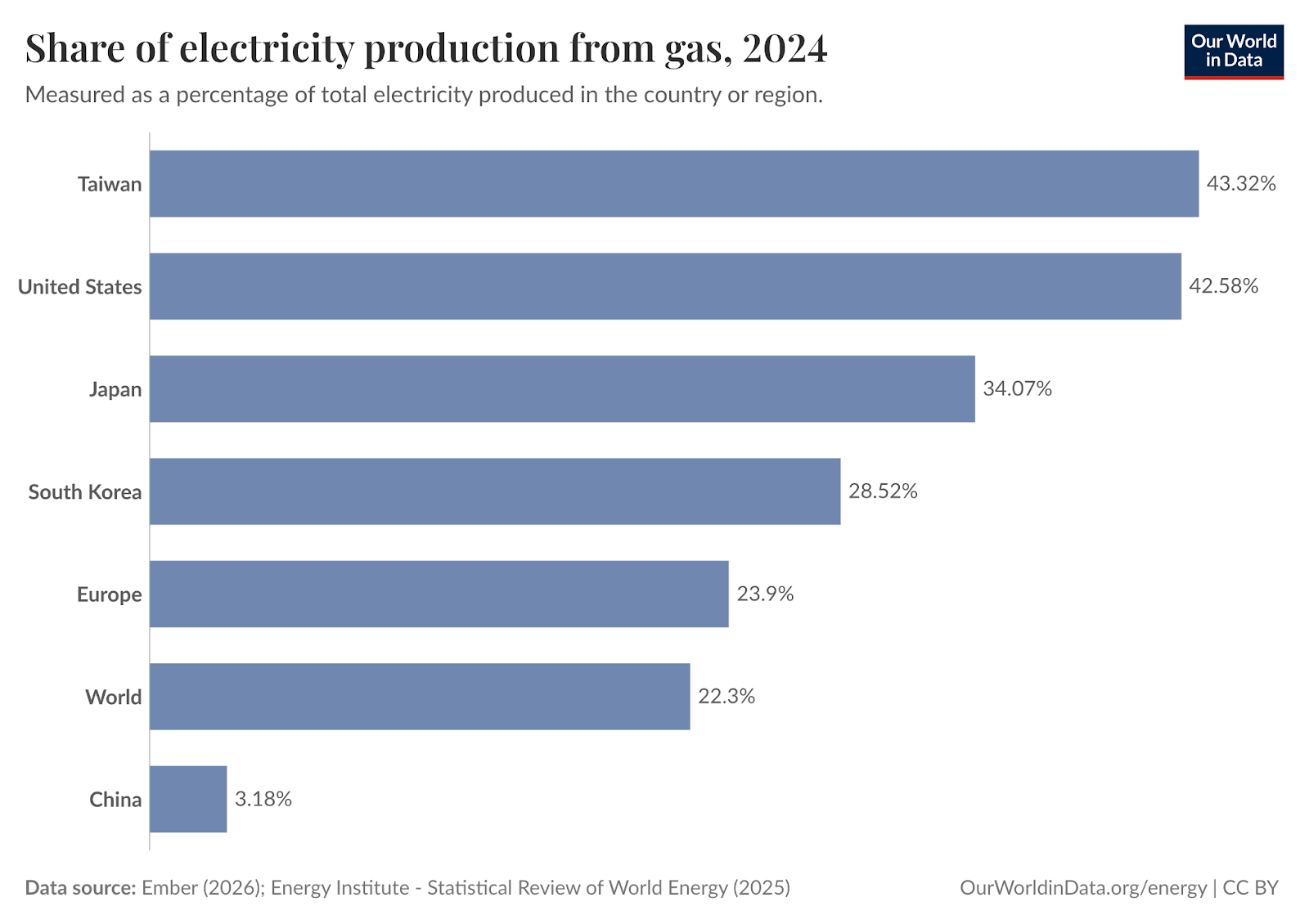
Courtesy of Ember Energy Institute and OWID, who also provide a nice world map
By contrast, the US has been insulated from the LNG shock, with prices stable since before the war. This is because the US produces more gas than it consumes (it’s the largest LNG exporter in the world) and its LNG exports are bottlenecked by the capacity of its exporting infrastructure. US LNG exports were already at capacity before the war, so in the short run European and Asian buyers cannot bid up US natural gas to the global average.4 In short, the Hormuz closure has significantly increased electricity costs in much of Europe and Asia, but not in the US.
However, there are two major steps of the compute supply chain that depend on electricity in Asia and Europe: chip fabs and data centers.
Energy for fabs
Most of the world’s AI chips are manufactured in East Asia. TSMC in Taiwan handles nearly all leading-edge wafer fabrication and chip packaging, while South Korea hosts two of the three main players in the world’s memory fab capacity (SK Hynix and Samsung).5
However, despite both regions’ dependence on LNG, I think it is pretty unlikely that a prolonged Hormuz crisis will interrupt AI chip production.
Fabs consume a lot of energy, but the returns to that energy are enormous. TSMC used 25,000 GWh of electricity in 2024, around 8% of Taiwan’s total electricity consumption. But at the average price for industrial customers of NT$3.81 (~11 cents USD) per kWh, TSMC’s energy bill in 2024 would have been just $3 billion, or under 3% of its 2024 revenue.
Making AI chips is very profitable, so there’s a lot of headroom for power prices to increase. Chipmakers have very good margins (>50% operating margins for both TSMC and SK Hynix). And that’s before the also excellent margins at the chip designer/seller level, with Nvidia’s gross margins at 70-75%. Energy is such a small fraction of the final chip price that TSMC could absorb a doubling of power costs, or pass it to Nvidia, who could easily absorb it too.6
So power prices in Asia would have to increase a lot to threaten chip fabs, e.g. by well over ten-fold. This is far greater than the ~70% increase we’ve seen so far.
Could gas prices continue to climb? I’m not qualified to say what the upper bound might be. The research group Oxford Institute for Energy Studies estimated that a one-year closure could push gas prices in Europe to $40 per million BTU, almost quadruple the pre-war price (though still lower than the 2022 peak following Russia’s invasion of Ukraine, which did not broadly shut down Europe’s most profitable factories to my knowledge). And Taiwan might be even more dependent on LNG than Europe. In general, demand for fuel or electricity is very inelastic in the short run, meaning that supply shocks can cause disproportionate effects on prices.
There are also policy dynamics at play: Taiwan subsidizes residential power relative to industrial power, and in a severe crunch Taiwan and South Korea could ration power away from commercial customers to meet basic needs. But I suspect that chip fabs would be the highest-priority industrial customers in both countries, with other businesses rationed first.
And the US government could intervene in a severe shortage. The government of Taiwan has said that they have received supply assurances from a “major” LNG producing nation to meet its needs. They didn’t say which producer this was, but in any case AI chips are so important to the US’s economic and strategic interests that the US government may ensure that Taiwan gets the LNG they need if chip production is threatened.
Overall, it looks unlikely to me that the energy restrictions will disrupt AI chip production unless the scale of the energy shock dramatically escalates.7 The energy crunch in Taiwan and Korea would have to be truly catastrophic, not just severe.
Energy for data centers
AI data centers are disproportionately located in the US, which is insulated from the LNG shock. But a significant share are in Europe and Asia (estimating the precise distribution is out of scope here), where the war could cause serious energy problems for the buildout of AI data centers.
AI data centers need much more electricity than fabs. The data centers running TSMC’s AI chips draw significantly more power than TSMC’s several gigawatts of direct electricity use.8
Still, as with chip fabs, it’s unlikely that already-built AI data centers in Europe or Asia will shut down. At normal prices, energy costs are a modest share of a data center’s total cost of ownership or revenue potential.9 Once the upfront capital cost to build an AI data center has been incurred, energy prices would have to massively surge to force a shutdown.
However, planned data centers are a different story. The hyperscaler clouds don’t enjoy Nvidia/TSMC-level margins, and -some “neoclouds” (smaller, newer AI cloud companies) are reportedly on at least somewhat shaky financial footing. Even if power is a minority of total costs, a 10–20% increase in total costs from an energy crunch could be enough to kill some projects.
It’s not clear if this would make a big difference in equilibrium. Nvidia could cut prices if enough customers can no longer afford to power its chips. Rising GPU-hour prices due to demand growth could rescue marginal projects. And the decision to build a data center depends on forecasted energy costs over the coming years; over time Asia and Europe could build up alternative energy sources, or the US could ramp up LNG exports, reducing global prices. Finally, total data center capacity may be fungible by location, with the US eventually absorbing data centers diverted from Europe and Asia.10
Still, an extended Hormuz closure causing a large, longer-term energy shock in much of Asia and Europe would plausibly be at least moderately important in slowing the overall scale of AI compute investments in the medium term.
Helium
Helium is even more outside my wheelhouse than oil and gas, but it deserves a mention. Helium isn’t just used for party balloons and blimps. It’s essential for chip fabrication, serving as an inert gas and a means to cool wafers, with one source claiming that 24% of global helium is used for semiconductors. Helium is also necessary for many other uses like MRI machines, cooling superconductors for scientific research, and fiber optics; see this post from Construction Physics for an overview.
The Persian Gulf supplies around one-third of the world’s helium, primarily from Qatar. These exports were blocked by the Hormuz closure, so in relative terms this disruption is even greater than for oil and LNG.
However, the loss of Qatar’s helium supply doesn’t look likely to interrupt AI chip production. The New York Times spoke to several experts who believed that chipmakers would be able to outbid other users of helium, though the logistics may be challenging. South Korea claims it has sufficient helium reserves to last through June, with SK Hynix and Samsung working to secure supply from the US.11
I don’t know enough about helium to be too confident here. But, as with energy, it seems unlikely that the most profitable subsets of the semiconductor industry — AI chips and the requisite high-bandwidth memory — will be the ones squeezed out by a 33% helium shock.
Gulf data centers and investment flows
Over the past month, Iran has been targeting many neighboring Gulf states12 with drone and missile attacks, including direct attacks on (non-AI) Oracle and AWS data centers in the region. At least in the case of AWS, these attacks were serious enough to cause service disruptions. And Iran’s Islamic Revolutionary Guard Corps has directly threatened to destroy Stargate UAE, the gigawatt-scale data center that is currently under construction on behalf of OpenAI in the United Arab Emirates.
These attacks may cause disruptions or outright cancellations of AI data centers in the Gulf states. This could be due to direct damage, but more likely through the perception that the Gulf region will face greater geopolitical risks even after this conflict ends.
This is potentially quite significant. Stargate UAE alone is a large project, initially planned for >1 GW of power capacity with an eventual goal of 5 GW. But I am personally somewhat skeptical that the Gulf was ever going to host more than, say, 10% of the world’s AI data centers. Gulf states like Saudi Arabia and the UAE are very wealthy and energy-abundant relative to their small populations, but they are fundamentally much smaller in terms of GDP (~2% of the world total), total electricity production, workforce, or geographic area than regions like the US, the rest of Asia, or Europe.13
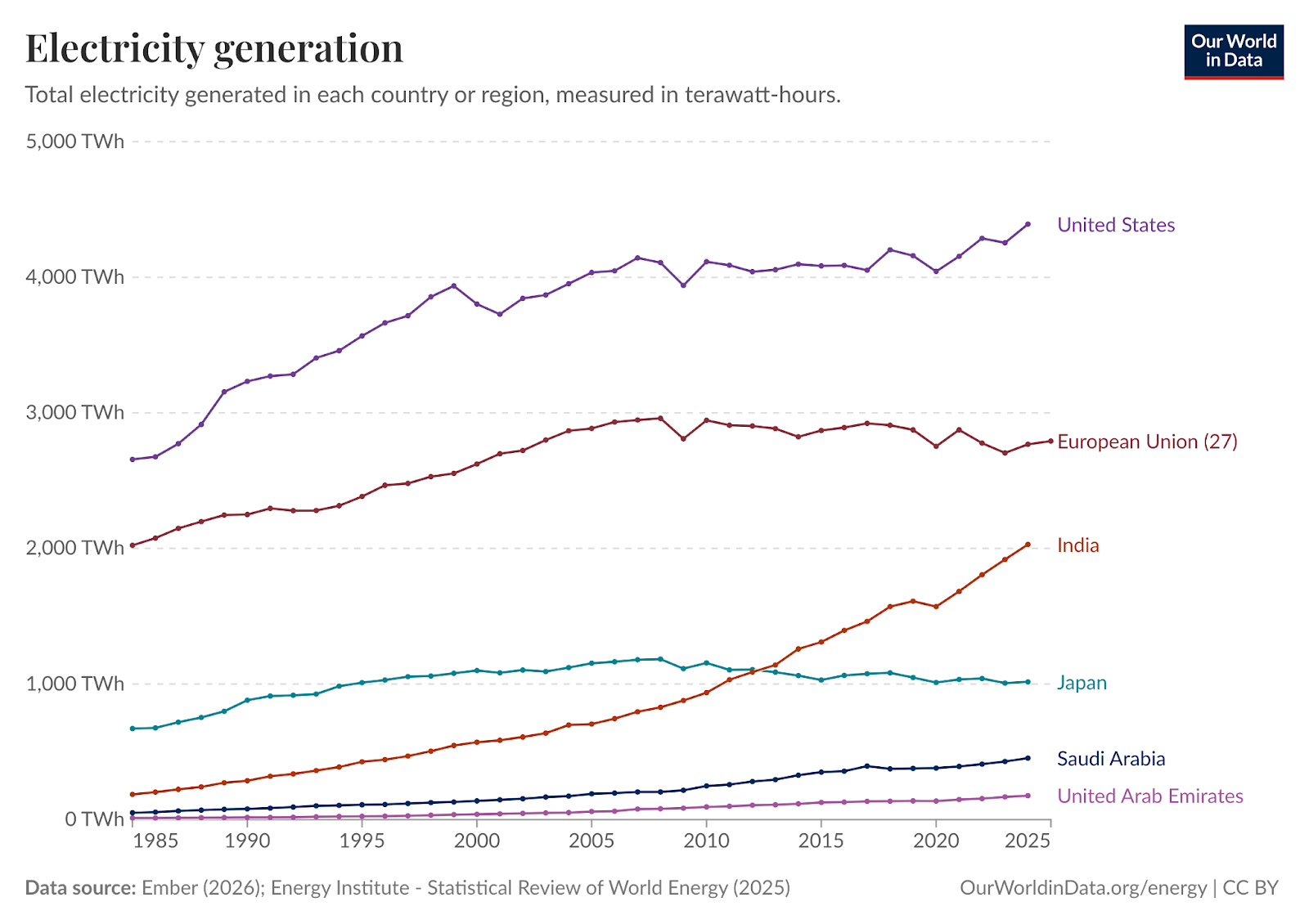
Courtesy of Ember Energy Institute and Our World in Data
Indeed, the Gulf states don’t actually seem to be a great place to build data centers. Amelia Michael, a researcher with GovAI, observes that the UAE has higher energy costs than the US, along with environmental challenges and a limited local workforce.
One possible driver of Gulf megaprojects is that the Gulf is a very important source of capital funding for AI: companies plan data centers there to cultivate ties with deep-pocketed investors and sovereign wealth funds. These Gulf AI investments have reportedly added up to $300 billion in total.
This spigot of funding may be interrupted if the Iran War continues, which may be more consequential than the direct impact on data centers. If the Gulf proves unsuitable for data centers, that capital can flow elsewhere — but only if the capital is still there. Gulf economies are built on oil, and a prolonged export disruption will massively crimp the cash flows that would have flowed into AI.14 Oil exports haven’t been completely cut off: Saudi Arabia and the UAE are still exporting >5M barrels of oil per day through pipelines bypassing Hormuz, but that’s a fraction of the 20M barrels/day that formerly flowed through the strait.
Gulf investors may also become more risk-averse, prioritizing investments they perceive to be safer; though as of March 12, both the UAE and Saudi Arabia have said they don’t plan to change their investment strategies.
In the near term, funding disruptions could affect OpenAI and Anthropic, both reportedly planning IPOs as soon as this year, with potentially many billions of Gulf funding at stake. One sign that Gulf investments are important to AI is that Anthropic decided to seek Gulf investments despite moral and reputational risk. Anthropic CEO Dario Amodei wrote in a leaked memo last year about his decision to tap the “truly giant amount of capital in the Middle East, easily $100B or more”, despite his moral reservations about enriching “dictators” (and the subsequent leak suggests that this decision was controversial internally).
But I also don’t want to overstate the importance of Gulf funding. The Gulf states are a massive source of concentrated capital, with the sovereign wealth funds of the UAE, Saudi Arabia, Kuwait, and Qatar adding up to over $5 trillion. Because many of these funds invest heavily in tech/venture startups, they are hugely important to the startup industry. But ultimately, the Gulf states aren’t that rich relative to the entire rest of the world.
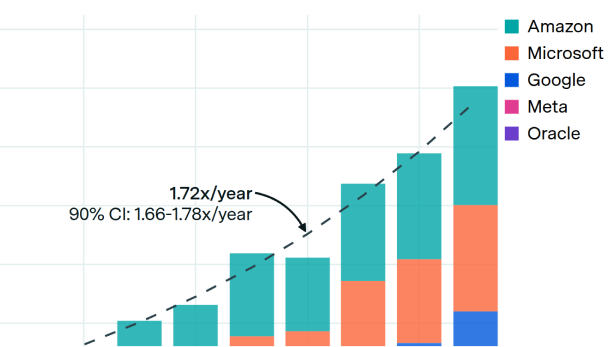
The overall pace of the global compute buildout will be mostly determined by hyperscaler capex, financed by the immense cash flows of tech giants like Microsoft, Google, Meta, and Amazon15 and by a huge global bond market. Total AI capital spending may exceed $1 trillion per year soon. Gulf investment flows into AI are on the order of tens of billions annually: significant, but not critical.
Takeaways
Overall, I think the Iran War won’t be a huge deal for the AI sector, even if Hormuz stays closed for many more months. Chipmaking is massively profitable, so TSMC, Samsung, and SK Hynix will most likely be able to secure the power, helium, and other resources they need. Some data center plans in Europe or Asia may be cancelled due to rising costs, but in the US data centers will be insulated from the energy shock. I think the most important direct effect may be the disruption of Gulf investment flows, but they aren’t the biggest source of funding for AI.
But this all assumes the conflict doesn’t escalate dramatically. A wider regional war, or spillovers to other theaters, or severe second-order macroeconomic effects, could change the picture in ways I can’t model here. The Iran War (if it continues to be a war) is a dynamic situation, and there’s a real risk that this post will be outdated shortly after publication. I will keep “monitoring the situation” with interest.
Thanks to Anson Ho, Luke Emberson, Jaime Seville, and Lynette Bye for their feedback on this post
-
And there will be prolonged after-effects even if there’s an immediate, lasting peace deal and reopening of the Strait, due to damage to oil and gas infrastructure caused by the war, and impact of oil well “shut ins”: shutting down an oil well can cause damage to the oil. All my claims in this post are conditioned on “the war and Hormuz closure do not actually end this week”, but the distinction may not be too critical.

-
Not all natural gas is liquefied, so the 20% shock to LNG is a smaller share of overall world gas, but LNG is necessary to export gas to an island like Taiwan or a pseudo-island like South Korea.
-
In general, since gas is just one input into electricity generation into these countries, the percentage increase in gas prices should be an upper bound in the percentage increase in power prices. However, the respective price increases can be similar in a gas shortage: to clear an electricity market, prices need to be equal to the marginal cost of generating power, so power prices will be closely linked to the cost of gas generation (fuel plus other operating expenses).
-
This is not the case for oil; the price of oil in the US is similar to global prices.
-
This simplifies a very complex upstream supply chain including semiconductor manufacturing equipment. But TSMC and the memory companies are probably the most energy-intensive part of the chipmaking process.
-
If Nvidia sells a GPU for $40k at a gross margin of 75%, then it makes a gross profit of $30k and pays its suppliers (mainly TSMC) $10k. If TSMC has an operating margin of 50%, that means it costs them $5k to produce the GPU including marginal production cost and overhead operating costs. I cite operating margin instead of gross margin for TSMC/Hynix to ensure I’m including all fab-related costs.
-
For example, if there are escalating direct attacks on oil and gas infrastructure on both sides—Iran has already attacked LNG in Qatar—leading to severe long-term damage. There is a pipeline to Oman bypassing Hormuz with a capacity of ~20% of Gulf LNG exports, so these attacks could reduce Gulf gas exports even further in the short term. Or there could be spillover to other theaters; Ukraine has escalated its attacks on Russian oil production to try to prevent Russia from benefiting from the recent surge in oil prices.
-
This can be found by dividing TSMC’s consumption of 25,000 GWh per year by the number of hours in a year.
-
One estimate of the energy cost of running 20k Nvidia H100s, using prevailing power prices in the US, is $20.7M per year ($1000 per H100 per year), while an H100 can be rented out for roughly $2/hour, or over $15,000 per year.
-
Availability of suitable sites with grid connections and infrastructure may be a constraint as well as raw energy supply, so reducing the geographic scope of data center construction probably will have some effect on the global compute build out.
-
The US is the largest producer of helium outside of the Middle East, and also has around one-third of the world’s supply.
-
“Gulf states” is common shorthand for the six wealthy Arab-majority monarchies that border the Persian Gulf: Saudi Arabia, United Arab Emirates, Bahrain, Qatar, Kuwait and Oman. Iraq and Iran itself are also major oil exporters on the Persian Gulf, but have a rather different vibe.
-
To clarify, while I would expect Asia (ex-Gulf and ex-China) to eventually build more AI data centers than the Gulf states even absent this war, the impact of the Iran war on Gulf data centers may be more significant than the energy impact on Asian data centers, so the disruption to Gulf data centers could still be larger.
-
My simple model here is that because profits from the Gulf oil and gas industry are reinvested into sovereign wealth funds or privately-held investment funds, they are the main source of outgoing capital flows from the Gulf. But it’s conceivable that even if oil money stops coming in for a while, Gulf investors that are highly bullish on AI could sell their non-AI investments so they can plow more into AI, though this seems quite risky.
-
See chart 12 in Understanding AI’s “16 charts that explain the AI boom”
About the authors
Related work