OpenAI and Anthropic are growing about as fast as, or faster than any company of their size has grown in history. It’s extremely rare for a tech company making more than $1 billion to be growing over 100% per year.1
In fact, both labs are way above that threshold. OpenAI tripled its revenue run rate (recent revenue extrapolated to an annual rate) in the past year, from $13 billion last August to over $40 billion now. Anthropic grew its revenue from $1 billion to $9 billion in 2025, and its growth rate accelerated from there: Anthropic more than tripled its run rate in just the first quarter of 2026. Reportedly, it reached $65 billion by the end of July.2
Now, some of these eye-popping Anthropic growth rates should be taken with a caveat: Anthropic was coming from behind and overtaking its initially larger rival, OpenAI.3 To factor this out, we might look at Anthropic and OpenAI combined. Their growth rates have been both extremely rapid and remarkably robust since 2023: together, they tripled in 2024, and then grew more than fourfold in 2025. And this year they’ve already grown by 3.5×, from $30B to $105B combined, and it’s only August! Remember: the 2025 growth rates were already record-breaking, and now these labs are growing faster from a higher baseline.4
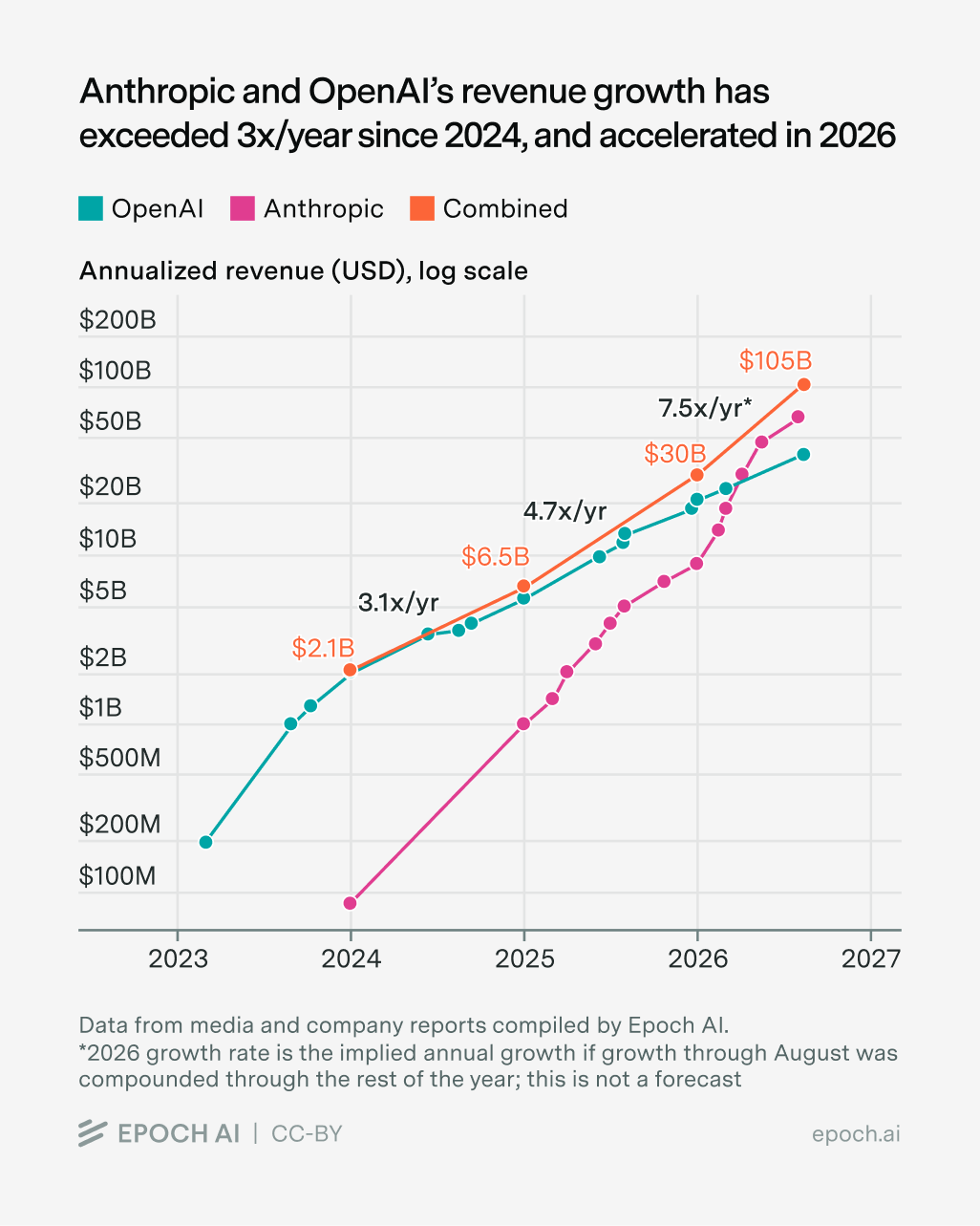

How should we update from 2026’s hypergrowth?
A priori, it’s natural to think that 3× or 4× annual growth of an industry the scale of frontier AI today is just unsustainable. Perhaps LLMs are seeing rapid technical progress and rapid diffusion because these technologies are so new. But as these companies grow, especially when they approach the size of the largest firms in the world today with hundreds of billions in annual revenue, this growth will slow. The frontier labs will run out of technical low-hanging fruit, their models and products will mature, and the adoption curves will saturate. Revenue growth rates will slow down, from 3× per year to 2×, then 50% per year, then 20-30% per year (a la mature tech giants in recent years).
In this light, the fact that revenue growth was so robust in 2025 vs 2024 was surprising, and the 2026 acceleration is simply astonishing. So how should we interpret it?
One approach is to see this as a temporary acceleration, driven by the labs’ coding agents reaching a critical threshold around the time Opus 4.5 was released late last year. We previously saw this pattern with ChatGPT’s original launch. GPT-3 was a niche product earning OpenAI at most tens of millions of dollars in revenue per year.5 ChatGPT, and the subsequent GPT-4, led to an explosion in usage growth and revenue, taking OpenAI to $1 billion annualized in 2023, or more than tenfold growth. OpenAI’s revenue growth then slowed down to 3× in 2024.
Similarly, the explosion in revenue from coding agents might settle down very quickly in the coming months, and frontier AI might finally enter a period of decaying growth and maturation. Of course, this depends on what critical thresholds lie beyond Opus 4.5-level coding agents — e.g. undertaking large projects, or going outside coding to broadly automate white collar work. Given that growth curves are often just a series of stacked S-curves, we’re left with the question of how many of these thresholds lie ahead of AI now.
Will the unusual pace of growth continue? Each year that frontier growth does not slow down could be interpreted as evidence that AI is simply defying gravity. Unlike other tech industries that mature and saturate their markets, AI is simply on a path to automate and transform the entire economy. Or, will this be just the last major growth spurt in frontier LLMs, or AI generally? Gravity may reassert itself, and frontier AI’s growth will slow down to match previous industries.
The answer partly depends on whether revenue growth comes from progress or diffusion. Progress continues as long as progress continues.6 Diffusion meanwhile slows significantly after a few years. Obviously, both have played a key role in the revenue growth of the last four years. But it matters whether each new level of capabilities creates its own diffusion curve, which suggests each step up leads to further revenue growth, or whether frontier AI in general just saturates.
AI vs the world
Anthropic and OpenAI together are now earning revenue at a rate of $100 billion per year. Exponential View estimates that the whole generative AI market is approaching $200B/year in total. This is already around one-thousandth the size of the world economy.
This puts a real-world handle on the usefulness of today’s AI. Claude and GPT models are currently good enough that the world pays almost ten billion dollars per month to use them; if model progress flatlined tomorrow, revenue would almost certainly continue to grow for a while due to diffusion. If both benchmark scores and revenue grow briskly in the next year and combined revenue exceeds $300 billion per year, then even if capabilities progress freezes starting in August 2027, AI will still eventually be a trillion-dollar industry.
But if frontier AI continues to grow its revenue 3× per year, or ~10× every two years, then naively — very naively — it would take about six years for it to grow to the size of the current world economy.7 This is not really a reasonable forecast, but it does provide a good frame to understand the current growth rate. Either frontier AI growth slows down in the next six years, or it will have dramatically reshaped the entire economy.8 If frontier AI triples its revenue again in the next year, that’s one down, five left to go.
This is why we’re watching these numbers so closely. Each passing year, or frankly each passing quarter with continued hypergrowth in frontier AI revenue provides important evidence on AI’s trajectory.9 In the short run, it means that AI has proven substantially more useful than it was several months ago. Revenue, and the investments motivated by that revenue, also feeds into the compute feedback loop, wherein better AI begets more revenue begets more compute begets better AI.
But it’s also crucially important how robust this revenue growth is: when will we see the growth curve start to bend, if ever? This tells us whether frontier AI is on a fundamentally different trajectory than the technologies we’ve seen so far.
-
As Exponential View put it: “Traditional software companies see growth rates spike, then plateau after 1-2 years of product-market fit. However, OpenAI and Anthropic have maintained over 100% growth well into the multi-billion-dollar scale, something previously thought impossible.”

-
Note that the two companies use different revenue accounting standards. When people buy tokens through cloud platforms, OpenAI books only the cut it receives from the cloud provider, while Anthropic books the full cost, which inflates Anthropic’s reported revenue relative to OpenAI’s.
-
While OpenAI and Anthropic aren’t the only model developers, they seem to make up the majority of the frontier AI market. Exponential View’s estimate of the total deduplicated revenue of the entire generative AI industry was around $175 billion annualized run rate as of June 2026. Every other dedicated model developer (e.g. the Chinese labs, Mistral, xAI before the SpaceX acquisition) was below $1 billion/year in run rate as of late 2025 or 2026.
-
The growth rate within 2026 may be slowing down. For example, the two labs were reportedly around $55B combined at the end of Q1, nearly doubling in the first quarter, but took around four months to double again (still a faster doubling time than in 2025). There’s enough uncertainty in the exact dates and revenue figures around each of these reports (more details here) that these calculations shouldn’t be taken literally.
-
OpenAI reportedly made $28 million in revenue in 2022, including the month following ChatGPT’s launch.
-
Yes, this is trivial, but AI progress looks steady and we have decent reasons to expect it to continue for at least a few years.
-
The exact correspondence between the scale of AI revenue and its impact on GDP is outside the scope of this post. It suffices to say that the emergence of a new >$10T/year industry would have a dramatic effect on the world.
-
In addition, on this trend the top frontier labs are just 1-2 years away from matching the largest individual tech companies in the world, and less than four years away from matching the annual growth in the world economy today.
-
For more commentary on the implications of frontier AI revenue, the AI Futures Project has proposed a model relating AI revenues to automation of coding and AI research.
About the authors