Clark, Nevada, United States
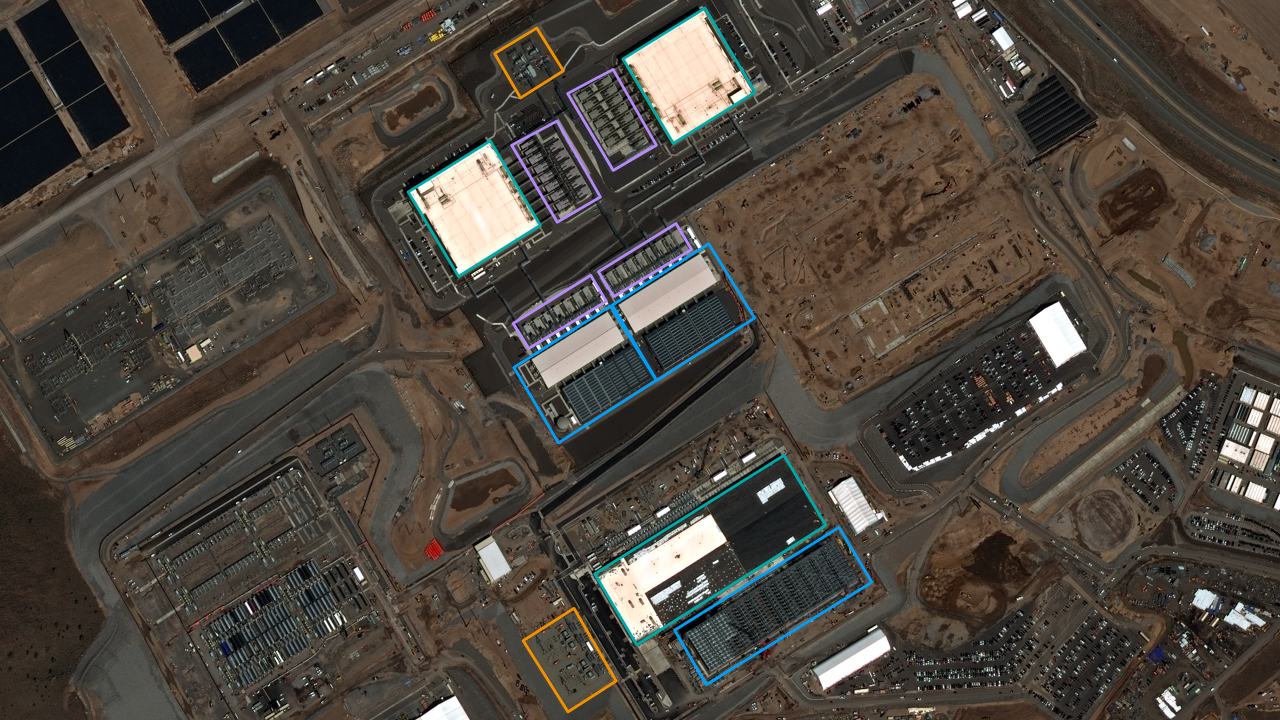
Google Storey County is an operational AI data center with AI chips owned by Google and used by Google DeepMind (speculative). It hosts an estimated 154k H100-equivalents of compute, supported by 161 MW of IT power at a capital cost of $6.1 B. In Q2 2027, we project it to rise to 652k H100-eq compute, 300 MW IT power and a cost of $11.4 B. We estimate that it uses Google TPU v5e and Google TPU v6e chips.
The timeline of IT power and compute capacity is based on satellite imagery, our cooling equipment power model, chip availability, and chip efficiency.
Storey County is one of Google’s rare dry-cooled campuses, likely an adaptation to water-scarce Nevada.
Satellite imagery
CURRENT COMPUTE
154k H100-eq
3.04e20 8-bit OP/s
PROJECTED
652k H100-eq
1.29e21 8-bit OP/s
CURRENT IT POWER
161 MW
PROJECTED IT POWER
300 MW
CURRENT COST
$6.1 B
PROJECTED COST
$11.4 B
Building 1, which was first operational in 2021, has increased power capacity by about 75%. This is based on the expansion of the dry cooling array from 4 to 7 columns (seen on Google Earth). Its backup generators also grew from 18 to 33, an 83% increase. Around this time (2023 Q3) the quarterly PUE of the campus is 1.24, down from the initial 1.29 in 2022 Q3. Since no other buildings have been added, these changes indicate an increase in power density, which may entail a new generation of hardware getting installed.
Building 2 now has generators in place, but there is still a crane and construction work present.
Building 2 is operational. Based on a Google Earth image showing complete building shell, mechanical equipment and generators, plus cars parked at the front.
Building 3 foundation is underway. Building 2 exterior looks totally clean/landscaped.
Building 3 has a partially complete shell, electrical and mechanical equipment. Building 4 foundation is underway.
Building 3 is estimated to be operational. We estimate the operational date by analogy to the time that Building 1 took to go from a foundation to being operational. The power capacity is based on the number of generators reported in an air quality permit application (p.92-93). The dry cooler array is more than double the size of the Building 1 array, which suggests an even larger power capacity than we estimate, but we believe the generator-based estimate is more reliable here.