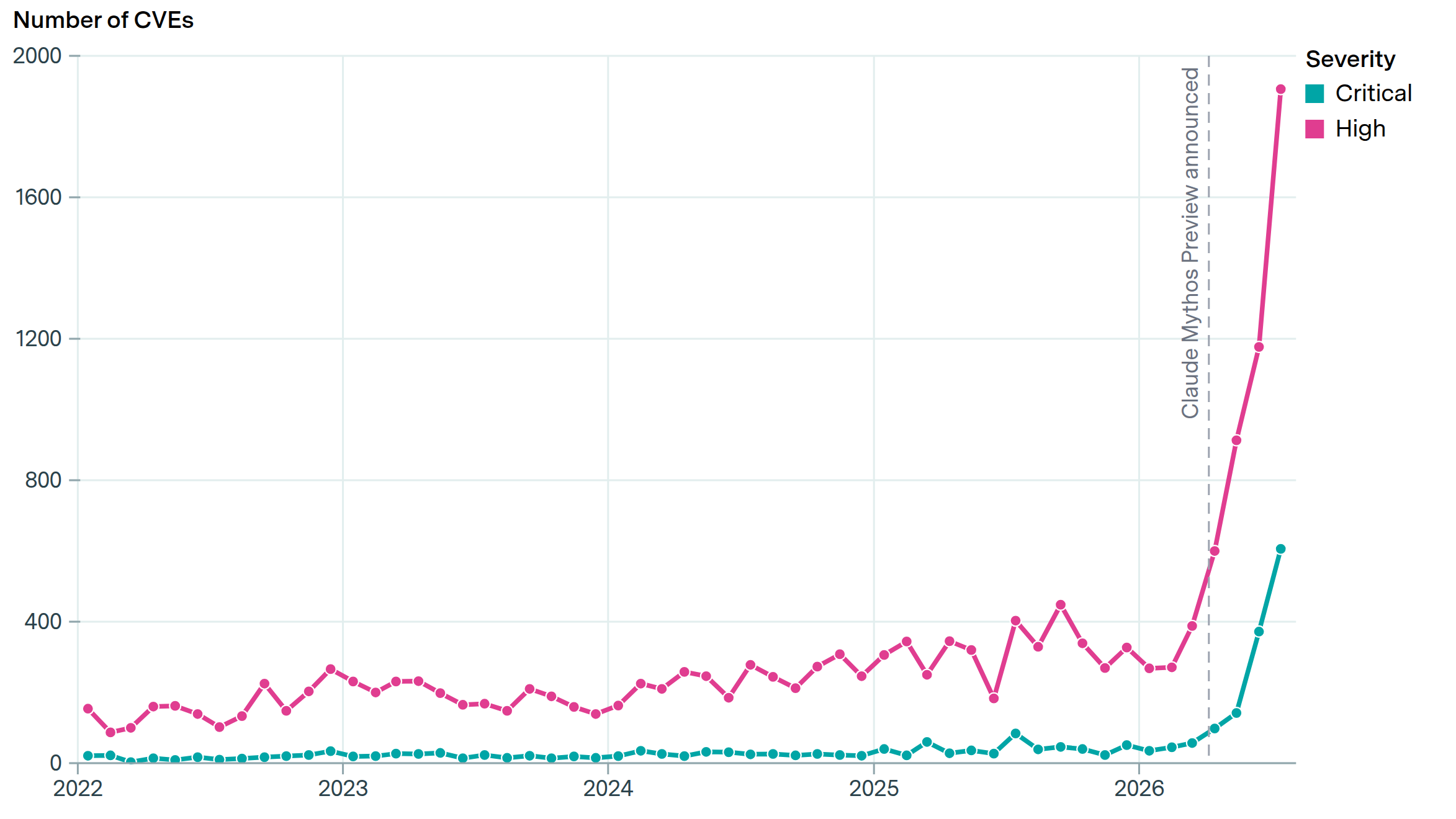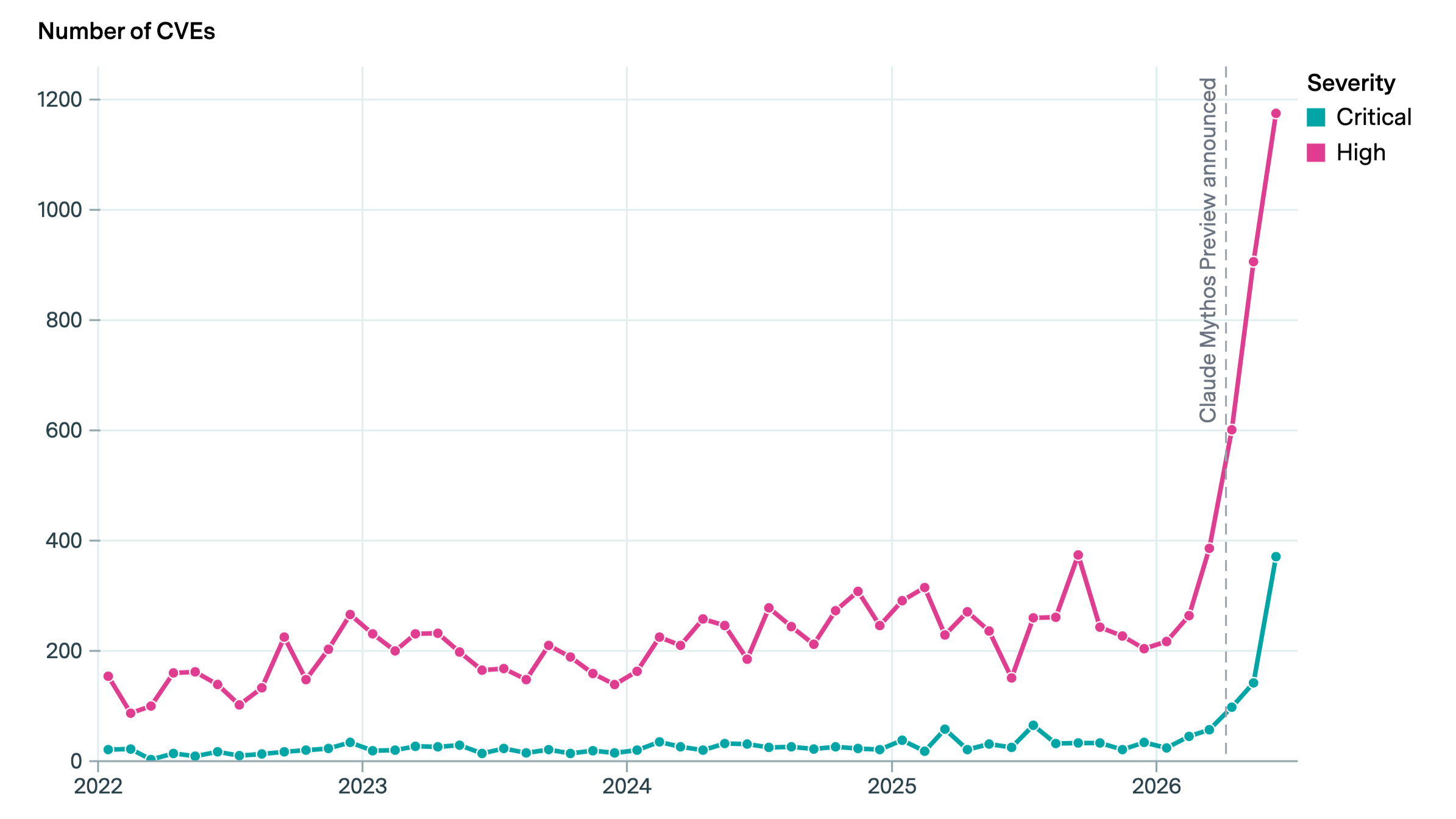

June and September polls from Epoch AI/Ipsos show no detectable increase in the share of US adults experiencing cyber incidents. In September, about 45% reported at least one incident in the past 12 months, such as an account break-in or a data leak, compared to 46% in June.
| Survey wave | Field dates | Incident in past 12 months | Share of US adults (%) | 90% CI lower bound (%) | 90% CI upper bound (%) | Respondents (unweighted) |
|---|---|---|---|---|---|---|
| June 2026 | June 12-14, 2026 | 32.2 | 29.8 | 34.7 | 1,021 | |
| June 2026 | June 12-14, 2026 | 19.8 | 17.8 | 22.0 | 1,021 | |
| June 2026 | June 12-14, 2026 | 7.8 | 6.5 | 9.3 | 1,021 | |
| June 2026 | June 12-14, 2026 | 7.9 | 6.6 | 9.4 | 1,021 | |
| June 2026 | June 12-14, 2026 | 5.7 | 4.6 | 7.1 | 1,021 | |
| June 2026 | June 12-14, 2026 | 2.1 | 1.5 | 3.0 | 1,021 | |
| June 2026 | June 12-14, 2026 | Any of these incidents | 46.2 | 43.6 | 48.8 | 1,021 |
| June 2026 | June 12-14, 2026 | None of these | 45.3 | 42.7 | 47.9 | 1,021 |
| June 2026 | June 12-14, 2026 | Not sure | 7.5 | 6.2 | 9.0 | 1,021 |
| September 2026 | September 18-20, 2026 | 32.1 | 29.7 | 34.6 | 1,024 | |
| September 2026 | September 18-20, 2026 | 18.2 | 16.3 | 20.3 | 1,024 | |
| September 2026 | September 18-20, 2026 | 6.1 | 4.9 | 7.5 | 1,024 | |
| September 2026 | September 18-20, 2026 | 6.0 | 4.9 | 7.4 | 1,024 | |
| September 2026 | September 18-20, 2026 | 5.0 | 3.9 | 6.2 | 1,024 | |
| September 2026 | September 18-20, 2026 | 0.9 | 0.5 | 1.6 | 1,024 | |
| September 2026 | September 18-20, 2026 | Any of these incidents | 44.6 | 42.0 | 47.2 | 1,024 |
| September 2026 | September 18-20, 2026 | None of these | 45.4 | 42.8 | 48.1 | 1,024 |
| September 2026 | September 18-20, 2026 | Not sure | 8.7 | 7.3 | 10.3 | 1,024 |

This period followed the limited release of Claude Mythos Preview in April, with AI cybersecurity capabilities continuing to advance over the summer. Our initial poll ran June 12–14, just days after Anthropic publicly released Claude Fable 5 and gave a group of vetted partners limited access to Claude Mythos 5. By September, increasingly capable open-weight models were also available.
Epoch's work is free to use, distribute, and reproduce provided the source and authors are credited under the Creative Commons BY license.
Learn more about this graph
In this analysis, we examine the change between two poll waves in the share of US adults who report having experienced at least one cyber incident in the previous 12 months. We find no change for incidents in aggregate, and no specific incident type rose in a way we can reliably statistically detect. The share reporting any incident changed from 46% (90% CI: 44% to 49%) in June to 45% (42% to 47%) in September.
We also find no detectable change among respondents who report frequent AI use. Among them, the share changed from 53% (90% CI: 48% to 59%) to 51% (45% to 57%).
Other indicators and publicized incidents suggest increasing AI cyber capabilities may be affecting measurable security outcomes. We previously documented a sharp increase in serious vulnerability disclosures in June, followed by a further increase in July. The incident involving OpenAI models hacking Hugging Face is one documented example of what frontier models can do offensively capabilities.
In addition to closed models, cyber capabilities among open-weight models have increased as well. Among these, the US Center for AI Standards and Innovation (CAISI) assessed the open-frontier model GLM-5.3 as having similar cyber capabilities to US frontier models around the time of the Fable 5 release.
Our polling examines a different outcome: whether a larger share of ordinary Americans report experiencing cyber incidents.
Data
Analysis
Assumptions and limitations
Download this data
Explore this data

Tracking how employed Americans use AI at work, across demographics.
Related insights