
Severe cybersecurity vulnerability disclosures (CVEs) spiked in 2026. In June, notable organizations published around 1,500 high- and critical-severity CVEs — more than 3.5× the monthly record prior to Mythos’ release. For up to date information, see our Cyber Vulnerabilities explorer.
| Month | Critical | High |
|---|---|---|
| 2022-01 | 21 | 154 |
| 2022-02 | 22 | 87 |
| 2022-03 | 3 | 100 |
| 2022-04 | 14 | 160 |
| 2022-05 | 9 | 162 |
| 2022-06 | 17 | 139 |
| 2022-07 | 10 | 102 |
| 2022-08 | 13 | 133 |
| 2022-09 | 17 | 225 |
| 2022-10 | 20 | 148 |
| 2022-11 | 23 | 203 |
| 2022-12 | 34 | 266 |
| 2023-01 | 19 | 231 |
| 2023-02 | 20 | 200 |
| 2023-03 | 27 | 231 |
| 2023-04 | 26 | 232 |
| 2023-05 | 29 | 198 |
| 2023-06 | 14 | 165 |
| 2023-07 | 23 | 168 |
| 2023-08 | 15 | 148 |
| 2023-09 | 21 | 210 |
| 2023-10 | 14 | 189 |
| 2023-11 | 19 | 159 |
| 2023-12 | 15 | 139 |
| 2024-01 | 20 | 163 |
| 2024-02 | 35 | 225 |
| 2024-03 | 26 | 210 |
| 2024-04 | 20 | 258 |
| 2024-05 | 32 | 246 |
| 2024-06 | 31 | 185 |
| 2024-07 | 25 | 278 |
| 2024-08 | 26 | 244 |
| 2024-09 | 22 | 212 |
| 2024-10 | 26 | 273 |
| 2024-11 | 23 | 308 |
| 2024-12 | 21 | 246 |
| 2025-01 | 38 | 291 |
| 2025-02 | 18 | 315 |
| 2025-03 | 58 | 229 |
| 2025-04 | 21 | 271 |
| 2025-05 | 31 | 236 |
| 2025-06 | 25 | 151 |
| 2025-07 | 65 | 260 |
| 2025-08 | 32 | 261 |
| 2025-09 | 33 | 374 |
| 2025-10 | 33 | 243 |
| 2025-11 | 21 | 227 |
| 2025-12 | 34 | 204 |
| 2026-01 | 24 | 217 |
| 2026-02 | 45 | 264 |
| 2026-03 | 57 | 386 |
| 2026-04 | 98 | 601 |
| 2026-05 | 142 | 906 |
| 2026-06 | 371 | 1,175 |
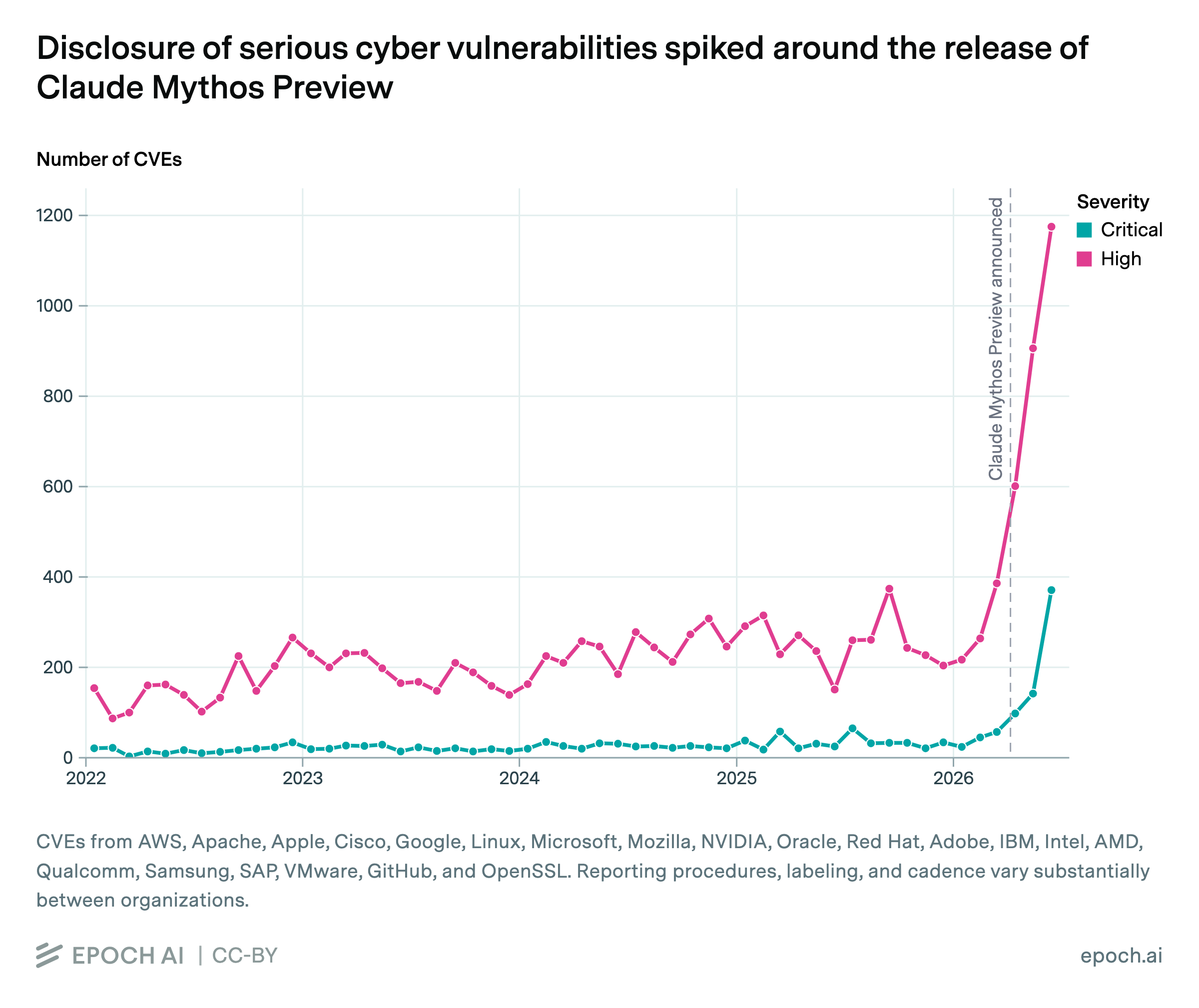
The spike follows Anthropic’s April announcement that Claude Mythos Preview could autonomously discover software vulnerabilities, and that the company’s Project Glasswing partners — including Microsoft, Google, Apple, and AWS — had been using it to find and fix bugs ahead of the model’s public release. Since its commencement, Project Glasswing claims to have found over 10,000 high- or critical-severity vulnerabilities, many of which have yet to be individually disclosed. Similar efforts have been undertaken by OpenAI with their Daybreak product.
Epoch's work is free to use, distribute, and reproduce provided the source and authors are credited under the Creative Commons BY license.
Learn more about this graph
In April 2026, Anthropic announced that its latest internal model (Claude Mythos Preview) was capable of autonomous cybersecurity vulnerability discovery and exploitation. Since then, both Anthropic and OpenAI have launched efforts to use frontier models to harden critical software before malicious actors are able to use the same models for harm.
We show that the number of Common Vulnerabilities and Exposures (CVEs) jumped significantly following these announcements. Compared to the previous monthly record before the Mythos Preview announcement, the number of high- and critical-severity vulnerabilities increased more than 3.5x in June.