Suppose that in the next few years, robotics capabilities take a large leap forward. Humanoid robots or mobile manipulators become able to perform most manual tasks that humans can. The potential market is enormous: billions of people do physical work, and a robot that could substitute for a human worker at a fraction of the cost would face nearly unlimited demand.
But robots are physical objects. While software can be copied and deployed nearly instantly, each robot must be manufactured from real components in real factories by real workers. Even if capabilities jumped overnight, production would take time to catch up.
How much time? In this post, we aim to produce numbers useful for people trying to answer that question. We focus on five form factors: humanoids, quadrupeds, robotic arms, wheeled robots, and drones. While the future of robotics may involve form factors that don’t yet exist at scale, or coordinated fleets of different kinds of robots, we believe that our analysis of existing form factors is still useful even in that world.
We approach this from two angles. First, we look at reference classes: how fast is robot production growing today, and how fast has production scaled historically when hit by sudden demand shocks? Second, we look at the actual constraints: what does it take to build a robot factory, and which components would run out first if you tried to produce robots at massive scale?
This piece is accompanied by a notes document that covers the underlying data, methodology, and lines of thinking that were relevant but too detailed to include here. Most paragraphs link directly to the relevant section of that document.
We mostly set aside the question of recursive self-improvement, where robots help build more robots. This dynamic would eventually become crucial: capable humanoids could help assemble further robots, accelerate factory construction, and generate the training data needed to improve further. But it also would kick in a bit later, once a large number of capable robots have already been deployed, so we focus here on the production landscape before that happens. We outline a few thoughts on where RSI might first bite in the notes document. More broadly, we don’t attempt to model how superintelligent AI directing the scale-up would change the picture. Instead, we assume throughout that ordinary human engineers, managers, and factory workers are running things.

Our main findings:
- In 2025, we estimate robot production at roughly 16,000 humanoids (doubling every 6 months), 81,000 quadrupeds (doubling every 10 months), 570,000 robotic arms (doubling every 8 years), 33 million wheeled robots, and 16 million drones. Although the growth trend for humanoids is rapid, it stems from a tiny, anomalous base, so the doubling rates for quadrupeds and other more established form factors are more reliable.
- Historical demand shocks such as WWII mobilization, or the production of drones following the war in Ukraine have accelerated production growth rates by 1.4–2.2x in the most comparable cases. This would imply doubling times of roughly 5–8 months for quadrupeds and 10–16 months for mature form factors. It’s unclear whether these cases are optimistic or pessimistic for robotics.
- New factories can take as little as 6 to 9 months to build in China (though they usually take 10 to 12 months) and 2+ years in most Western countries. This sets a latency on fast robot scaling, at least initially: output cannot grow much above current trends until new factories come online.
- Most robot components are not binding production constraints. The main exception is high-precision reducers, which currently cap humanoid production at roughly 500,000 units/year — about 30x current output — and quadruped production at about 750,000/year, though we expect these ceilings to rise over the coming years as supply chains respond to demand.
Reference classes for robot production scaling
Where robot production stands today
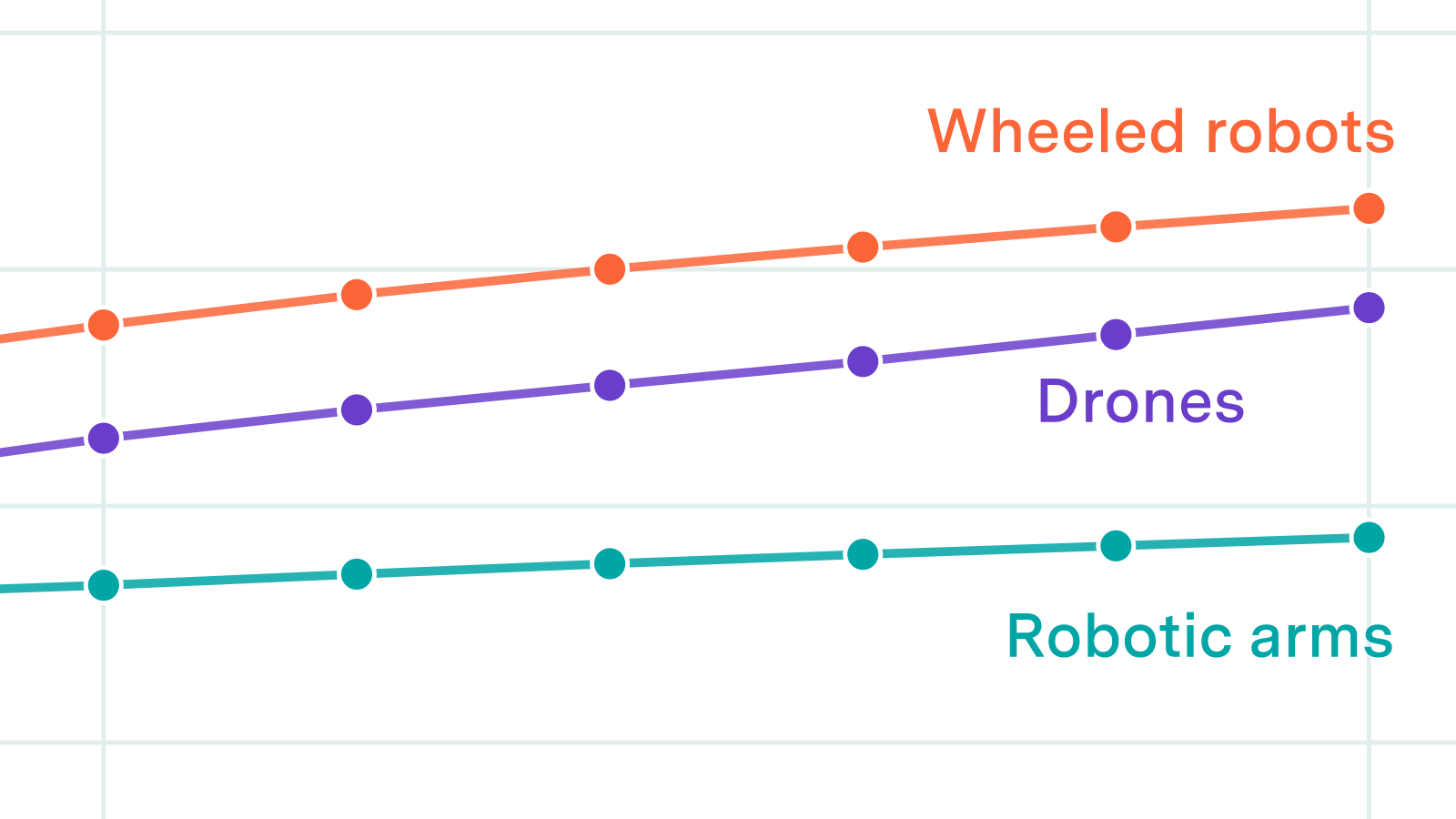
For most form factors, robot production is growing exponentially, with an average doubling time of about 3 years across all categories. But the variation is large: established form factors like drones and wheeled robots are growing more slowly, on a slightly sub-exponential trend, while newer form factors are scaling much faster.
| Form factor | 2025 production | Doubling time (2022–2025 trend) |
|---|---|---|
| Humanoids | ~16,000 | 6 months |
| Quadrupeds | ~81,000 | 10 months |
| Robotic arms | ~570,000 | 98 months (~8 years) |
| Wheeled robots | ~33 million | 42 months (~3.5 years) |
| Drones | ~16 million | 33 months (~2.7 years) |
Humanoids. The 6 months doubling time for humanoids is striking, but several things make it hard to read as a reliable trend. First, the absolute numbers are tiny: it is much easier to sustain fast doubling rates when you’re going from a few hundred to a few thousand units than when you’re going from 500,000 to 1 million. Second, most current humanoid purchases are not driven by productive use: most of today’s humanoids can’t do much genuinely useful work, so most demand is for research or marketing purposes, which is not representative of future use cases. This makes the current regime probably anomalous.
That said, the trend is not zero evidence. Humanoids are scaling faster than many products at comparable early stages, and the current low scale means they are still in a regime where there hasn’t been much investment in highly automated production lines or optimized supply chains, because demand hasn’t required it. As humanoids become more useful, these investments may get made and allow the current growth trends to continue.
Quadrupeds. Quadrupeds are a more reliable trend. Production has gone from a few thousand to ~81,000, driven by inspection, security, and surveillance applications. Chinese manufacturers (led by Unitree with ~40% global market share) have cut prices by over 90% relative to Boston Dynamics, with entry-level quadrupeds now available for ~$1,600.
Robotic arms. Robotic arms are the oldest and most mature category, with ~570,000 units annually, especially driven by electronics and automotive manufacturing. Close to hundreds of thousands of units were already produced annually in the 1990s. Growth has been steady but slow: this is an established market, not an emerging one. That said, the category is not immune to re-acceleration: China’s manufacturing expansion drove a new growth wave in the 2010s after a long plateau.
Drones and wheeled robots. Drones (~16 million/year) and wheeled robots (~33 million/year, mostly robot vacuums) are produced at large scale. Their growth is more incremental, though both have seen recent surges in specific segments: military drones from the Ukraine war, and robotic lawn mowers growing at over 300% year-on-year, in a similar fashion as what happened to robotic arms.
Naively extrapolating these production trends to 2031 suggests a world with ~75 million humanoids, ~24 million quadrupeds, ~312 million drones, and ~593 million wheeled robots. The projections for quadrupeds, drones, and wheeled robots seem plausible if current pilot programs in surveillance, delivery, and logistics prove successful. The humanoid extrapolation is much more speculative, since the current growth regime is probably anomalous.
How fast can production scale following demand shocks?
The previous section looked at what would happen if we extrapolate current production trends. However, we want to know what happens if robot capabilities crossed a threshold that made them extremely useful for a huge range of tasks. This would create a massive demand shock and capital would essentially no longer be a constraint.
Historical reference classes. To get a sense of how much faster production could get under those conditions, we looked at historical cases where a sudden external shock forced rapid production ramp-ups for complex physical goods.
| Case | Annual production multiplier before → after |
|---|---|
| US fighter planes (WWII) | 1.25x/yr → 2.8x/yr |
| US tanks (WWII) | 2.57x/yr → 4.47x/yr |
| Soviet tanks (WWII) | 1.32x/yr → 1.91x/yr |
| US synthetic rubber (WWII) | ~1.0x/yr → 4.65x/yr |
| World FPV drone production (due to Ukraine war) | 1.11x/yr → 1.32x/yr |
| US + EU artillery shells (Ukraine) | ~1.0x/yr → 1.7x/yr |
The WWII cases show how entire national economies were redirected, as automobile factories were converted to produce military vehicles. This allowed production to grow massively for years before dropping sharply the moment that the demand signal disappeared. In the case of synthetic rubber, we see that even with massive government capital, it took four years to build an industry from near-zero under wartime urgency. The Ukraine drone case cuts the other way: FPV production ramped to over 2 million units per year starting from artisan workshops with no traditional factory infrastructure initially. In our notes, we also include additional, more distant, reference classes including satellites, GLP-1 agonists, and Covid-era demand shocks.
What does this tell us about robot production? These different cases show that demand shocks can accelerate production growth by roughly 1.4 to 2.2 times (comparing annual production multipliers before and after the shock), and that these accelerated rates can be sustained for years while the underlying demand is real and sustained. Applied to current robotics baselines, a shock of similar magnitude suggests that mature categories like arms, wheeled robots, or drones could reach doubling times of 10–16 months, while quadrupeds could reach doubling times of 5–8 months.
To make these rates concrete, consider a stylized scenario: current trends continue until a demand shock hits at the end of 2027, with humanoids assumed to slow from their current anomalous pace to a doubling time of roughly 9 months by EOY 2027. By that point, current trends would put humanoid production at roughly 200,000/year and quadruped production at roughly 500,000/year. Applying the reference-class acceleration for three years gives a range of roughly 10–30 million humanoids/year and 15–60 million quadrupeds/year by the end of 2030. Drones and wheeled robots start from larger bases and could reach 150–600 million/year.
How should we read these reference classes? On the one hand, the kind of demand shock we’re imagining, robots capable of replacing a large fraction of manual labor, could be far larger in economic magnitude than anything in our table. Manufacturers could mobilize more capital, and face stronger incentives to solve every bottleneck fast, which could drive faster production growth. On the other hand, wartime cases are unusual in that the government can use its authority to redirect entire industries.
In any case, these reference classes don’t tell us what specifically would constrain a production ramp-up. Historical cases suggest that growth of this magnitude is physically achievable, but they don’t tell us which specific components or factory capacity would be the limiting factors for robots, or if and how even faster growth could be achieved. For that, we turn to the inside view.
Inside view: what are the actual constraints?
Even if money is no object and demand is unlimited, producing a robot still requires: a factory with the workers to operate it, and physical components (motors, reducers, sensors, screws) sourced from upstream suppliers. Each of these could bottleneck robot production.
Building factories
You cannot build most robots without factories, and building factories takes some time. Making a factory requires constructing the building itself, but more importantly setting up the production line inside it: installing and qualifying precision equipment, developing the process, and getting workers able to operate it.
How long does it take to build a factory? Tesla Shanghai went from groundbreaking to trial car production in 8 months. This is one of the better reference points, since car assembly is mechanically closer to humanoid assembly than most other factory types. Assuming demand is massive and money is no object, 6–9 months is probably the right figure for China. Outside China, equivalent projects typically take two years or more.
Retrofitting. Retrofitting existing auto plants is most useful in Western countries, where greenfield construction takes over 2 years. A full assembly retool in the US can happen in 6 to 10 months: for example, Ford’s Louisville 3 million sq ft plant converted from ICE to EV production in 8–10 months. In China, where greenfield construction can already be as fast as 6–9 months, retrofitting seems to offer less of an advantage.
How many factories and workers would be needed? Agility’s RoboFab provides a rough anchor: 70,000 sq ft currently produce around 150–500 humanoids/year, with a stated target of 10,000/year. Assuming that this target is slightly overstated and the real number is 60%, we get a density of around 0.09 humanoids per square foot per year. This is similar to car factories, which run at about 0.1 vehicles per square foot per year. We find a similar density for quadruped production, for example in Abbott Robotic’s factory.
Working backwards from the RoboFab range: reaching 10 million humanoids/year, a 600x scale-up from the 2025 number, would require around 110 million square feet. That’s roughly the surface of 20 Tesla Texas-scale facilities. Since building a Tesla Gigafactory requires 2000 personnel, that’s 40k workers in total.
Once built, these factories need to be staffed. For battery gigafactories, the operational headcount roughly matches construction headcount (so another 40k workers). For automotive plants, the operational headcount is closer to 2–3x (so 80k–120k workers). RoboFab plans 500 staff across 70k square feet: this extrapolates to something above the automotive range, but that does not account for economies of scale. Overall, a reasonable working assumption suggests somewhere between 40k and 120k workers. Most of these positions don’t require highly advanced skills, so training could realistically run in parallel with the year-long construction window.
The upshot. The hard latency before new humanoid or quadruped capacity comes online is 6–9 months in China or 2+ years for greenfield builds in the West, though retrofitting existing auto plants could cut this to 6–10 months. Drones and wheeled robots are less constrained here, with drones in particular having demonstrated they can scale without purpose-built factory lines. Beyond the initial latency, scaling robot production would require many production lines running in parallel: reaching 10 million humanoids per year would need roughly 20 Tesla Gigafactory-scale facilities. This would imply around 40,000 construction workers, plus 40,000 to 120,000 operational staff to run the facilities once they have been built.
Getting the components
Even with enough factories, you need the components to fill them. We compiled data on current global production volumes for the major components used in robots and compared them to per-unit requirements for each form factor. The ceilings in the table represent a theoretical maximum: they assume the entire global supply of each component is redirected to robot production. In practice, these components serve other markets that won’t simply disappear, so the real-world ceilings are lower. The tables below show only our estimates of the humanoid and quadruped ceilings. The underlying annual production volumes, per-robot component counts, and sources are in our full bill-of-materials spreadsheet, as well as the corresponding numbers for other form factors like drones and wheeled robots.
Three component tiers
Most components are not binding constraints. Cameras (7 billion/year), MEMS sensors (31 billion/year), bearings (tens of billions/year), batteries (2 billion kWh/year), and wiring (30 million tons/year) are all produced at scales that would easily absorb a 10x or even 100x increase in robot production. Even at a million humanoids per year, camera demand from robots would be less than 0.1% of current camera output.
A handful of other components would matter at higher volumes. Servo motors, planetary roller screws, torque sensors, and high-resolution encoders could be constraints if humanoid production was in the millions per year. These components are farther from bottlenecking production than high-precision reducers (see below), and our production estimates are likely lower bounds since public data on manufacturing is scarce.
How many humanoids and quadrupeds per year each component’s existing global supply could support, assuming all of it goes to robots.
| Component | Humanoid ceiling | Quadruped ceiling |
|---|---|---|
| Planetary roller screws | 1,500,000 | — |
| Lead screws | 2,500,000 | — |
| Ball screws | 2,500,000 | — |
| Torque sensors | 1,250,000 | 2,500,000 |
| High-res encoders | 1,250,000 | 2,500,000 |
| Motion controllers | 3,750,000 | 7,500,000 |
| Servo motors | 4,545,000 | 10,000,000 |
Reducers are the closest to a binding constraint. Reducers are mechanical components that sit between a motor and a joint. Motors spin fast but produce little torque; reducers trade speed for torque, letting a small motor lift a heavy limb. A humanoid needs one at each major joint (hips, knees, ankles, shoulders, elbows, wrists), so typically each humanoid contains 20 to 40 reducers depending on the design.
How many humanoids and quadrupeds per year each reducer type’s existing global supply could support, assuming all of it goes to robots.
| Component | Humanoid ceiling | Quadruped ceiling |
|---|---|---|
| Planetary reducers | 500,000 | 750,000 |
| Cycloidal/RV reducers | 500,000 | — |
| Strain wave reducers | 1,000,000 | 1,500,000 |
There are three main types of high-precision reducers: planetary gearboxes (used for load-bearing joints like the thighs), cycloidal/RV reducers (common in elbows), and strain wave gears (compact, used in space-constrained joints like wrists and fingers). Planetary gearboxes (about 3 million/year), cycloidal/RV reducers (about 2 million/year), and to a lesser extent strain wave gears (about 12 million/year) set the production ceiling. At 6 planetary reducers and 4 cycloidal reducers per humanoid, current output caps production at roughly 500,000 humanoids per year.
What if we need more reducers per robot? The robot in our bill of materials is low to medium end, and does not attempt very dexterous hands. Some manufacturers are moving in the opposite direction: Tesla’s current Optimus generation has roughly 50 actuators per hand, and if enough of the industry converges on that level of complexity, per-robot reducer demand could triple or more relative to our baseline. Moreover, reducers for fingers are much smaller than the reducers used for other joints, so the capacity in existing suppliers of harmonic drives may be inadequate.
However, it’s unclear how serious of an impediment this will be to fast scaling. The applications most likely to drive demand in the near-term, such as logistics, warehousing or light manufacturing, don’t require full hand dexterity. Moreover, we’ve frequently seen software progress compensate for hardware limitations in robotics, such as Physical Intelligence achieving high precision tasks with only simple grippers.
How could reducer production scale? Reducer production can expand meaningfully. Precision reducers are not semiconductors: tolerances are measured in micrometers, not nanometers, and producing reducers does not require clean rooms. As in other industries like solar or EV batteries, the existing supply chain is already being disrupted by Chinese manufacturers who accept lower margins and invest aggressively. Suppliers, assemblers, and customers sit in the same Chinese manufacturing clusters, which lets them iterate far faster than geographically dispersed Japanese incumbents.
In a baseline scenario, 2x and 4x increases in reducer output by 2028 and 2030 are reasonable floors, consistent with current expansion plans. This would be enough to support roughly 1.5–3 million humanoids annually by 2030. Under a demand shock, a 10–30x increase is plausible, supporting 5–15 million humanoids per year. Reducers may remain a binding constraint, but at a much higher absolute ceiling than today.
Putting it together
Given all this, if a massive demand shock occurred in the next year or two, what production numbers seem reasonable three years into such a scale-up? These carry wide error bars, but it’s useful to distinguish what seems clearly achievable from what would require things going remarkably well.
To make the timing concrete, suppose a massive demand shock hits at the end of 2027. We then ask what annualized production rate the world could plausibly reach by the end of 2030. That is only about three years of post-shock scaling, and for humanoids and quadrupeds effectively closer to two years, because new factory capacity takes time to come online and upstream component bottlenecks only start easing materially after the first year or so. Drones and wheeled robots can respond faster because they depend less on purpose-built factories.
Humanoids. The two main constraints, factory buildout and reducer supply, still have to be solved in parallel, and both have real latency. If the demand shock hits at the end of 2027, much of 2028 is spent building capacity rather than producing robots. So the end of 2030 really means only about two years of full-speed humanoid production. On that timeline, an annualized production of 1.5–3 million/year by EOY 2030 seems clearly achievable. 5–10 million/year looks plausible if reducer capacity expands aggressively and multiple factory waves complete on schedule. Above 15 million/year would require things going unusually well, especially on reducers, and probably austere designs rather than highly dexterous hands. Overall, these numbers are a bit lower than the 10 to 30 million range from our reference class analysis.
Quadrupeds. Quadrupeds are simpler to manufacture than humanoids; there’s a larger existing base and no need for as many small precision reducers. 2–5 million/year at EOY 2030 seems clearly achievable, and 8–15 million/year seems like a good central estimate. 20 million is plausible but already near the high end of what reducer scaling could support.
Drones. The main eventual component constraint is propellers and possibly chips, but propellers are much easier to scale than precision reducers, and as we’ve seen with Ukraine, drones can ramp before purpose-built mega-factories exist. That makes production much more responsive in the first year after a demand shock. 100–200 million/year at the end of 2030 seems achievable without hitting especially hard limits. 300–500 million/year is ambitious but physically plausible. 1 billion/year would require a very large expansion in propellers in only three years, and still looks hard as a central case.
An important dynamic we haven’t addressed in this writeup is robots building robots. Robotic arms already help manufacture other robots, and in a world where humanoids are capable, they could help build factories faster, accelerate the production of components, and generate the training data needed to further improve capabilities. This recursive dynamic would compress the timelines described above, at least after the first few waves of production. We outline a few initial thoughts on how this might happen in our notes document, but treat it as an important topic for future analysis.
Alongside this report, we’ve released a series of forecasting questions on the future of robotics in collaboration with Metaculus. If you have views on where these trends are headed, come weigh in.
Acknowledgements
Thanks to Amelia Michael, Benjamin Alt, and Daniel Kokotajlo for their helpful feedback. Thanks to Romeo Dean for the ideas that inspired some of this work, especially the components section. This work was funded by a donation from Girish Sastry.
About the authors


Related work