What we found
- One in five employed adults now delegates some tasks to AI rather than humans. 20% of respondents say AI now handles at least one task that was previously handed off to a coworker or contractor.
- AI is used for all ten work tasks we asked about. Among workers who perform each task, the share using AI ranges from 25% (maintaining records) to 57% (designing systems and software).
- AI rarely performs most or all of a task, but workers save time more often when it does. Workers report saving time on 37% of tasks where AI assists with part of the work. When AI performs most or all of the task, workers report saving time on 53% of tasks.
- Workers accept more than half of AI outputs with minimal revision. Across AI-assisted tasks, 66% of outputs were used unchanged or with only minor edits, compared to 5% that were majorly reworked or mostly redone.
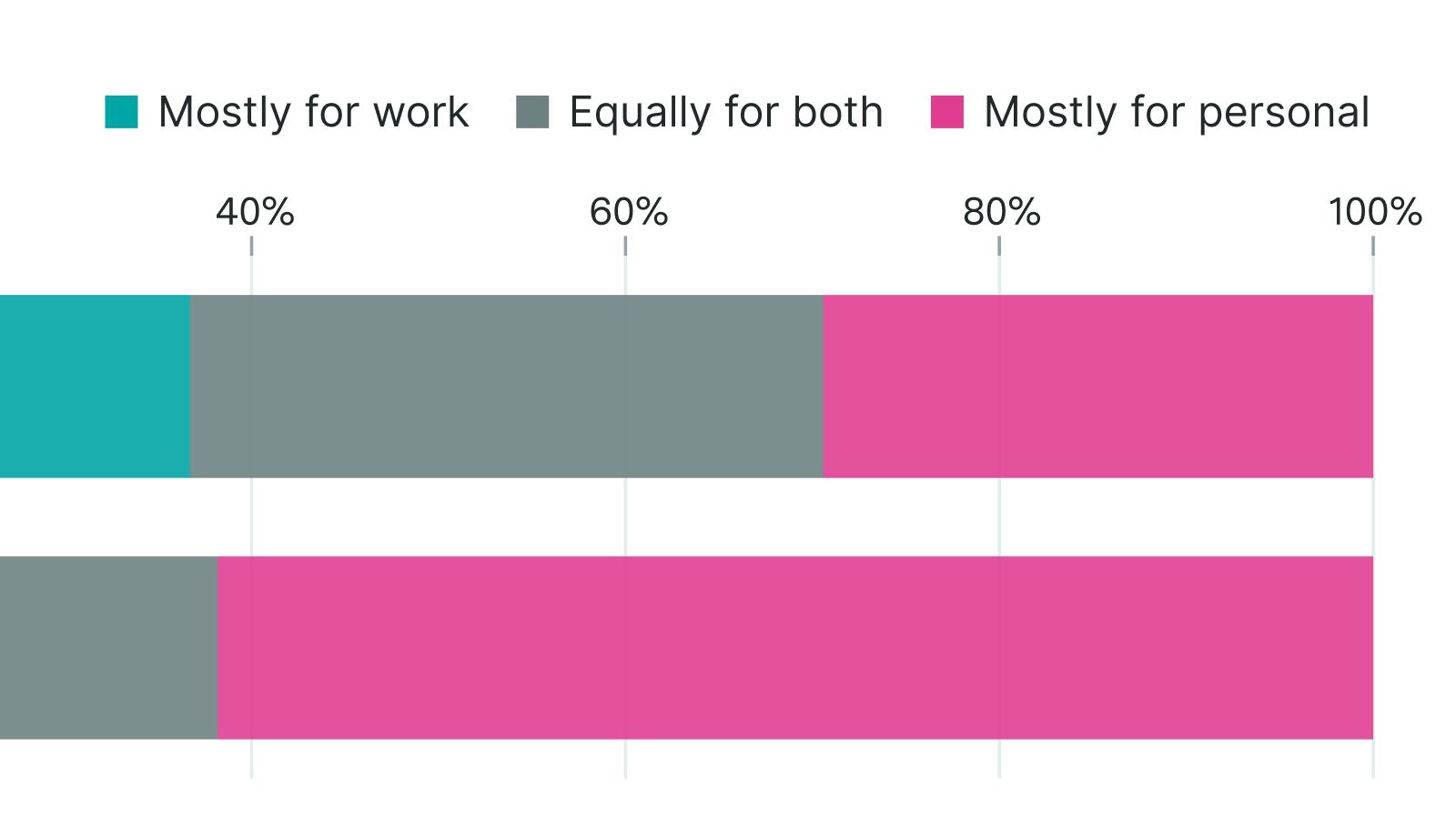
Our previous survey, fielded March 3-5 of this year, found that AI has become a common workplace tool in the US, with 51% of employed AI users reporting they use it at least as much for work as for personal tasks. To zoom into workplace AI usage, we surveyed 1,106 employed US adults about how they use AI for ten work tasks. The surveyed tasks were selected to be broadly representative of US knowledge work.
AI is now delegated work previously given to other humans
Reallocation from humans to AI is one concrete way that AI is entering workflows. We asked workers whether AI now handles mostly all, or all, of any task that they or their team previously delegated to a contractor or coworker. One in five said that this has happened for at least one of the ten tasks we measured.
This reallocation of work to AI appears across all ten tasks we measured. It is most common for “analyzing data” (7.1% of respondents), followed by “reading work documents” (5.7%) and “maintaining records” (5.3%). Although we are seeing task-level substitution, this does not necessarily equal full worker displacement.

About this survey
The data in this analysis come from an Epoch AI/Ipsos survey on the Ipsos KnowledgePanel, a probability-based online panel recruited via address-based sampling.
The survey was fielded July 10–19, 2026, and includes 1,106 employed US adults.
Probability-based sampling reduces self-selection bias and produces estimates that are more representative of the employed US population. All estimates are weighted to be representative of employed US adults. We remove a small set (n=3) of invalid responses for the analysis.
The tasks are common work activities drawn from O*NET, the US Department of Labor’s occupational database, and were selected based on employment share to reflect common knowledge work.
Read more about our methodology here.
All point estimates and counts are weighted unless otherwise specified. Confidence intervals are 90% and are estimated using Taylor series linearization, treating the respondent as the primary sampling unit. For findings measured at the task level, this keeps the multiple tasks a worker reported together, so the intervals account for that clustering. The full survey questionnaire, data files, and graphs are available at the polling hub.
AI is used for tasks that cut across widely held jobs
AI use is reported across all ten tasks, although adoption rates vary considerably. Among workers performing the “designing computer systems or software” task, 57% use AI to some extent for that work. This share is 46% among workers “analyzing data” and 39% for “reading work documents”. Uptake is lowest for “maintaining records”, where 25% of workers who perform it use AI.
This breadth of use does not mean AI performs the whole task. In most cases, workers describe it as assisting with only part of the work. Full or nearly full task reallocation to AI is most common for workers designing computer systems or software, at 10%, but remains below 7% for other tasks.

AI usually doesn’t do the whole task, but saves time most often when it does
More AI involvement is associated with a greater likelihood of reported time savings. Respondents report that when AI assists with part of the work, 37% of tasks take less time. Among tasks where AI does most or all of the work, the share rises to 53%.
There are several possible reasons for this association. One possibility is that AI taking on a larger share of a task saves workers time. Another is that workers hand more of a task to AI when they are trying to save time. It may also be the case that these findings simply reflect tasks that AI handles particularly well.

However, AI use is not always accompanied by reported time savings. Roughly one in six AI-assisted tasks now takes more time than before. The share is similar whether AI assists with part of the task or performs most or all of it. Possible reasons for this may be that engaging with AI makes these tasks take longer or that workers are spending more time on a task for other reasons, such as AI freeing them up to do more of it or a more high-quality version of the task.
Workers accept most AI outputs with minimal revision
Across tasks both partially and fully performed by AI, 66% of AI outputs are used as produced or with only minor revisions. 6% are used without any changes. More extensive revision is reported for 27% of outputs, and 5% of outputs are majorly reworked or mostly redone.

That two-thirds of outputs are kept with at most minor edits could suggest workers usually find AI outputs useful enough to incorporate into their work. However, editing burden is not a direct measure of output quality, and there is no consistent relationship between reported time savings and amount of output editing.
Conclusion
These survey results offer a snapshot of how tasks are divided between people and AI in current workflows. Our four key takeaways portray AI as a versatile but usually not self-sufficient workplace tool. Together, they point to tasks being reallocated between people and AI rather than the wholesale automation of jobs.
To learn more about how AI is used in the workplace, visit the Polling on Usage explorer to find the full survey results, methodology, and interactive visualizations!
About the authors



Related work