Updated Sep. 4, 2026

Largest AI data centers ranked by power capacity, 2026

This chart ranks the largest current and future AI data centers by their IT power, measured in megawatts (MW).

Settings
View

Display

Color by

Data

The largest AI data centers by power capacity

Epoch AI estimates that as of September 2026, Colossus 2 is the largest tracked AI data center at about 946 MW of current IT power, followed by Anthropic-Amazon New Carlisle at about 910 MW and Microsoft Fairwater Atlanta at about 636 MW. These figures are operational capacity (power the facilities can already draw), not planned end-state capacity, which for several sites is substantially larger. For scale, the city of San Diego draws electricity at an average rate of about 800 MW.

Ranked by planned end-state capacity instead, the largest data centers are:

Data centerProjected IT power (est.)Projected completion
Microsoft Fairwater Wisconsin2,263 MW2028
Anthropic-Amazon New Carlisle1,925 MW2028
OpenAI Stargate New Mexico1,750 MW2028
Meta Hyperion1,676 MW2028
Colossus 21,531 MW2027

The largest planned AI data center Epoch tracks is Microsoft Fairwater Wisconsin, projected for completion in Q2 2028 with an end-state capacity of about 2,263 MW.

Explore the full AI Data Centers dataset

How to read this chart

Definitions

  • Data center (bar). A building or campus-level AI facility.
  • IT power (bar length). The electrical power capacity needed for a facility's computing hardware, in megawatts. The chart ranks facilities by this metric.
  • Current and projected IT power. "Current IT Power" is the power a facility can draw today; "Projected IT Power" is the power expected once the facility's planned buildout is complete. Both appear when you hover over a bar.

What else to know about this data

  • These figures are estimates, not disclosed specifications. Epoch reports in its data-centers methodology that about 80% of the time an IT power estimate falls within a factor of 1.4 of the true value, so individual numbers should be read as approximate.
  • The chart shows power capacity, not actual power draw. A facility does not necessarily run at full capacity at all times.
  • Coverage is deliberately scoped: Epoch focuses on facilities that became operational in 2024 or later (with some exceptions), and includes planned data centers only when construction has started and the project has a significant chance of being completed. The threshold for inclusion is roughly 100 MW of IT power at full buildout. Most tracked facilities are in the United States; to keep coverage globally balanced, Epoch uses a lower threshold for facilities outside the US.
  • Even within that scope, coverage is not comprehensive. Smaller data centers, especially those consuming less than 100 MW, are harder to find; together, these can add up to a significant amount of power consumption.
  • A whole data center is not necessarily devoted to a single AI training run. Facilities can run many workloads in parallel or be partitioned across users.

How it's measured

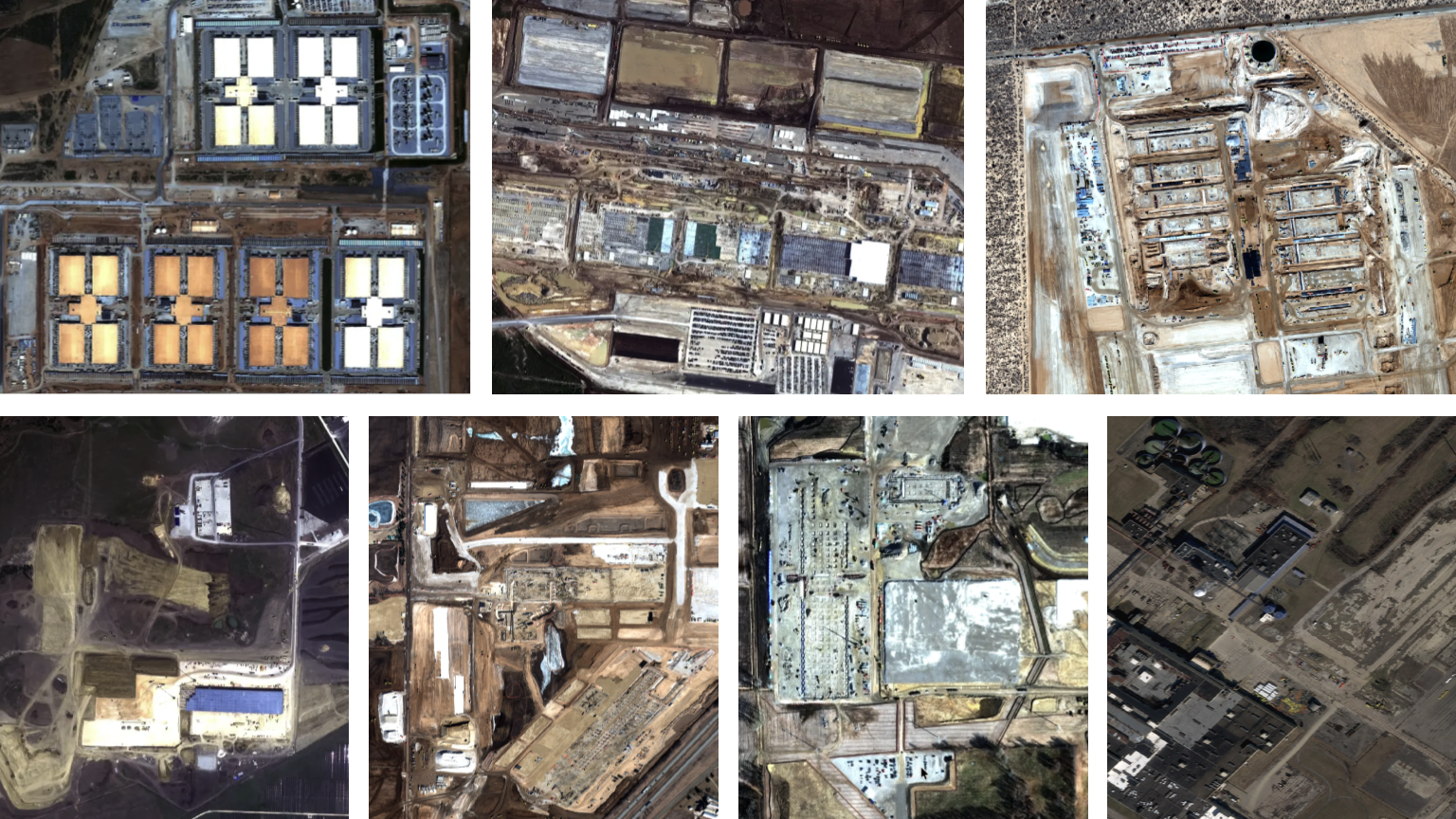
Epoch identifies candidate data centers from company announcements, news outlets, third-party databases, social media, and our GPU Clusters database (for example, OpenAI's Stargate site in Abilene was already tracked there). We then research each site using commercial and public satellite imagery, permitting documents, company disclosures, and, in some cases, drone or thermal imagery.

IT power is estimated from the best available evidence. Sometimes that means inferring it from the facility's visible cooling equipment. When the type and number of chips are known, we instead multiply the chip count by the power each chip's server draws. The second method of estimation is more reliable, but harder to obtain. The cooling system's own power draw is not itself counted in IT power. Total facility power is a separate, derived figure: IT power multiplied by a peak power-usage effectiveness (peak PUE), a unitless ratio, for which we default to about 1.2 for hyperscalers such as Google and Amazon and 1.4 otherwise, unless facility-specific evidence points elsewhere.

Read the full methodology

Citations

Freely reusable under a Creative Commons Attribution 4.0 license, provided the source and authors are credited.

Citation

Epoch AI, 'Largest AI data centers ranked by power capacity, 2026'. Published online at epoch.ai. Retrieved from 'https://epoch.ai/graphs/largest-ai-data-centers-by-power-capacity' [online resource]. Accessed 9 Sep 2026.

BibTeX Citation

@misc{EpochAIDataCenters2026Graph, title = {{Largest AI data centers ranked by power capacity, 2026}}, author = {{Epoch AI}}, year = {2026}, month = {9}, url = {https://epoch.ai/graphs/largest-ai-data-centers-by-power-capacity}, note = {Accessed: 9 Sep 2026} }

Python Import

import pandas as pd data_url = "https://epoch.ai/data/data_centers/data_centers.csv" df = pd.read_csv(data_url)