



The largest AI models today are trained with over 1025 floating-point operations (FLOP) of compute. The first model trained at this scale was GPT-4, released in March 2023. As of June 2025, we have identified over 30 publicly announced AI models from 12 different AI developers that we believe to be over the 1025 FLOP training compute threshold.
| Model | Domain | Organization | Publication date | Reference | Link | Parameters | Training compute (FLOP) | Model accessibility | Confidence | Country (of organization) | Estimated over 1e25 FLOP | Training compute estimation method |
|---|---|---|---|---|---|---|---|---|---|---|---|---|
| Aramco Metabrain AI | Language | Saudi Aramco | 2024-03-04 | 2.5e+11 | 1.0e+25 | Unreleased | Likely | Saudi Arabia | checked | Operation counting | ||
| Claude 3 Opus | Multimodal,Language,Vision | Anthropic | 2024-03-04 | 1.6e+25 | API access | Speculative | United States of America | checked | Benchmarks | |||
| Claude 3.5 Sonnet | Multimodal,Language,Vision | Anthropic | 2024-06-20 | Claude 3.5 Sonnet | 2.7e+25 | API access | Speculative | United States of America | checked | Cost | ||
| Claude 3.7 Sonnet | Language,Vision,Multimodal | Anthropic | 2025-02-24 | Claude 3.7 Sonnet | 3.4e+25 | API access | Likely | United States of America | checked | |||
| Claude Opus 4 | Language,Multimodal,Vision | Anthropic | 2025-05-22 | API access | Unknown | United States of America | checked | |||||
| Claude Sonnet 4 | Language,Multimodal,Vision | Anthropic | 2025-05-22 | API access | Unknown | United States of America | checked | |||||
| Doubao-pro | Language | ByteDance | 2024-10-28 | Doubao General Model Pro (Doubao-pro) | https://www.volcengine.com/docs/6360/1264663 | 5.0e+11 | 2.5e+25 | API access | Speculative | China | checked | Operation counting |
| Gemini 1.0 Ultra | Multimodal,Language,Vision | Google DeepMind | 2023-12-06 | 5.0e+25 | API access | Speculative | checked | Benchmarks,Hardware | ||||
| Gemini 1.5 Pro | Language,Multimodal | Google DeepMind | 2024-02-15 | 1.6e+25 | API access | Speculative | checked | Benchmarks | ||||
| Gemini 2.0 Pro | Language,Multimodal,Vision,Video,Audio | Google DeepMind | 2024-12-11 | Hosted access (no API) | Unknown | checked | ||||||
| Gemini 2.5 Pro | Language,Vision,Video,Multimodal,Speech | Google DeepMind | 2025-03-25 | Gemini 2.5: Our most intelligent AI model | API access | Unknown | checked | |||||
| GLM-4 (0116) | Language | Zhipu AI | 2024-01-17 | 1.2e+25 | API access | Likely | China | checked | Operation counting | |||
| GLM-4-Plus | Language | Zhipu AI | 2024-08-29 | GLM-4-Plus | https://bigmodel.cn/dev/howuse/glm-4 | 3.6e+25 | API access | Unknown | China | checked | Benchmarks | |
| GPT-4 | Multimodal,Language,Vision | OpenAI | 2023-03-15 | GPT-4 Technical Report | https://arxiv.org/abs/2303.08774 | 2.1e+25 | API access | Speculative | United States of America | checked | Hardware | |
| GPT-4 Turbo | Multimodal,Vision,Language,Image generation | OpenAI | 2023-11-06 | 2.2e+25 | API access | Unknown | United States of America | checked | Benchmarks | |||
| GPT-4.1 | Multimodal,Language,Vision,Video | OpenAI | 2025-04-14 | https://openai.com/index/gpt-4-1/ | API access | Unknown | United States of America | checked | ||||
| GPT-4.5 | Language,Vision,Multimodal | OpenAI | 2025-02-27 | Introducing GPT-4.5 | https://openai.com/index/introducing-gpt-4-5/ | 2.1e+26 | API access | Speculative | United States of America | checked | Benchmarks | |
| GPT-4o | Multimodal,Language,Audio,Speech,Vision | OpenAI | 2024-05-13 | Hello GPT-4o | 3.8e+25 | API access | Speculative | United States of America | checked | Benchmarks | ||
| Grok-2 | Language,Vision,Multimodal | xAI | 2024-08-13 | Grok-2 Beta Release | https://x.ai/blog/grok-2 | 3.0e+25 | Hosted access (no API) | Confident | United States of America | checked | Comparison with other models,Reported | |
| Grok-3 | Language,Vision,Multimodal | xAI | 2025-02-17 | Grok 3 Beta — The Age of Reasoning Agents | https://x.ai/blog/grok-3 | 4.6e+26 | Hosted access (no API) | Confident | United States of America | checked | Hardware,Comparison with other models | |
| Inflection-2 | Language | Inflection AI | 2023-11-22 | Inflection-2: The Next Step Up | https://inflection.ai/inflection-2 | 1.0e+25 | Hosted access (no API) | Confident | United States of America | checked | Hardware,Benchmarks | |
| Inflection-2.5 | Language | Inflection AI | 2024-03-07 | https://inflection.ai/inflection-2-5 | 1.0e+25 | Hosted access (no API) | Speculative | United States of America | checked | Comparison with other models | ||
| Llama 3.1-405B | Language | Meta AI | 2024-07-23 | The Llama 3 Herd of Models | 4.1e+11 | 3.8e+25 | Open weights (restricted use) | Confident | United States of America | checked | Reported,Operation counting | |
| Llama 4 Behemoth (preview) | Multimodal,Language,Vision | Meta AI | 2025-04-05 | 2.0e+12 | 5.2e+25 | Unreleased | Likely | United States of America | checked | Operation counting | ||
| Mistral Large | Language | Mistral AI | 2024-02-26 | Mistral Large, our new flagship model | https://mistral.ai/news/mistral-large/ | 1.1e+25 | API access | Likely | France | checked | Cost | |
| Mistral Large 2 | Language | Mistral AI | 2024-07-24 | https://mistral.ai/news/mistral-large-2407/ | 1.2e+11 | 2.1e+25 | Open weights (non-commercial) | Likely | France | checked | Hardware,Cost,Benchmarks | |
| Nemotron-4 340B | Language | NVIDIA | 2024-06-14 | 3.4e+11 | 1.8e+25 | Open weights (unrestricted) | Confident | United States of America | checked | Operation counting,Hardware | ||
| o1 | Language,Mathematics,Multimodal | OpenAI | 2024-12-05 | API access | Unknown | United States of America | checked | |||||
| o3 | Language,Vision,Multimodal | OpenAI | 2024-12-20 | API access | Unknown | United States of America | checked | |||||
| Pangu Ultra | Language | Huawei | 2025-04-10 | https://arxiv.org/abs/2504.07866 | 1.4e+11 | 1.1e+25 | Hosted access (no API) | Confident | China | checked | ||
| Sora | Video,Vision | OpenAI | 2024-02-15 | Video generation models as world simulators | Unreleased | Unknown | United States of America | checked | ||||
| Veo 2 | Video,Vision | Google DeepMind | 2024-12-16 | Our state-of-the-art video generation model | API access | Unknown | checked | |||||
| Veo 3 | Video,Vision | Google DeepMind | 2025-05-21 | Our state-of-the-art video generation model | https://deepmind.google/models/veo/ | API access | Unknown | checked |
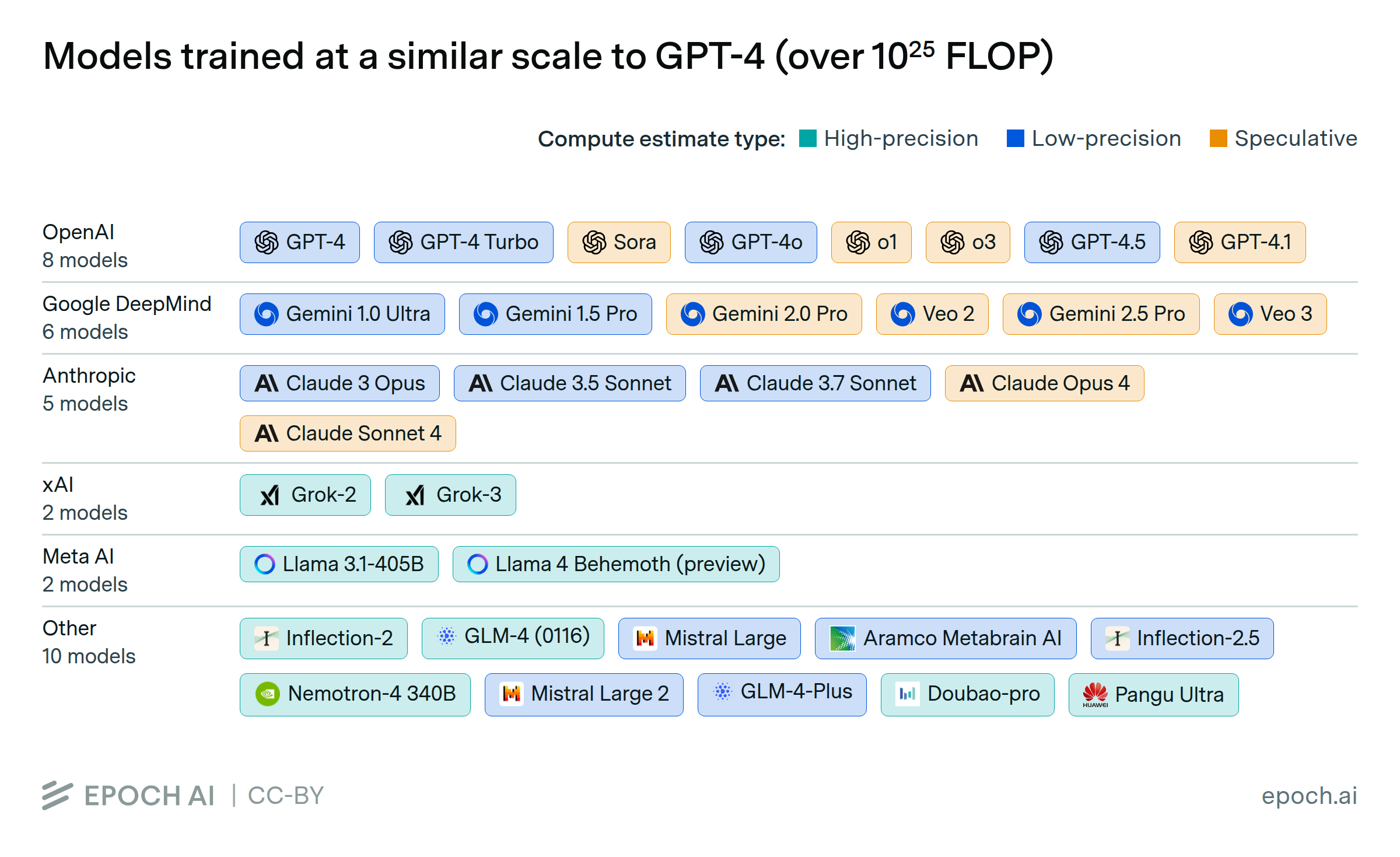
Training a model of this scale costs tens of millions of dollars with current hardware. Despite the high cost, we expect a proliferation of such models—we saw an average of roughly two models over this threshold announced every month during 2024. Models trained at this scale will be subject to additional requirements under the EU AI Act, coming into force in August 2025.
Epoch's work is free to use, distribute, and reproduce provided the source and authors are credited under the Creative Commons BY license.
Learn more about this graph
To search for AI models exceeding 1025 FLOP we examined three sources:
- Recent releases from leading AI labs
- Top-scoring models on AI benchmarks and leaderboards
- The most-downloaded large models on the open model repository, Hugging Face
We performed an exhaustive review of recent model releases from AI developers known to have access to enough AI hardware for large-scale training: Google (including Google DeepMind), Meta, Microsoft, OpenAI, xAI, NVIDIA, and ByteDance. Other organizations that have developed models in the Epoch database of notable AI models were examined briefly for recent, large-scale model releases.
To identify other large models developed by other, lesser-known labs, we examined common language benchmarks such as MMLU, MATH and GPQA, as well as the Chatbot Arena and HELM leaderboards. We searched for any scores that matched or exceeded the performance of lower-performing models known to be trained with over 1025 FLOP (i.e. the minimum score across the original GPT-4, Inflection-2, or Gemini Ultra). We also searched for large models developed by Chinese developers. To do this, we examined the China-focused CompassRank and CompassArena leaderboards. We looked at all models scoring above models known to be trained with just under 1025 FLOP, such as Yi Lightning and Llama-3 70B.
Models that met these criteria were added to our wider database of AI models. We then estimated their training compute, and whether it might exceed 1025 FLOP. For several AI models, developers provided insufficient information for us to directly estimate training compute. In this case, we estimated training compute from model performance. For language models, we did this using imputation based on benchmark scores. For image and video models, where fewer standardised benchmark scores were available, we relied on other measures of output quality, such as user preference testing.
There are no standardized benchmarks for frontier image and video models, meaning we could not use benchmark scores to search for these models. For example, recent video models such as Veo 2 were evaluated in their release materials by human preference of their outputs versus competitors. To address this, we individually examined the leading video generation and drawing services. We used user preferences and developers’ compute resources to assess whether such models might exceed the 1025 FLOP threshold.
Data
Assumptions
Download this data
Explore this data

Our comprehensive database of over 3500 models tracks key factors driving machine learning progress.