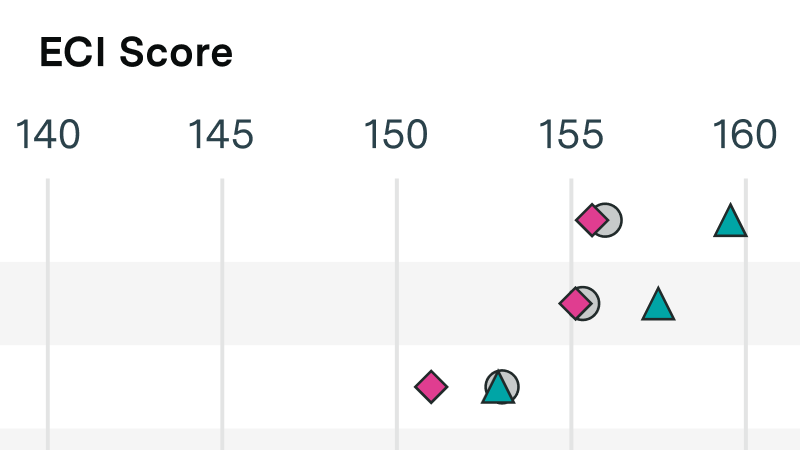

OpenAI’s GPT-6 Astra tops the Epoch Capabilities Index (ECI), our composite measure of model capabilities, with a score of 166, ahead of Anthropic’s Claude Fable 5.1 at 164 and OpenAI’s own GPT-5.6 Sol at 162. But this hides some complexity: while its Math-ECI of 170 sets a new record, on software engineering benchmarks Astra’s SWE-ECI of 164 still lags behind Fable 5.1’s 167.
| Model | Developer | ECI type | ECI | 90% CI lower | 90% CI upper | Benchmarks used |
|---|---|---|---|---|---|---|
| GPT-6 Astra | OpenAI | General ECI | 166.31 | 163.00 | 171.88 | 16 |
| Claude Fable 5.1 | Anthropic | General ECI | 164.47 | 161.36 | 168.28 | 15 |
| GPT-5.6 Sol | OpenAI | General ECI | 161.81 | 159.57 | 165.20 | 22 |
| Kimi K3 | Moonshot | General ECI | 157.63 | 155.38 | 160.45 | 19 |
| GPT-6 Astra | OpenAI | Math ECI | 169.83 | 165.98 | 175.37 | 4 |
| Claude Fable 5.1 | Anthropic | Math ECI | 165.73 | 162.84 | 175.91 | 4 |
| GPT-5.6 Sol | OpenAI | Math ECI | 162.76 | 159.85 | 166.24 | 4 |
| Kimi K3 | Moonshot | Math ECI | 158.39 | 155.23 | 162.76 | 4 |
| GPT-6 Astra | OpenAI | SWE ECI | 163.58 | 160.42 | 169.82 | 4 |
| Claude Fable 5.1 | Anthropic | SWE ECI | 167.44 | 161.95 | 178.53 | 3 |
| GPT-5.6 Sol | OpenAI | SWE ECI | 160.47 | 157.94 | 165.85 | 6 |
| Kimi K3 | Moonshot | SWE ECI | 161.54 | 158.59 | 165.87 | 5 |
| Snapshot | Snapshot date | Model | ECI | 90% CI lower | 90% CI upper | Benchmarks used | SWE benchmarks used | SWE benchmarks |
|---|---|---|---|---|---|---|---|---|
| At launch | 2026-09-03 | GPT-6 Astra | 169.23 | 164.85 | 174.02 | 9 | 1 | MirrorCode |
| Current | 2026-09-15 | GPT-6 Astra | 166.31 | 163.00 | 171.88 | 16 | 4 | MirrorCode; WeirdML; DeepSWE; FrontierCode |
| At launch | 2026-09-03 | Claude Fable 5.1 | 162.88 | 160.10 | 166.34 | 12 | 1 | FrontierCode |
| Current | 2026-09-15 | Claude Fable 5.1 | 164.47 | 161.36 | 168.28 | 15 | 3 | MirrorCode; WeirdML; FrontierCode |

Based on pre-release evals we gave Astra an ECI of 169 when it launched, but this fell as more software engineering benchmark results became available. Math-ECI and SWE-ECI are both domain-specific ECIs, refit on only one domain’s benchmarks, measuring a model’s strength relative to the general ECI. Explore these and custom subsets in our Domain-specific ECI Explorer.
Epoch's work is free to use, distribute, and reproduce provided the source and authors are credited under the Creative Commons BY license.
Learn more about this graph
We compare four recent models (GPT-6 Astra, Claude Fable 5.1, GPT-5.6 Sol and Kimi K3) using the Epoch Capabilities Index (ECI), as well as domain-specific ECI variants meant to measure math and software capabilities. Domain-specific ECIs retain the benchmark difficulty parameters from the general ECI fit and re-estimate each model’s capability from only a subset of those benchmarks from a specific domain, making the resulting scores comparable to general ECI scores. See our domain-specific ECI documentation for details on methodology.
Data
We use the General, Math and SWE ECI based on all benchmark scores available as of September 13th 2026. It is available to download below. In particular, the math benchmark scores available for GPT-6 Astra are OTIS Mock AIME, FrontierMath Tiers 1–3, FrontierMath Tier 4 and ProofBench, and the software engineering subset is MirrorCode, WeirdML, DeepSWE and FrontierCode.
The number of benchmark results behind each model’s scores:
| Model | General ECI | Math-ECI | SWE-ECI |
|---|---|---|---|
| GPT-6 Astra | 16 | 4 | 4 |
| Claude Fable 5.1 | 15 | 4 | 3 |
| GPT-5.6 Sol | 22 | 4 | 6 |
| Kimi K3 | 19 | 4 | 5 |
Assumptions and limitations
- Small benchmark counts. Each domain-specific ECI here rests on three to six results, so confidence intervals are fairly wide. As a result, GPT-6 Astra and Fable 5.1 have overlapping 90% confidence intervals on all three ECI variants.
- Scores move as data arrives. The ECI is refit whenever results are added. In the 10 days between the September 3 and September 13 refreshes, Astra fell by 2.9 points and Fable 5.1 rose by 1.6.
- Domain-specific ECIs are relative measures. They show how a model performs in one domain relative to its overall ECI and do not track absolute progress within a domain, as written in the documentation.
Download this data
Explore this data

Benchmark results featuring the performance of leading AI models on challenging tasks.
Related insights