
Suppose we double all the labor, capital, land, and other rival inputs used to produce rival goods. At minimum, we can produce twice as much: we can always do the same things twice.
But if we double all the inputs to research, there’s no analogous guarantee that technological progress proceeds twice as quickly. The two research teams could do the same work twice, but since ideas are nonrival, the repeated work will be mostly worthless. Having two copies of the same paper or blueprint, describing the same new algorithm or floorplan twice, is no more valuable than having one. So, more research inputs accelerate progress only to the extent that research can be divided into different useful tasks, carried out simultaneously, and usefully recombined. In other words, the returns to more researchers depend on how parallelizable R&D is.
This matters because automating R&D — in particular AI R&D — will allow for an explosion in the number of “researchers”. Though parallelizability constraints are familiar in informal discussions of AI takeoff, the standard growth models people use to study the implications of automated [AI] R&D assume that research is parallelizable without bound: however many effective researchers we obtain, doubling their number is assumed to speed tech progress by a constant proportion. In a new paper, I argue that this extrapolation is implausible, and I ask what changes if so.
Automating R&D will still probably produce a technological explosion, but the usual empirical case for expecting one — and especially for forecasting its timing — is incomplete. We need to know not only how quickly technology lets us produce ever more “research effort”, but also how quickly technology improves our ability to use growing quantities of research effort at once.
Parallelization technology
In a conventional model, technological progress depends on two forces: (1) ideas get harder to find as the technological frontier advances, but (2) society dedicates more resources to finding them. Technological progress is sustained when the second force offsets the first.
These models do allow R&D to exhibit diminishing returns to research inputs. Doubling the number of researchers need not double the rate of progress. Still, the models assume that by using enough R&D inputs at any given time, technology can advance arbitrarily quickly.
This is implausible. Imagine a robot factory that wants to increase its productivity: how quickly or cheaply it can produce each robot. No matter how many of today’s engineers, using today’s tools, surge onto the team, the factory’s productivity will not have doubled ten minutes later. Potential improvements must be identified, implemented, and tested, and it will likely take several rounds of this process before the improvements yield a more productive robot factory. Without technology to divide up that work — a sufficiently accurate simulator of the line, say, allowing parallel testing — no headcount can eliminate the time needed for these sequential steps.
This does not necessarily imply a hard physical limit on progress. Once better tools (including better robots) have already been developed, it might be possible to redesign and rebuild the factory much more quickly. But today’s tools place a ceiling on how much research effort can be absorbed productively today.
I therefore propose another input to technological progress: parallelization technology. “Effective research inputs” are limited by whichever is scarcer:
(2a) the raw research inputs; or
(2b) the “parallelization technology” needed to divide, execute, coordinate, and integrate their work.
For an example of parallelization technology, consider Anthropic’s development of agent teams. By coordinating the work of many AI agents, an effective agent team lets a given research project productively use more compute at once.
Historically, I think that parallelization technology has evolved quickly enough that a simple lack of research inputs has typically been the more important bottleneck to technological development. But if automating R&D allows research inputs in some domain to grow extremely quickly, the technology needed to parallelize them may matter much more.
Why this matters for an intelligence explosion
The simplest model of AI recursive self-improvement goes as follows. Once AI can fully automate AI research, better algorithms let us run more “AI researchers” on the same stock of compute. Those researchers produce still better algorithms, which create still more effective researchers, and so on.
In the conventional model, whether this feedback loop explodes can be inferred from historical growth rates. If intelligence — more precisely, “algorithm quality” in the relevant sense — has grown faster than the research inputs used to produce it, this suggests that the returns to additional research inputs are strong enough to overpower the increasing difficulty of innovation. Thus, once algorithm quality itself multiplies effective research inputs, algorithm quality will advance ever more quickly, and an intelligence explosion will be underway.
Bounded parallelizability introduces another parameter. Recursive self-improvement is now governed not only by
- how quickly ideas get harder to find and
- how strongly progress responds to more research inputs,
but also by
- how quickly advances in technology raise the ceiling on how well research inputs can work in parallel.
There are three possible cases:
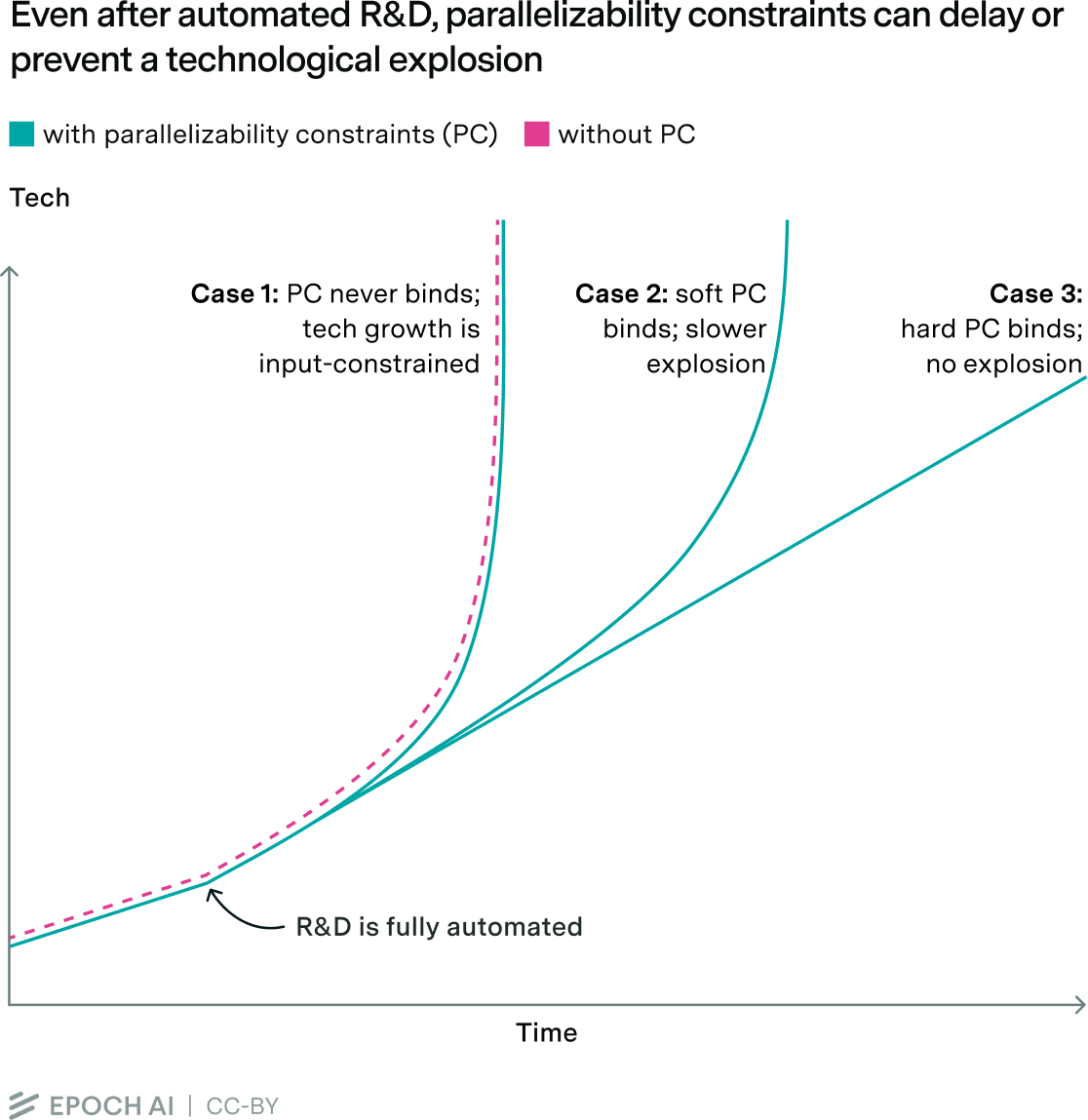
Case #1: If parallelization technology improves at least as quickly as effective research inputs, the conventional result survives.
Case #2: If it improves faster than the technological frontier but more slowly than research inputs, an explosion still occurs, but more slowly.
Case #3: If it improves only fast enough to sustain ordinary exponential growth, automating R&D may raise the growth rate without making it accelerate indefinitely.
So estimates showing that AI algorithm quality has historically grown faster than AI research inputs are still informative. If algorithm quality has grown more slowly, recursive self-improvement on fixed inputs will not explode in this model either. But if performance has grown faster, the conclusion is no longer pinned down. We must also estimate the returns to investing in technologies that make AI research more parallelizable.
It’s worth emphasizing that automating AI R&D could also accelerate research, including AI research, through channels other than increasing the number of “simulated researchers”. For example,
-
Each instance of the AI system can get more intelligent over time — in terminology of the AI Futures Model, can develop better “research taste” — much more quickly than humans can.
-
Unlike human researchers, AI models will presumably not be tempted to leave a frontier lab to start competitors. Some economic growth models suggest that this would facilitate technological development tremendously: see my earlier paper here, Section 4.2.
-
A given number of AI model instances could be designed to exhibit much greater cognitive diversity than an equal-sized human research team. Today, to be sure, they exhibit much less, and this is a severe limitation. Even if every instance of Claude Fable 5 were in every sense as smart as Einstein, their biases are highly correlated across instances, and a hundred Einsteins might have taken longer to advance quantum mechanics than an Einstein and a Bohr. But since artificial neural networks are so much more malleable than human brains, investments in fine-tuning and continual learning should eventually allow AI teams to be more cognitively diverse than human teams.
Still, one important channel through which automating AI R&D will accelerate research — the primary channel, in most models of recursive self-improvement to date — is simply that it will allow us, in effect, to greatly increase the researcher population. Parallelizability constraints could greatly limit the effectiveness of this channel in the long run.
Why isn’t AI R&D perfectly parallelizable?
One might think that AI research can already be fully parallelized. Given enough chips, couldn’t we just run every possible experiment simultaneously and select the best result?
No. Even if each parameter were a single bit, a 10-trillion-parameter model would have 2(10 trillion) possible weightings. Using today’s storage technology, merely storing all of them would require a structure so large that light would take vastly longer than the age of the universe to cross it.1
More realistic AI R&D contains at least two distinct bottlenecks.
First, experiments have serial depth. Training runs and experiments consist partly of computations that must wait for earlier computations. More compute lets us run more experiment streams at once, but only technological advances, like faster-running chips, would let us compress each stream.
Second, cognitive work must be coordinated. A million AI researchers are useful only insofar as they can generate nonredundant plans, learn from one another’s results, allocate themselves across promising directions, and integrate their work. Parallelization technologies determine how many researchers can be used productively at once — and at any moment, that number is finite. Raising it is itself a research problem, subject to the same constraints as any other.
Automated researchers may be much easier to coordinate than humans. New instances can begin with identical weights and contexts, and they can share code, experiment logs, and machine-readable outputs without years of education or onboarding. The transition from human to machine research could therefore produce a large one-time jump in what I call “agent parallelizability”. But a large jump is not the same as an infinite ceiling, so with a sufficiently fast-growing population of virtual researchers, progress may eventually be limited by the rate at which we can continue improving parallelization technology.
Conclusion
The upshot is not that parallelization bottlenecks will necessarily prevent or even delay an intelligence explosion, just that they constitute one of the parameters determining whether and when an explosion occurs. The value of the relevant parameter is an important empirical question, and one that has barely been studied.
Experiments could shed light on it, but they would have to be carefully designed to separate (i) the diminishing returns to parallel research effort from (ii) the diminishing returns induced by the increasing difficulty of sustained progress over time. One option would be to give increasingly large populations of AI agents a well-defined research problem, such as improving NanoGPT training efficiency, and measure how progress scales over a fixed period. We could then observe at what point additional agents mostly duplicate work or create coordination costs, and how that point moves with investment in scaffolding and coordination tools.
In sum, automating R&D will permit a rapid increase in the number of “researchers”. This will doubtless greatly accelerate innovation in many domains, including AI, but innovation will accelerate only to the extent that our ability to parallelize R&D work keeps pace with this growing researcher population. Though parallelization technology has not featured at all in the models of technological development economists and AI forecasters have used to date, it may be central over the years to come.
-
Merely storing the weights of each would take over 1TB, which using today’s technology must occupy well over 0.01cm3. Storing all possible 10T-parameter models, using today’s storage, would thus require a cube with sides over 10(1 trillion) km long, and would take light over 10(1 trillion) years to traverse.
