
Compute scaling has driven much of the progress in AI so far. But maintaining recent growth rates requires exponentially increasing amounts of capital: The largest frontier labs are now planning infrastructure deployments that cost tens to hundreds of billions of dollars, substantially beyond their current profits and potentially beyond what they can fundraise themselves. This raises a question for the future of AI: Will financing constrain continued compute scaling?
Anthropic’s infrastructure buildout provides a useful test case. In November 2025, when Anthropic had less than $9 billion in annualized revenue, the company announced plans to invest $50 billion in American compute infrastructure. Subsequent disclosures allow us to identify nearly $50 billion of debt financing associated with the buildout. Much of this financing was assembled in early 2026 before Anthropic’s revenue spiked, making it a good test of investors’ willingness to lend against AI companies’ future revenue growth.
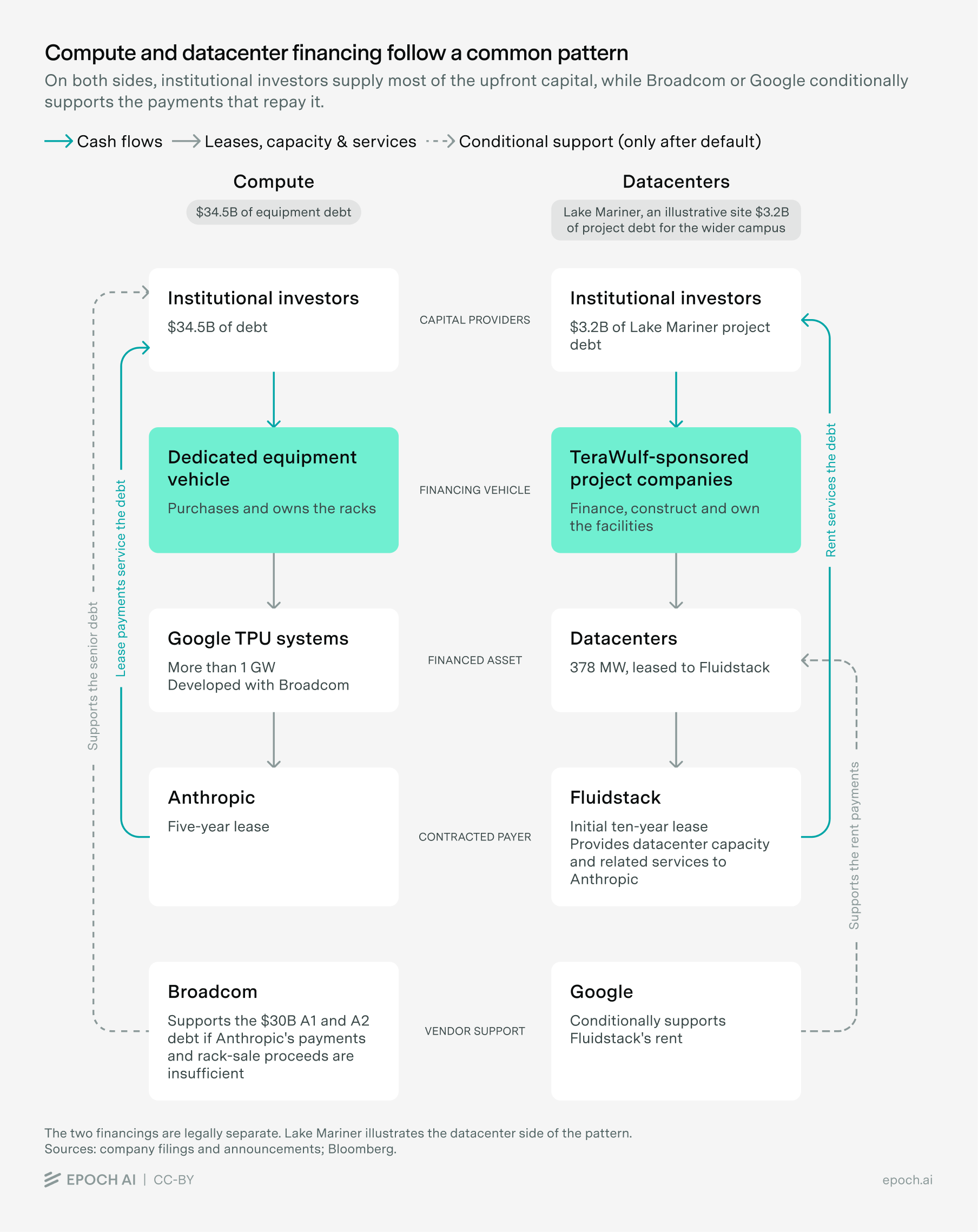
In this case, Anthropic needs both computing systems and places to run them. They have secured debt to fund the leases for more than 1 GW of TPU systems from Google and five datacenters from Fluidstack. Each side has its own financing. Roughly $35 billion in debt to purchase the TPU systems, with Broadcom conditionally supporting much of the financing if Anthropic stops paying. On the data center side, five companies have issued approximately $15.2 billion of loans to construct 1.43 GW of critical IT capacity, with Google providing conditional support if Fluidstack stops paying rent. In both structures, institutional investors lend the capital upfront, while Broadcom and Google make the future payment streams more dependable.
Anthropic’s buildout therefore suggests that financing is unlikely to be the immediate limit on frontier compute growth. Institutional investors appear willing to lend capital against the lab’s commitment to long-term payments, at least if more established organizations (i.e., the suppliers that benefit from the deployment) are willing to back part of the risk. The following sections trace how this works in general, then for Anthropic’s TPU systems and for the datacenters that will house them.

How vendor-supported financing works
Banks, insurers, and private-credit funds manage large pools of institutional capital that seek relatively predictable returns. A long-term commitment to lease computing systems or datacenter capacity creates a promise of payments that can incentivize those funders to provide debt while the underlying TPU racks and completed facilities provide collateral. This allows outside investors to pay for infrastructure upfront and be repaid over time.
A long-term lease makes the amount and timing of Anthropic’s payments predictable, but investors must still judge whether Anthropic will actually make them. Anthropic’s revenue has grown extraordinarily quickly, but rapid growth is not the same as a long record of stable cash flows. Lenders have less evidence about how the company would perform through changes in technology, competition, or regulation, and would ordinarily demand a higher return to bear that uncertainty.
Broadcom and Google help bridge this gap. Both companies benefit commercially as more TPU systems are deployed, and both have longer operating histories and more diversified sources of cash flow than Anthropic. Investors therefore have more evidence that they can honor their commitments through changing business conditions. By agreeing to absorb part of the losses if Anthropic or Fluidstack stops paying, Broadcom and Google can make the debt cheaper and more attractive to a wider range of investors without supplying the money themselves. This is vendor-supported financing: Suppliers use their credit to help finance deployments from which they benefit.
Compute: an Anthropic lease with Broadcom support
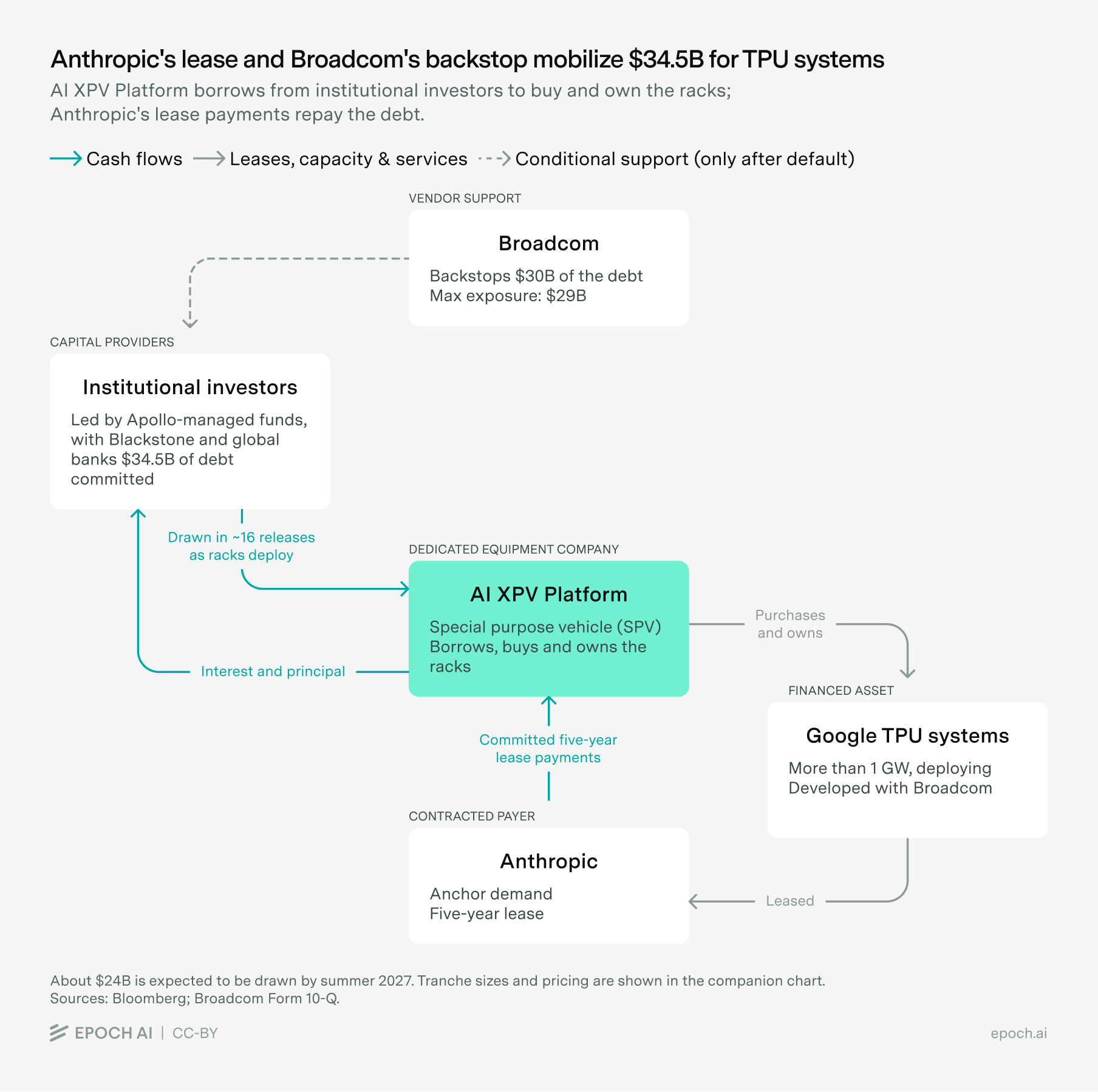
The compute financing provides the clearest evidence that institutional capital is increasingly available at the scale frontier labs require. Led by Apollo-managed funds, with Blackstone and global banks, investors committed $34.5 billion of debt to finance more than 1 GW of Google TPU systems for Anthropic. Of this amount, $30 billion benefits from Broadcom’s support, while $4.5 billion does not. The unbackstopped portion matters because it shows that investors were willing to take more direct exposure to Anthropic; Broadcom’s support allowed most of the financing to be raised at a lower interest rate.
The financing begins with Anthropic’s commitment to lease the TPU systems for five years. A dedicated equipment company, AI XPV Platform, borrows from investors, uses the money to purchase the racks and lease them to Anthropic. Anthropic’s lease payments are then used to pay interest and repay the debt, while the racks provide collateral if Anthropic stops paying.
The equipment company is a special purpose vehicle, or SPV: a company created for a particular transaction. Keeping the lease, the racks, and the debt in one company makes the risks easier for every party to understand. Investors lend against a clearly defined pool of payments and collateral, while Broadcom can specify exactly when its support begins and the maximum amount it can owe without borrowing the full purchase price itself. The SPV makes clear where the risk sits, who gets paid first, and when Broadcom has to step in.
The lenders provide the funding as the systems arrive rather than all at once. The racks have begun deploying, with capital expected to be released in approximately 16 stages over a little more than a year and around $24 billion expected to be paid out by summer 2027. This keeps the amount of funded debt roughly aligned with the amount of equipment available as collateral following a default. Broadcom’s potential exposure grows at the same time and then declines as Anthropic makes payments.
The debt is divided into three tranches, or groups of investors with different claims on the vehicle’s payments and assets. If the equipment company suffers losses, the $6 billion A1 and $24 billion A2 tranches are repaid before the $4.5 billion B tranche. This makes A1 and A2 senior debt and B junior debt. The A1 tranche pays 1 percentage point above Treasury yields, A2 pays 5.75%, and B pays 8.5%.
Broadcom’s backstop protects the A1 and A2 investors, but not the B investors. If Anthropic defaults, Broadcom can take over the lease or arrange for the racks to be sold. The sale proceeds are used to repay investors, after which Broadcom covers remaining A1 and A2 shortfalls under the agreement, subject to a reported maximum exposure of $29 billion. B investors are repaid only after A1 and A2 and must rely more heavily on Anthropic’s payments and the value recovered from the racks. This is vendor-supported financing: Broadcom does not supply the $30 billion upfront, but promises to absorb part of the loss if Anthropic’s payments and the racks prove insufficient.
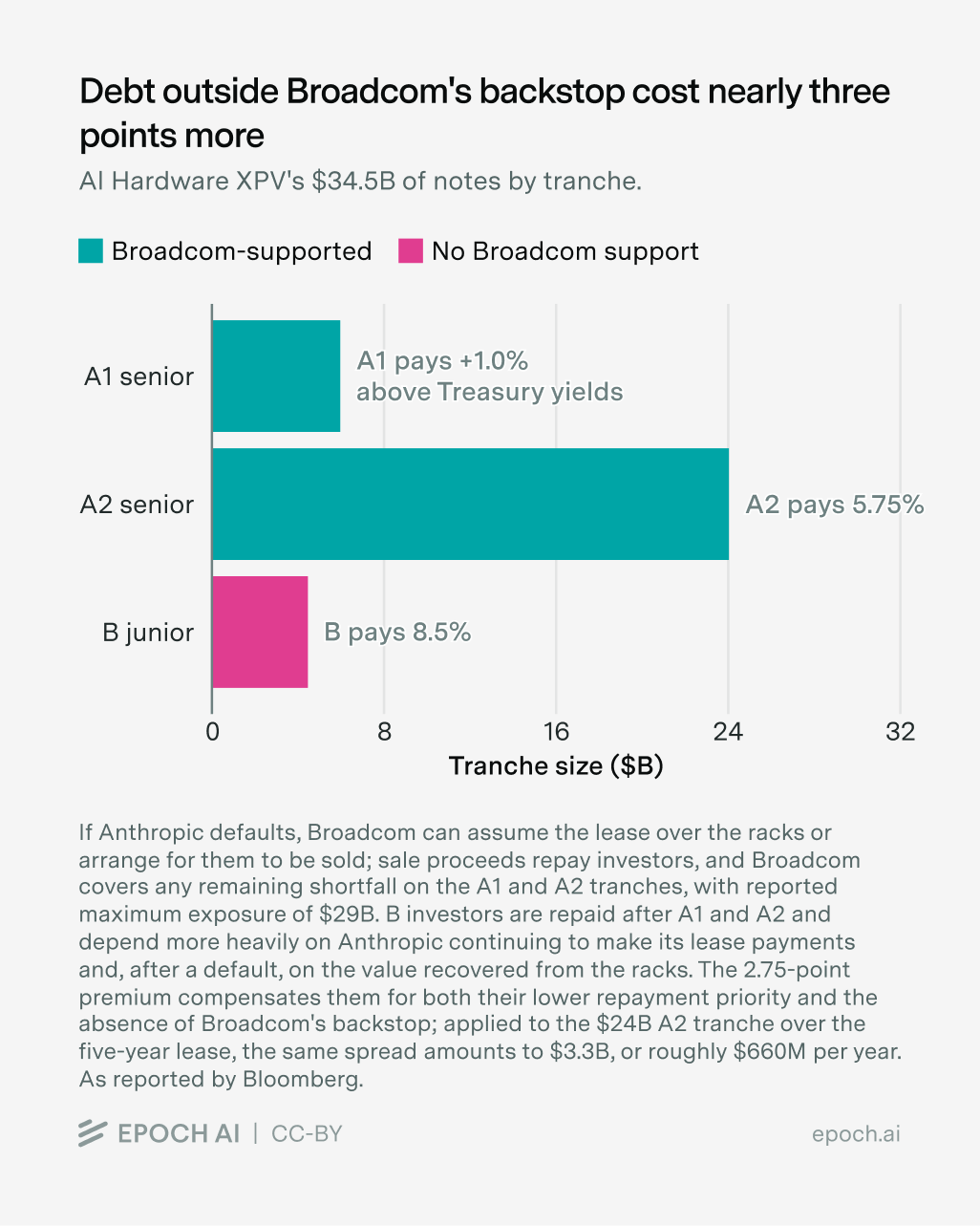
The contrast between A2 and B makes the economic effect visible. Investors supplied $4.5 billion without Broadcom’s support, but required an 8.5% interest rate, compared with 5.75% for A2. The 2.75-percentage-point difference reflects two protections at once: A2 is supported by Broadcom and is repaid before B. The comparison is therefore an upper bound on how much Broadcom’s backstop is worth to the investors, rather than a precise estimate.
Together, the tranches answer the article’s central question. Institutional investors were willing to take direct exposure to Anthropic and the value of the TPU racks, while Broadcom’s support helped make a much larger amount available on better terms. Anthropic did not need enough cash on hand to purchase $35 billion of systems itself: Its future lease payments attracted the capital, while a supplier that benefits from the deployment helped make most of that financing cheaper.
Datacenters: Fluidstack rent with Google support
Investors were also willing to lend money for constructing datacenters under a similar scheme. Across five sites, dedicated project companies have issued approximately $15.2 billion of debt to construct 1.43 GW of critical IT capacity that Fluidstack will lease for Anthropic’s deployment. This debt was raised before the facilities began being built: Investors supplied the construction capital upfront based on the facilities and the rent they are expected to generate once delivered.
Each site follows the same basic structure. A developer brings a site, access to power, permits, and the ability to manage construction. A dedicated project company borrows from institutional investors, uses the money to construct and own the datacenter, and leases the completed capacity to Fluidstack. Fluidstack begins paying rent as the capacity is delivered, and that rent ordinarily pays the interest and principal owed to investors. Anthropic leases from Fluidstack. The completed facility provides collateral if the payments stop. This is an example of project finance: future rent is converted into construction capital, with each project’s assets, contracts, and debts kept together in a dedicated company.
Google makes the future rent more dependable. The precise arrangements differ across the projects, but Google protects investors against part of the losses that could result if Fluidstack stops paying. At Lake Mariner, one of the project sites being developed as part of the deal, Google can pay missed rent and assume the lease, or fund a termination payment that is applied to the project debt. This is the datacenter equivalent of Broadcom’s role in the compute financing: Google places its credit behind a deployment from which it benefits commercially, while institutional investors provide most of the cash. This support increases the amount of capital available and reduces the return investors demand.
Using several developers allows the buildout to proceed faster and draws on scarce resources already controlled by different companies. A powered datacenter site is not interchangeable with an empty parcel of land: The valuable inputs include a large power connection, completed interconnection work, permits, equipment, and an established construction pipeline. By working across several developers and power markets, Anthropic and Fluidstack can assemble capacity in parallel rather than waiting for one company to acquire and develop every site.
| Project | Project sponsor | Critical IT load | Project debt |
|---|---|---|---|
| Lake Mariner | TeraWulf | 378 MW | $3.200bn |
| Barber Lake | Cipher | 207 MW | $1.733bn |
| Abernathy | Fluidstack JV | 168 MW | $1.300bn |
| River Bend | Hut 8 | 245 MW | $3.250bn |
| Meridian Arc | Next Frontier / Fluidstack JV | 430 MW | $5.700bn |
| Total | 1,428 MW | $15.183bn |
The five datacenter projects financed for Anthropic’s buildout, with critical IT load and project debt raised at each site.
Taken together, the five projects show the same financing mechanism being repeated across different developers and locations rather than appearing in one exceptionally large transaction. They also make the physical side of the buildout visible: Institutional capital is being used to secure power, construct facilities, and deliver capacity on several timelines at once. The project companies place the site, buildings, leases, and construction obligations into a clearly defined package against which investors can lend.
Lake Mariner provides the clearest example of how these pieces fit together. At Lake Mariner, TeraWulf is the developer and has committed to fund the completion of the data center buildings. As each building is delivered, Fluidstack begins paying rent under an initial ten-year lease, with two five-year extension options. This rent becomes the ordinary source of repayment for investors, while Anthropic pays Fluidstack for the datacenter capacity and related deployment and operating services. Google’s lease-related backstop becomes effective when the corresponding lease begins, and Google received rights to acquire TeraWulf shares in exchange for providing its support. Investors therefore rely on TeraWulf to complete the facilities, Fluidstack to pay rent after delivery, Google to provide support if Fluidstack defaults, and the facilities themselves as collateral.
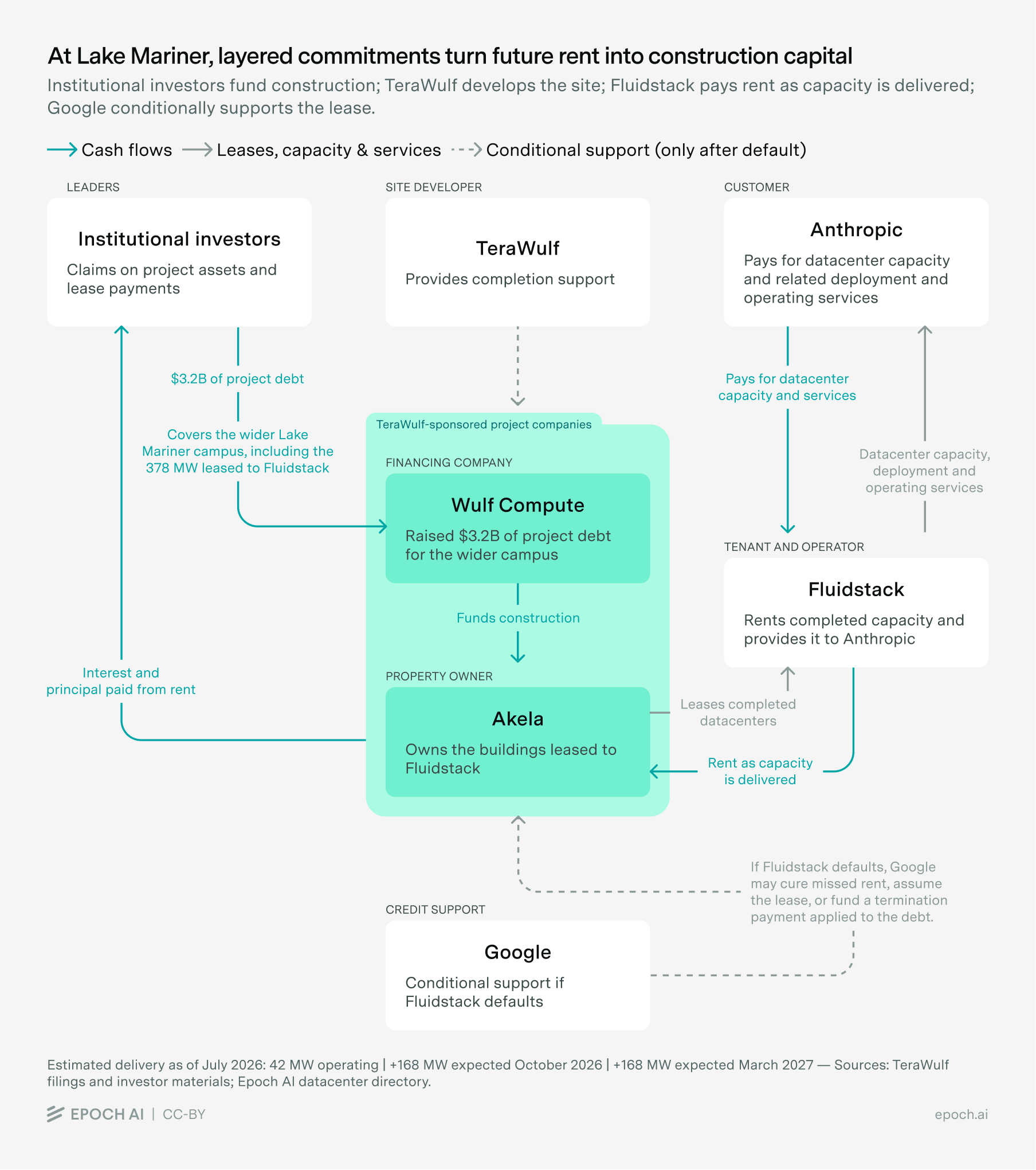
Unlike the compute financing, Lake Mariner does not contain an otherwise comparable tranche without Google’s support, so I cannot isolate precisely how much the backstop reduced the interest rate. The $3.2 billion of debt nevertheless pays 7.75%, suggesting that investors are still pricing meaningful risks. I think these include the possibility of construction delays and the conditions and limits attached to Google’s support. TeraWulf’s completion commitment and Google’s backstop address different parts of the transaction: One helps ensure that the facilities are delivered, while the other makes the rent more dependable once the leases begin.
The sequence illustrates what the financing accomplishes: Institutional investors provide most of the money before the facilities are operating; the developer supplies the scarce site, power, and construction capability; Fluidstack supplies the long-term rent; and Google makes that rent more dependable. Future demand for compute is thereby converted into construction capital and, ultimately, delivered datacenter capacity.
What this means for frontier compute growth
At least in the near term, financing is unlikely to be the binding constraint on frontier compute growth. Nearly $50 billion of debt has been raised for an infrastructure program announced when Anthropic had less than $9 billion in annualized revenue. Anthropic did not need to raise the full cost of the buildout, and it’s unlikely other AI companies will either.
The market supporting these transactions is expanding extremely quickly. Anthropic’s annualized revenue rose from approximately $9 billion at the end of 2025 to more than $47 billion by May 2026, while OpenAI had passed $25 billion by February 2026. This growth gives the labs greater capacity to commit to future compute purchases and gives investors greater confidence in financing them. A structure assembled around a much smaller Anthropic therefore supports the proposition that labs should be able to finance substantially larger buildouts if the frontier labs and market continue to grow.
The participants are already attempting to turn this structure into a much larger market. Broadcom, Apollo, and Blackstone describe the $35 billion compute financing as the initial transaction in a platform designed to support more than 20 GW of deployments for frontier labs, including Anthropic and OpenAI, through 2028. The first transactions establish contracts, market prices, and a pool of investors. As the systems are deployed and payments arrive, they will also create a performance record that makes subsequent deals easier to evaluate. If these financings perform as expected, more institutions should become comfortable with the asset class, allowing later deployments to become larger and cheaper to finance.
Thanks to Isabel Juniewicz, Josh You, Ben Cottier, and Lynette Bye for reviewing my draft and providing helpful comments and suggestions.