
We tested three of the most prominent AI text detectors (Pangram, GPTZero, and Originality.ai) on both AI and human text. On AI text generated from basic prompts, false negative rates were near zero (at most 0.7% across detectors). However, when we gave models five samples of a specific author’s work and asked them to mimic it, an average of 38 of 297 (~13%) of the resulting passages went undetected. Detectors performed particularly poorly on mimicked scientific writing, failing to detect ~26% of AI-generated passages.
| Text type | Error type | Detector | Errors | Total | Error rate (%) | 90% CI lower (%) | 90% CI upper (%) |
|---|---|---|---|---|---|---|---|
| Human writing | False positive | Pangram | 0 | 495 | 0.00 | 0.00 | 0.54 |
| Human writing | False positive | GPTZero | 0 | 495 | 0.00 | 0.00 | 0.54 |
| Human writing | False positive | Originality.ai | 19 | 495 | 3.84 | 2.65 | 5.53 |
| AI, direct prompt | False negative | Pangram | 0 | 297 | 0.00 | 0.00 | 0.90 |
| AI, direct prompt | False negative | GPTZero | 2 | 297 | 0.67 | 0.22 | 2.01 |
| AI, direct prompt | False negative | Originality.ai | 1 | 297 | 0.34 | 0.08 | 1.49 |
| AI, imitating a human author | False negative | Pangram | 30 | 297 | 10.10 | 7.58 | 13.35 |
| AI, imitating a human author | False negative | GPTZero | 32 | 297 | 10.77 | 8.16 | 14.10 |
| AI, imitating a human author | False negative | Originality.ai | 53 | 297 | 17.85 | 14.49 | 21.78 |
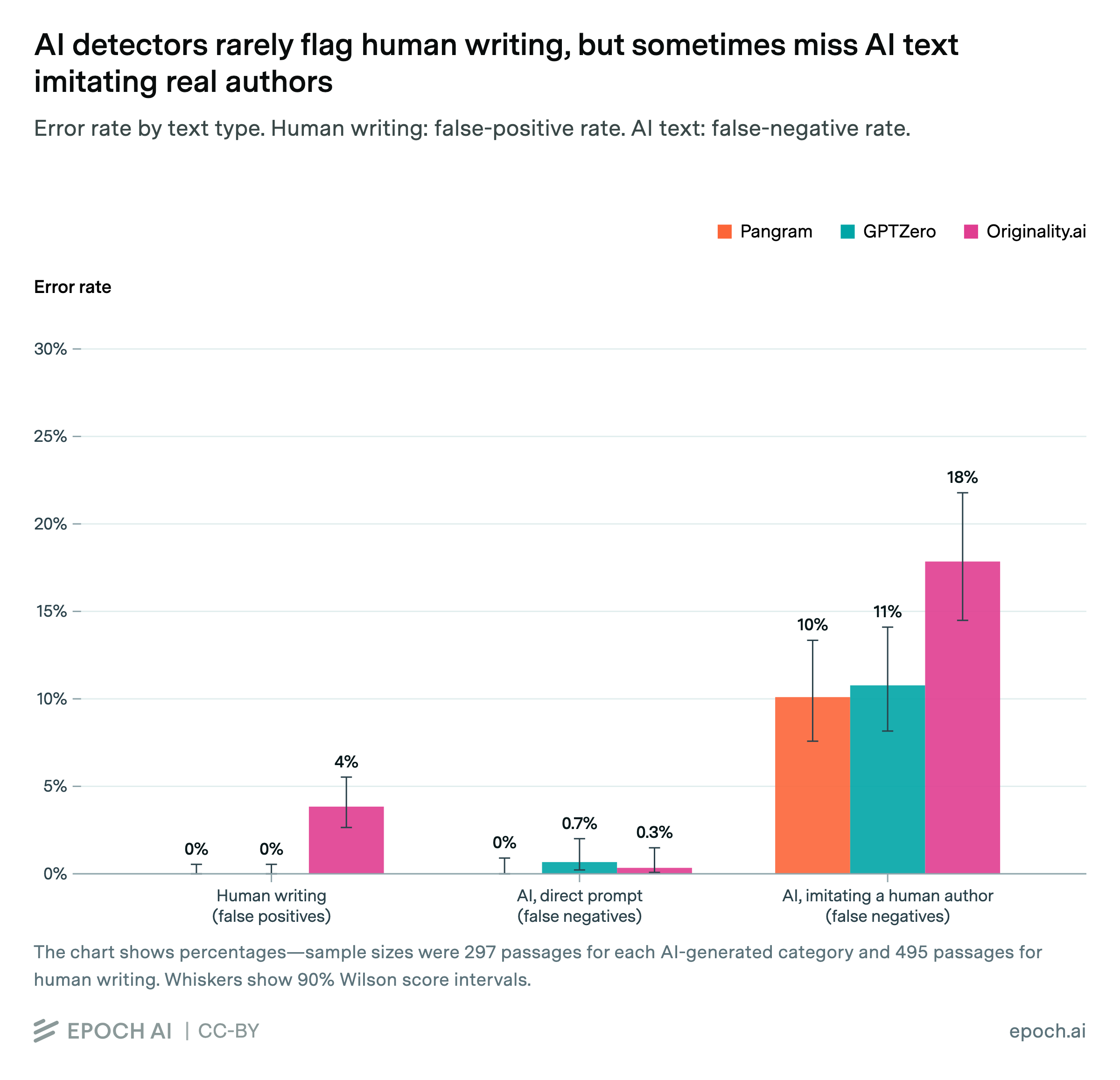
When judging genuine human text, detectors tended to be reliable — Pangram and GPTZero correctly flagged no human writing as AI, while Originality.ai incorrectly flagged 19 of 495 passages (3.8%).
Epoch's work is free to use, distribute, and reproduce provided the source and authors are credited under the Creative Commons BY license.
Learn more about this graph
We measure the performance of three AI text detectors (Pangram, GPTZero, and Originality.ai) under three conditions: human writing, AI written from a basic few-word prompt, and AI that imitates a specific author’s style. For human text, we report the false-positive rate (the share of human passages a detector flags as AI), and for AI text, the false-negative rate (the share of AI passages it does not flag as AI). We take each detector’s own document-level verdict at its default setting, counting only a clean “AI” result as correctly flagging a passage. Two of the detectors (Pangram and GPTZero) sometimes return a “Mixed” verdict, where a document is judged to be part human and part AI. This is also counted as a non-detection, since none of our passages are of this nature. On human text, a “Mixed” verdict would likewise be an error — counting toward the false-positive rate — but neither detector returned one on any of the 495 human passages.
The pattern across conditions is consistent: false-positive rates are low overall, with only Originality.ai mistaking any human-written text for AI. Likewise, when given a basic prompt (no instruction to mimic or reference text), AI is almost always caught. However, a substantial share of style-imitated AI goes undetected, especially in scientific writing. Data and figure code are in the project repository, linked here.
Data
The human corpus is 495 passages of roughly 500 words from 99 authors, split evenly across blogging, fiction, and scientific writing. Authors are well-known writers with substantial pre-2022 output: bloggers and newsletter writers from their own archives, published short-fiction authors, and scientists from arXiv. A coding agent selected authors with a substantial body of freely available work published before that date, and over-provisioned the candidate pool in order to keep only authors with at least five verifiable passages. The same coding agent extracted each passage verbatim from an archived copy of the original source — pre-2022 Wayback Machine snapshots for blogging and fiction, arXiv sources for scientific writing — and verified it against that source by word-level overlap and a publication date. Where two passages share a source, they are non-overlapping excerpts. Moreover, given that ChatGPT was released in November 2022, it is highly unlikely that any samples contain text from a language model.
For each author and each of three frontier models (Claude Opus 4.8, GPT-5.5, and Gemini 3.1 Pro), we produced two AI passages on a shared topic using two prompting conditions. We began with style imitation: we showed the model five of the author’s real passages and asked it to write a new piece, on a subject of its own choosing, in the same style. We then derived a basic generalized prompt matching that piece’s topic — for example, “Write a short story about a lost dog” — and had the same model write a second passage based on it. This yields 297 passages per condition. We trimmed every passage to remove titles and headings, which could otherwise let a detector anchor on format rather than prose.
GPT-5.5 also tended to over-write, running about 1.5× the requested length, so we capped over-long passages at a sentence boundary. Because only the GPT-5.5-generated passages ended mid-thought after this cut, we also removed the last sentences of other passages as a precautionary measure to match and minimize confounders.
We scored each passage with three detectors: Pangram (version 3.3.2), GPTZero (model 2026–05-11-base), and Originality.ai (Turbo 3.0.2). We called the Pangram and GPTZero APIs directly; Originality.ai offers no API at the Pro subscription tier, so we scored it through the web bulk uploader, where two passages failed in the batch and were rescored by hand. The detectors describe different approaches. Pangram is a trained neural classifier that does not use perplexity, and reports that repeated “hard-negative mining” pushes its false-positive rate toward zero. GPTZero relies on perplexity and burstiness — how surprising the word choices are, and how much that surprise varies across the text. Originality.ai is a supervised classifier trained on a large labeled corpus of human and AI writing.
Analysis
| Text type | Detector | Overall | Blog | Fiction | Scientific | Claude | GPT-5.5 | Gemini |
|---|---|---|---|---|---|---|---|---|
| Human | Pangram | 0% (0/495) | 0% (0/165) | 0% (0/165) | 0% (0/165) | — | — | — |
| GPTZero | 0% (0/495) | 0% (0/165) | 0% (0/165) | 0% (0/165) | — | — | — | |
| Originality | 4% (19/495) | 1% (2/165) | 10% (16/165) | 1% (1/165) | — | — | — | |
| AI, basic | Pangram | 0% (0/297) | 0% (0/99) | 0% (0/99) | 0% (0/99) | 0% (0/99) | 0% (0/99) | 0% (0/99) |
| GPTZero | 1% (2/297) | 0% (0/99) | 1% (1/99) | 1% (1/99) | 2% (2/99) | 0% (0/99) | 0% (0/99) | |
| Originality | 0% (1/297) | 0% (0/99) | 1% (1/99) | 0% (0/99) | 1% (1/99) | 0% (0/99) | 0% (0/99) | |
| AI, imitation | Pangram | 10% (30/297) | 4% (4/99) | 1% (1/99) | 25% (25/99) | 5% (5/99) | 5% (5/99) | 20% (20/99) |
| GPTZero | 11% (32/297) | 6% (6/99) | 2% (2/99) | 24% (24/99) | 8% (8/99) | 10% (10/99) | 14% (14/99) | |
| Originality | 18% (53/297) | 19% (19/99) | 5% (5/99) | 29% (29/99) | 12% (12/99) | 27% (27/99) | 14% (14/99) |
As seen in the Overall column, all three detectors perform well on human text and on plainly-prompted AI. The exception is Originality.ai’s nineteen false positives, all of which were flags of writing that predates ChatGPT. Performance is also poor on the style-imitation row, where they miss between 30 and 53 of every 297 passages — false-negative rates of 10% to 18%, with 90% intervals spanning roughly 8% to 22%.
Splitting those misses by genre and generating model for each detector shows the same pattern in all three. Scientific text remained the hardest genre for all three detectors. The most-evaded single cell was Gemini scientific for Pangram (48%) and GPTZero (36%); for Originality it was GPT-5.5 scientific (39%).
| Detector | Genre | Claude | GPT-5.5 | Gemini | All models |
|---|---|---|---|---|---|
| Pangram | Fiction | 0% (0/33) | 0% (0/33) | 3% (1/33) | 1% (1/99) |
| Blogging | 3% (1/33) | 0% (0/33) | 9% (3/33) | 4% (4/99) | |
| Scientific | 12% (4/33) | 15% (5/33) | 48% (16/33) | 25% (25/99) | |
| GPTZero | Fiction | 3% (1/33) | 0% (0/33) | 3% (1/33) | 2% (2/99) |
| Blogging | 6% (2/33) | 9% (3/33) | 3% (1/33) | 6% (6/99) | |
| Scientific | 15% (5/33) | 21% (7/33) | 36% (12/33) | 24% (24/99) | |
| Originality | Fiction | 6% (2/33) | 9% (3/33) | 0% (0/33) | 5% (5/99) |
| Blogging | 9% (3/33) | 33% (11/33) | 15% (5/33) | 19% (19/99) | |
| Scientific | 21% (7/33) | 39% (13/33) | 27% (9/33) | 29% (29/99) |
Assumptions and limitations
The way we treat “Mixed” verdicts affects two of the detectors. Counting “Mixed” as a detection rather than a non-detection would lower the style-imitation false-negative rate from 10.1% to 6.1% for Pangram and from 10.8% to 8.8% for GPTZero; Originality.ai returns no “Mixed” label and is unaffected.
The corpus covers 99 authors, meaning the per-genre and per-model cells also contain only 99 passages each, but the genre-by-model cells contain only 33. Because we take five passages per author, with occasionally more than one from the same work, the human passages are not fully independent. This concern is only relevant to the false-positive rate; each AI passage is a separate generation, so the false-negative rates are unaffected.
AI detectors can be updated by their makers without notice, so we pin the versions available in June 2026. We test a single evasion method — few-shot style imitation with five reference passages — and did not test the effectiveness of paraphrasing tools, manual editing, or other approaches. We only report each detector’s default verdict. All passages are about 500 words, and detection can depend on length as well as content.