What we found
- AI is becoming a mainstream work tool. Half of employed Americans who used AI in the past week reported using AI tools at least as much for work as for personal tasks.
- AI is changing what people do at work. It has replaced existing tasks for 27% of employed AI work users and created new ones for 21%.
- AI work use is higher among paid subscribers. Employer-paid subscribers are far more likely to use AI for work than free-tier users, and self-payers fall in-between.
AI tools have moved from a niche technology to a part of everyday life. In a new Epoch AI/Ipsos survey of over 2,000 U.S. adults, half reported using AI tools in the past week.
But adoption rate alone does not capture the full picture of how AI is used. Among employed users, it has become a work tool that is already changing the tasks they perform, with substantially higher workplace use among paid subscribers than free-tier users.
AI is now a workplace tool, not just a personal one
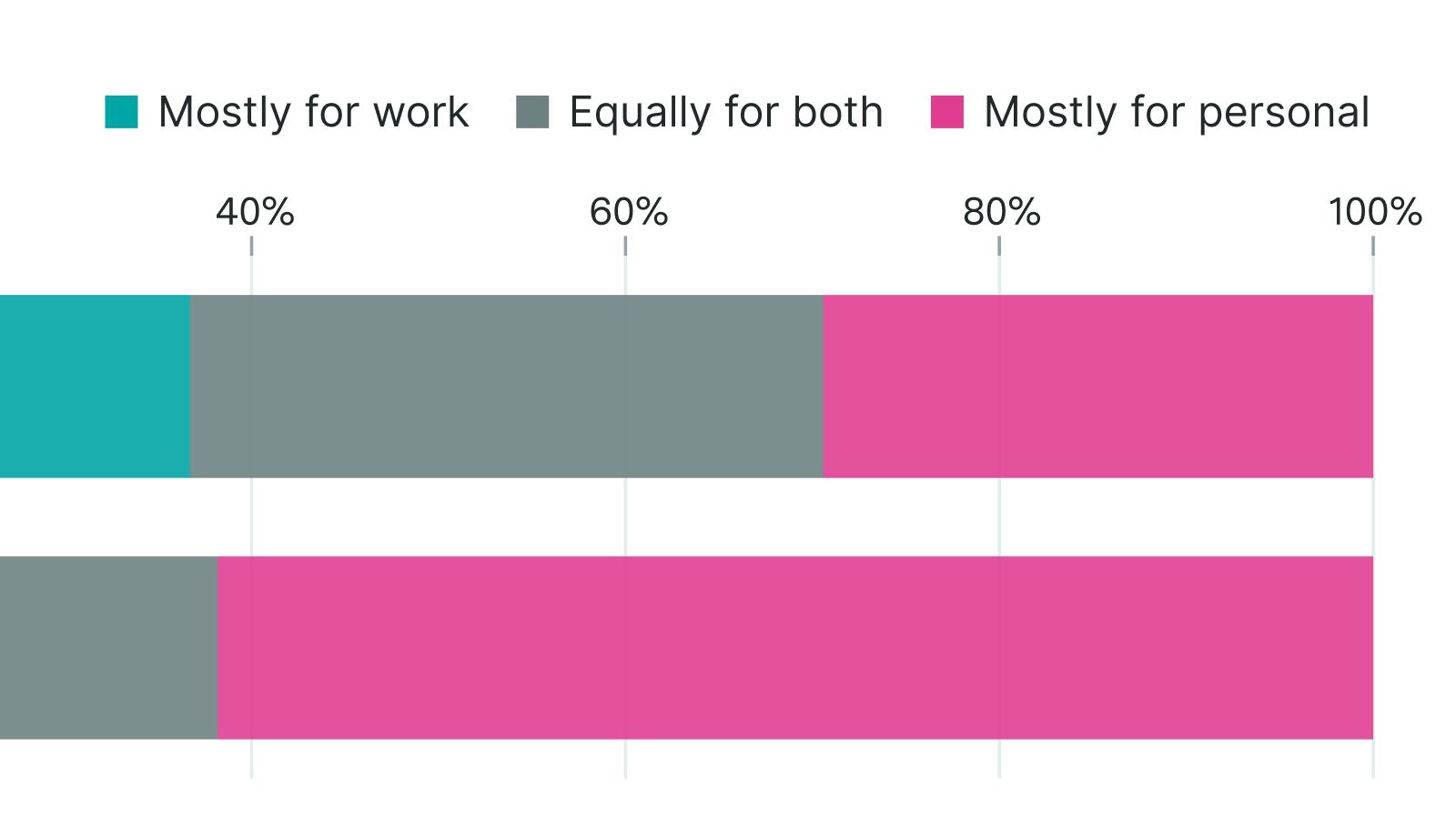
Among employed Americans who used AI in the past week, half reported using AI at least as much for work as for personal tasks, while the other half reported primarily personal use.
This aligns with a broader shift toward workplace adoption. Pew Research Center reported in October 2025 that roughly one in five U.S. workers used AI on the job. Though not directly comparable with our survey, our results support the idea that AI is becoming part of routine workflows.

About this survey
The data in this analysis come from an Epoch AI/Ipsos survey on the Ipsos KnowledgePanel, a probability-based online panel recruited via address-based sampling.
The survey was fielded March 3-5, 2026, and includes 2,021 respondents.
Probability-based sampling reduces self-selection bias and produces estimates that are more representative of U.S. adults. All estimates are weighted to U.S. Census benchmarks. We remove a small set of non-valid responses for the analysis.
Read more about our methodology here.
All point estimates and counts are weighted unless otherwise specified. All standard errors are computed using Taylor series linearization. The full survey questionnaire, data files, and graphs are available at the polling hub.
AI both creates and replaces tasks at work
We asked employed AI users whether AI had changed the tasks they perform at work. Among those who use AI at least as much for work as for personal tasks:
27% said AI has replaced some of their existing tasks (task automation). An example of task automation could be an employee using AI to summarize a document they would ordinarily read themselves. Most in this group reported this happened without them taking on new AI-enabled tasks.
21% said they had started doing new tasks because of AI (task augmentation). An example of task augmentation could be a data analysis tasks that would ordinarily require the worker to know how to code. Nearly half in this group reported this happened without any existing tasks being automated away.
We did not collect detailed examples of specific tasks, but these results provide an early, nationally representative snapshot of how AI is reshaping work at the task level.

Work use is higher among paid subscribers
The largest differences in workplace use appear between paid-tier users (such as subscribers to ChatGPT Plus) and free-tier users.
Among employed AI users, 38% of free-tier users reported using AI at least as much for work as for personal tasks. The share rises to 58% among self-paying subscribers and 76% among users with employer-provided subscriptions. As we would expect, paid access, especially when provided by employers, is associated with more intensive workplace use.

It’s unclear whether this is driven by employers or by workers. One possibility is that employers drive adoption by providing access to paid tools, making workplace integration dependent on organizational decisions. Microsoft Copilot, which leads paid AI usage among both work-oriented and personal-oriented users, illustrates this dynamic: its prevalence likely reflects bundling with Microsoft 365, a product widely deployed in workplaces through enterprise licensing.

Another possibility is that workers adopt paid tools in response to work demands after encountering the limits of free-tier access, including cases where frequent users request subscriptions from their employers.
Conclusion
Taken together, our findings show that AI use is now widespread and that its role in work is already substantial for many. While most people still use AI mainly for personal tasks, about half of employed users use it at least as much for work. This share is even higher among those with paid tools, particularly when provided by employers. Broader workforce impacts will ultimately be driven by accumulations of individual changes in how people work, making usage patterns like these an important signal to track.
To learn more about AI usage in the workplace and beyond, visit the Polling on Usage explorer to find the full survey results, methodology, and interactive visualizations!
Thanks to JS Denain, Anson Ho, Isabel Juniewicz, Jaime Sevilla, Elliot Stewart, and Peter Wildeford for helpful comments.
About the authors