MazeBench measures how well AI agents can learn an unfamiliar 3D puzzle game by playing it. Agents need to collect 100 gems in an environment made of 256 rooms, a task that tests spatial and long-horizon reasoning. The game mechanics and controls are intuitive, but collecting every gem requires increasing mastery of specific skills. The benchmark is well engineered, with strengths in its scoring, reporting, and environment. To verify the robustness of the benchmark, we ran three experiments, described in Findings. We designate MazeBench as Verified; while we found some limitations, none were significant enough to call for a Flawed verdict.
Interpretation
The primary MazeBench score is the percentage of the 100 gems an agent collects.1 Because the score counts individual gems, it measures partial progress, and not just whether an agent passed or failed. The secondary metric, also reported as a percentage, is a measure of exploration: the number of rooms the player visited, out of 256.2
Visiting rooms rewards exploration, while finding gems rewards stronger puzzle-solving ability. The two are linked: an agent can only collect all the gems after exploring all the rooms. An agent can cross many rooms without collecting their gems, partly because collecting a gem requires greater mastery of the room’s specific mechanic.
The leaderboard reports scores with relevant filters, allowing useful comparisons. It includes:
- Runs ranked by gems or by rooms, sorted by best score or most recent.
- Filtering by observation mode (vision, not yet run, or ASCII), coding tools (on or off), and developer.
- Results viewed as bar charts or as progress curves. The curves plot gems or rooms against moves, model responses, total tokens, uncached input tokens, or estimated API cost, so readers can compare efficiency as well as final scores.
Each run also has a detail panel that shows the harness, reasoning effort, version label, rooms, gems, moves, tokens, and API cost. Additionally, the view has charts of rooms and gems over the run, a rolling board-state novelty rate,3 a heatmap of the cells the player visited, and a written summary that discloses operator actions4 during the run.
The benchmark is far from saturated as of October 27, 2026: GPT-6 Astra with coding tools placed first after visiting only 44% of the rooms (113/256) and collecting 23% of the gems (23/100) in 19,787 moves, using 379.1 million tokens. Because individual runs can take billions of tokens, or thousands of dollars, the bottleneck becomes the authors’ budget constraints. As a result, most models have only been run once, so confidence intervals are not available.
The benchmark’s main limitation is that there is no pre-defined rule for when a run ends, so models end up with uneven budgets and many runs are stopped while the agent is still progressing.
Since the start of the review, the authors have added an additional filter to compare models on the same budget: 200 million tokens. We don’t believe that budget is sufficient to elicit enough performance to correctly estimate the final score, but it might be a useful measure of efficiency.
Task Analysis
MazeBench is a single task: one connected world that the agent plays as one long run. The world is a grid of 16 x 16 rooms, and each room is 16 x 16 tiles. It holds 100 gems in 92 rooms: 2 rooms have three, 4 rooms have two, and the other 86 have one.
The agent controls a character on the tile grid and moves it one step at a time. It sees the 3D world through a camera that it can rotate up, down, left, and right.5 The game is turn-based: the agent can send a single move or chain multiple in a row, after which it gets a new observation. Besides moving the camera and character, the agent can undo its last move(s), reset the current room to the state it originally was in when it entered it, and teleport to any room it has already visited.
While the benchmark does not formally categorize its rooms, they are generally built around a set of mechanics that the agent must discover: pushable boxes, ice, lifts, orange walls and buttons, punchers, floating floors, clones, and gates. Most rooms combine several of these, so later puzzles increasingly build on mechanics learned earlier. Some rules are intentionally not obvious. For example, when a gem is on ice, an agent cannot collect it by sliding over it; the agent must stop exactly on the tile where the gem is placed.6
Later gems in the reference solution cost more actions and are generally harder to collect: the solution file shows that the last 10 require an average of 238 actions compared to 118 for the first 10. Each gem counts equally toward the score, but collecting later gems represents more real progress than collecting early ones.
We confirmed that the developers’ solution collects all 100 gems in 40,500 commands. We found no way to cheat or “reward-hack” to obtain gems or visit rooms in an unintended way. Solving a room through random moves is not realistic because of the long chain of correct actions required. Even the first gem can be collected only after the agent solves a separate room with no gem, so an agent that takes random moves is unlikely to collect any gems at all. In some runs, agents have access to coding tools, which let them write and execute programs. But even then, they cannot simply write a program that solves the whole maze. Any search algorithm must rely on an accurate model of each room, built by the agent, and agents often struggle to perceive a room correctly, especially when parts of the room sit at different heights.
Elicitation and Scaffolding
Agents play through their developer’s own coding-agent CLI at the highest reasoning effort their harness offers.7
The setup gives agents generous resources. There is no action, token, or time limit by default, and reading the board or a move’s animation frames costs no actions.8 When an agent ends its turn, the harness tells it to continue until it collects all the gems. A run ends only when the agent wins, the run fails (because of API errors or agents using disallowed tools), or the operator pauses or stops it. Long contexts are handled by each CLI’s compaction rules. Runs are long and expensive: top runs use hundreds of millions of tokens, and some use billions. The benchmark’s main limitation is that it lacks a clear stopping condition; the operator can choose when to end a run, which causes uneven budgets across runs.
Three tooling conditions are available: no tools, a sandbox where Python code execution is allowed, and a sandbox where any language is allowed,9 all without network access. The leaderboard reports runs with and without coding tools separately, which works as a built-in ablation of tool use.
Findings
Vision Harness Experiment
As of this review, the leaderboard only reports ASCII runs, but vision runs are expected to be added soon. To check that the vision setup works as intended and that ASCII doesn’t grossly under-elicit visual understanding in models, we ran GPT-6.1 Terra10 with the vision harness and tools on, and compared it with the Terra’s ASCII leaderboard run, also with tools on.
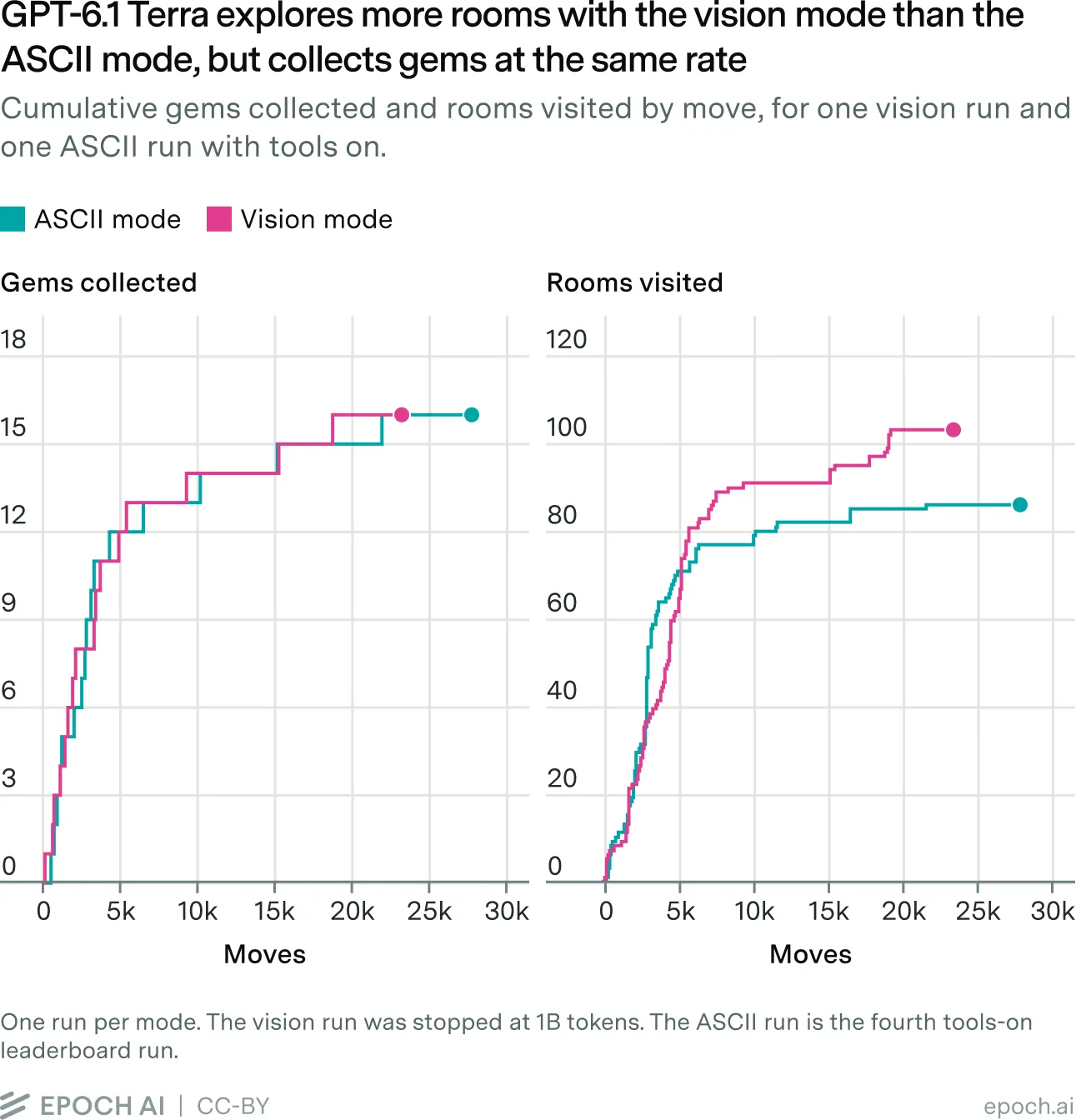
The two runs collected gems at almost the same pace. The gem counts stayed within one gem of each other for 97% of the run and identical for 62% of it, with two short gaps of two gems near 2,000 and 3,000 moves, and both runs ended with 16 gems. The vision run reached its 16th gem about 3,000 moves earlier.
Room discovery differed more. Between about 2,000 and 5,200 moves, the ASCII run found new rooms faster and led by up to 22 rooms. After that, the vision run continued to find new rooms while the ASCII run slowed down; the vision run ended with 103 rooms and the ASCII run ended with 86.
Our interpretation of these results is that ASCII and vision provide comparable elicitation and model performance. The main caveat of our results is that the experiment lacks robustness: it was done on a single run of one model, so we cannot interpret whether these differences were statistically significant. We stopped the vision run at 1 billion tokens, while the ASCII run stopped at 1.5 billion.
Isolated Rooms Experiment
A run gives the agent the whole world to explore. While analyzing traces, we noticed that models tended to leave difficult rooms quickly and switch to other rooms instead. Our hypothesis was that the constant switching between rooms was degrading model performance. We think that a sufficiently intelligent model should realize on its own that its effort would be better spent if it focused on one room at a time; however we wanted to quantify this phenomenon. To do so, we ran the best-scoring model, GPT-6 Astra, with vision and tools on, in a world restricted to 10 selected rooms.11 Each room had to contain exactly one gem, which could be collected without the agent taking actions in other rooms.12 We selected 10 that satisfied this condition.
Table 1. Astra’s results in the 10 experiment rooms, ordered by the actions needed to collect the gem
| Actions required to collect the gem | ||||
|---|---|---|---|---|
| Room | Developer’s solution* | Astra ASCII, no tools (leaderboard) | Astra ASCII, with tools (leaderboard) | Astra vision, with tools (experiment) |
| IxI | 35 | 37 | 34 | 36 |
| HxH | 57 | 176 | 158 | 60 |
| FxF | 93 | 191 | 192 | 152 |
| FxE | 171 | 495 | 165 | 131 |
| JxE | 173 | No gem (909) | 325 | 331 |
| PxI | 246 | – | – | 1,749 |
| DxL | 319 | – | 419 | 380 |
| NxA | 333 | – | – | 1,369 |
| ExM | 361 | – | – | 381 |
| HxA | 449 | – | – | 488 |
| Gems | 4 of 10 | 6 of 10 | 10 of 10 | |
*The solution file is one working route, not the shortest one, so Astra sometimes needs fewer actions. The Astra columns count every action Astra took in the room, over all its visits, until it collected the gem. A dash means the run never reached the room.
In our run with vision and tools on, Astra collected the first 8 gems in 2,181 actions and 80 minutes (all rooms but PxI and NxA). It then switched between the last 2 rooms (NxA and PxI) 10 times over 3.4 hours (2,909 actions) before solving them. This experiment suggests that Astra’s leaderboard score is limited by reaching and choosing rooms in the open world, rather than by solving individual rooms.
The main limitation of this experiment was bias in room selection: these did not include all mechanics available in the game, and being self-sufficient made them easier on the long-horizon reasoning axis.
Using Python, Astra manually encoded each room’s layout, then ran searches on the layout, mostly breadth-first and a few best-first. The main blocker for both rooms was 3D perception, especially elevation. Astra repeatedly re-checked heights from different camera angles but rendered the room incorrectly. Once it correctly understood the layout of the room,13 it quickly collected the gem. For example, in room NxA, Astra correctly identified the layout of the room after 1188 actions and then acquired the gem in only 181 additional actions. When agents play through vision, they render PNGs of the rooms one view at a time. They struggle with perception of individual images due to how tokenization works. These limitations are exacerbated in MazeBench, which requires models to reconstruct important elements of the rooms, such as elevation, through multiple angles.
Performance Analysis
MazeBench runs have no fixed budget, so we ran analysis on data from the best 10 leaderboard runs both with and without tools to understand if models were appropriately stopped by the operator, the impact of potential early stops, and what could be a more appropriate stopping rule. Run lengths vary significantly: from about 175 million to 2.2 billion tokens. Of the twenty runs, seven ended because of provider or subscription limits; one ended because of an integrity rule;14 two are partial runs that the operator published after hitting limits, both continued afterward; and the other ten runs were paused by the operator with no reason recorded. Sixteen out of these 20 runs were still making progress, defined as either visiting new rooms or collecting gems in the last 3,000 moves, before the run ended.
Progress also slows sharply during a run. The median rate falls from 1.9 gems per 1,000 moves in the first quarter of a run to 0.3 in the last quarter. When we cut every run at the same number of moves and rank the runs by gems, the early order has little relation to the leaderboard. At 2,000 moves with tools on, the two top-ranked runs (GPT-6 Astra and GPT-6.1 Sol) have the fewest gems of 10 runs, with 4 each, while the tenth-ranked in the final standings’ run has 6 at 2,000 moves. The order only comes close to the leaderboard at about 10,000 moves, a length that 11 of the 20 runs reached.
We looked at a stopping rule that would make budgets comparable without cutting off progress. It was difficult, through statistical methods, to arrive at objective rules that would let us confidently classify when runs are not making progress; therefore we instead simply estimate that a capable person would need about 100 hours to complete the benchmark.15 At $20 per hour, this gives a human-equivalent budget of $2,000, which we propose as the stopping rule for each run.
Taken together, these experiments suggest that the performance ceiling could be higher on a purely intelligence basis, but models still struggle with perception, context handling over millions of tokens, and long-term planning.
Limitations
Single runs. Most models have only one run on the leaderboard, so scores have no confidence intervals. Many leaderboard gaps are small: in the two top-10 tables (with and without tools), 12 of the 18 gaps between adjacent ranks are zero or one gem. A repeat run that differs by a single gem could change the order.
No fixed budget.16 Runs have no action, token, or time limit. They end when the operator pauses or stops them, usually because they have either hit the operator’s budgetary limit or 1 billion tokens, so different models get different budgets. The leaderboard reporting reduces this problem: its progress curves let readers compare models at the same number of moves, tokens, or cost. However, the headline ranking uses each run’s final score.
Contamination risk. The benchmark is fully public on GitHub. A model trained on the data, or on synthetic data made with the repository’s world editor, could know the layouts in advance, which would invalidate the measured construct. This limitation is partly unavoidable. Even a held-out set of rooms with gems would offer limited protection, because other developers can build similar environments for training.
Strengths
Scoring. The scoring is hard to game, and it properly tracks two dimensions of partial progress: the main goal of collecting gems and overall room exploration. The floor is 0%. All gems are obtainable, so the ceiling is 100%. The reporting is thorough: the leaderboard’s filters support useful comparisons, and the per-run details add further information.
Setup. Each harness gives the agent ample resources to perform at its best, with no action, time, or token limit. Optional sandboxed Python and multi-language executors let agents build their own solvers. Each harness allows only the game tools and the selected executor, and any other tool call invalidates the run. Every action is recorded and monitored, so any run can be replayed.
Flexibility. MazeBench can serve as a research platform. Its harness makes it simple to compare coding conditions, agent harnesses, and reasoning settings. Its world editor and benchmarking platform offer a way to explore variations independently.
Transparency. The benchmark is fully public, which supports audits and reproducibility.
Human baseline. The game is freely playable on the website, and an unofficial human leaderboard is generated from players who choose to submit their runs.
Rubric
1. Reviewability
| Level | Meaning | Status |
|---|---|---|
| Full | All tasks and scoring logic inspectable,17 and harness/API settings used for each model (reasoning effort, token/time limits, tool access, system prompts) are fully disclosed | [proceed to 2] |
| Partial | A representative sample of tasks and scoring logic inspectable, with full harness/API settings disclosed | [proceed to 2] |
| Inadequate | Limited, biased, or no inspectable tasks or scoring logic, harness/API settings undisclosed | [stop → NEI] |
2. Scoring
This is the minimum standard required to be Verified; failing any of these items results in a Flawed verdict.
| Scoring | |
|---|---|
| Examples |
|
| Default threshold for Flawed | Either errors affect ≥20%18 of the total score in the inspected sample,19 or there is an issue that corrupts grading at scale |
| Status | PassFlag [stop → Flawed]Not reviewed |
| Notes | — |
| Benchmark Consistency | |
|---|---|
| Examples |
|
| Default threshold for Flawed | Leaderboard has incomparable results from different versions |
| Status | PassFlag [stop → Flawed]Not reviewed |
| Notes | — |
| Elicitation | |
|---|---|
| Examples | Model elicitation is extremely constraining and is not the focus of the benchmark:
|
| Default threshold for Flawed | Substantially reduced performance compared to reasonable alternatives for the tasks |
| Status | PassFlag [stop → Flawed]Not reviewed |
| Notes | — |
| Bias in Evaluation Setup | |
|---|---|
| Examples |
|
| Default threshold for Flawed | Material model-specific advantage found |
| Status | PassFlag [stop → Flawed]Not reviewed |
| Notes | — |
3. Evaluation Quality
This is the standard we would like all benchmarks to meet, but it is not necessarily disqualifying to omit or fail these items.
| Question | Status | Notes |
|---|---|---|
| Elicitation and resource adequacy: Are the resources given to models (reasoning token/turn budget, tool access, etc.) sufficient for them to perform near their ceiling? | SufficientConstrainingUnreasonably constrainingUnknownNot reviewed | The only caveat is how runs end: without an explicit stopping rule, models have uneven budgets. |
| Scaffold fairness: What scaffold does the leaderboard report? | Shared common scaffoldMix of model-specific and common scaffoldsModel-specific scaffoldsNot reviewed | — |
| Is there evidence/risk of contamination? | As of Oct. 27, 2026: 100% of tasks public 100% of solutions publicNot reviewed | — |
| Has human completability been assessed? | All tasksRepresentative set of tasksPoor implementation (Unrepresentative set of tasks, unreasonable set of participants)Not establishedNot reviewed | All 100 gems are obtainable and all 256 rooms are reachable by humans playing under the same conditions. |
| Score range (if possible to estimate) | 0% floor, 100% ceilingNot reviewed | — |
| Statistical adequacy: how many runs/model (≥ 5 recommended for error bars) | 1 runs/modelUnknownNot reviewed | — |
| Construct validity | Measures stated capabilitiesPartially measures stated capabilitiesDoes not measure stated capabilitiesNot reviewed | — |
Developer Response
Link to developer response: mazebench.com/blog?post=epoch-ai-review-response
-
An agent gets credit for a gem only when its player finishes an action on the gem’s tile, an uncontrolled pass caused by slippery ice or the puncher mechanic does not count.

-
A room counts only when a move ends in it. Sliding or being punched through a room does not count.
-
The novelty rate is the share of moves, over the last 1,000, that produced a board state the agent had not reached before in the run. A board state includes the player and every movable object or mechanism in the room, but not gems or camera angle.
-
These are manual interventions such as pausing or stopping a run, retrying after rate limits, or rolling the game back to an earlier checkpoint after fixing a bug. These are necessary due to the length of the runs.
-
The input modes only change the way the image is rendered, but the environment stays the same.
-
This is documented and intended behavior which adds a degree of complexity to levels that use this mechanic.
-
The exception is Prime Agent, which uses the provider’s default.
-
The previously discussed 200M-token rule was added in November 2026, after the start of the review.
-
There are no runs reported with this mode yet, this is because the condition was added recently. Previously, agents could only use Python as a coding language.
-
The model was chosen because of its low cost, high speed, and good performance on the ASCII version, both with and without tools.
-
We edited the setup to allow for this setting. The ten rooms we chose are not connected, so agents had to use the tool to jump between rooms. Once a room was entered for the first time, the agent could freely re-access it at any point. The rooms were presented to the agent following the Table’s ordering.
-
We also refer to this feature as “self-sufficient” later in the review.
-
A path beneath the rear arches in NxA, an opening beneath the left wall in PxI.
-
A model used a tool that was not allowed, and the run was terminated.
-
This figure was estimated from the player runs leaderboard.
-
Either publicly or privately to reviewers under an NDA.
-
A benchmark is rated Flawed if scoring defects could affect ≥20% of the benchmark’s full score. For benchmarks with equally weighted all-or-nothing tasks, our threshold corresponds to ≥20% of tasks having defects. For benchmarks with partial scoring or unequal task weights, our threshold corresponds to ≥20% of the total possible score affected by defects. For single task benchmarks, our threshold is the reported score having defects that could affect it by ≥20%.
-
For benchmarks with >50 available tasks, we will sample a random set of 50 (stratified by category, when present). If the observed error rate is 15–25%, we will expand the sample to 100. For benchmarks with ≤50 available tasks, all available tasks will be assessed.
About Benchmark Reviews
Epoch AI’s Benchmark Reviews are independent reviews of external AI benchmarks. Our documentation describes the rubric behind this verdict, how we choose which benchmarks to review, and answers frequently asked questions.